As Federal leadership on Indigenous Reconciliation remains slow, what powers does local government have to facilitate progress?
The grapple for Federal constitutional recognition of Indigenous people has been building momentum over the last 12 months, but there is still no formal proposal on the table.
Prime Minister Malcolm Turnbull has decided to keep the Indigenous Advisory Council established by the outgoing, self-appointed Prime Minister for Indigenous Affairs, but it is unclear what this will achieve.
At a State level, in September Western Australia became the final state to introduce legislation to constitutionally recognise Indigenous people.
Damien O’Keefe of Reconciliation Victoria, an organisation that promotes Indigenous awareness and engagement across Victoria, told Local Government Focus that the local government sector is best positioned to implement direct change.
“All three levels of government are important, but local governments, because of that closeness to the community, have special opportunities to show that they are engaging on a very local and ongoing level.”
In 2012, Reconciliation Victoria released a report that examined how Victorian councils were engaging with Indigenous communities.
It discussed areas such as procurement; employment policies; cultural awareness training; and flying the Aboriginal flag.
The study found there had been a jump in Indigenous staff members employed by councils from 2001 to 2012 and O’Keefe said the results showed there was ‘enormous progress’ over that period, but this has slowed in the years since.
Similar organisations to Reconciliation Victoria exist across the country and Reconciliation South Australia; New South Wales Reconciliation Council; Reconciliation Queensland Incorporated; Reconciliation Western Australia; and these groups work with local government to varying degrees.
Since 2006, national body Reconciliation Australia has been helping organisations and businesses develop Reconciliation Action Plans (RAPs), internal documents designed to help an organisation
facilitate change.
To date, 75 councils across Australia have signed on to the program.
Tailored to the needs of a specific council, a RAP aims to identify clear actions and targets to promote reconciliation with local Indigenous peoples.
Reconciliation Australia told Local Government Focus, “When local governments take action as part of their RAP they demonstrate the respect that has long been denied to Australia’s First Peoples.
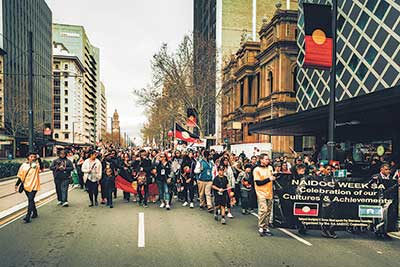
“RAP actions taken by local councils, like celebrating National Reconciliation Week, play an important role in raising awareness of Aboriginal and Torres Strait Islander histories, cultures and contributions.”
Adelaide City Council has committed to a RAP for the last eight years.
Co-chairperson of the Adelaide City Council Reconciliation Committee, Yvonne Agius said the current RAP is the most ambitious plan yet for Council and spans the operations of the entire organisation.
Agius said the plan aims to make a “meaningful and tangible” difference in recognising the importance of traditional custodians, the Kaurna people of the Adelaide Plains.
The Reconciliation Committee that Agius is part of oversees the implementation of the RAP and includes eight members of Aboriginal descent.
A sample of measures taken so far by Adelaide includes changing street signage to signify Indigenous significance, permanently flying the Aboriginal flag, and employing increased numbers of Indigenous staff members.
A morning tea hosted by Council as part of NAIDOC Week has swelled from 80 to 300 people in recent years.
Agius said the major challenges in implementing the RAP measures “are always resources and finances… but Council has always made good on their promises.
“The Aboriginal people of South Australia are thankful to Council for what they’ve done,” Agius said, “I recommend all councils to follow suit”.
O’Keefe from Reconciliation Victoria said although RAPs can be successful, they can also have limitations, as they don’t necessarily ensure continual consultation with Indigenous groups.
O’Keefe suggested a two-way partnership agreement with Aboriginal communities can be more beneficial, as it means councils foster deep ‘ongoing relationships’.
“Some councils have developed RAPs, but other councils have decided that there’s other mechanisms, such as Glenelg Council, they developed a partnership agreement, which is a bit like a treaty.”
An overall challenge for councils is translating good intentions into action, O’Keefe said.
“We find there’s quite a lot of good will, and councils wanting to do stuff, but they’re just not sure what to do, and how to go about it.”
At the Municipal Association Victoria (MAV) annual conference later this month, Reconciliation Victoria is set to officially launch a website dedicated to becoming ‘a one-stop shop’ for Victorian councils wanting information on Indigenous issues.
Dubbed ‘Maggolee’ – a Woi Wurrung word meaning “here in this place” – the site aims to showcase examples of best practice and encourage councils to do more.
O’Keefe is hoping this platform will help renew interest from councils and rectify the slowed progress Reconciliation Victoria has identified in the sector in recent years.
“We’re hoping the website is a way of giving [councils] some practical help in coming up with programs.”