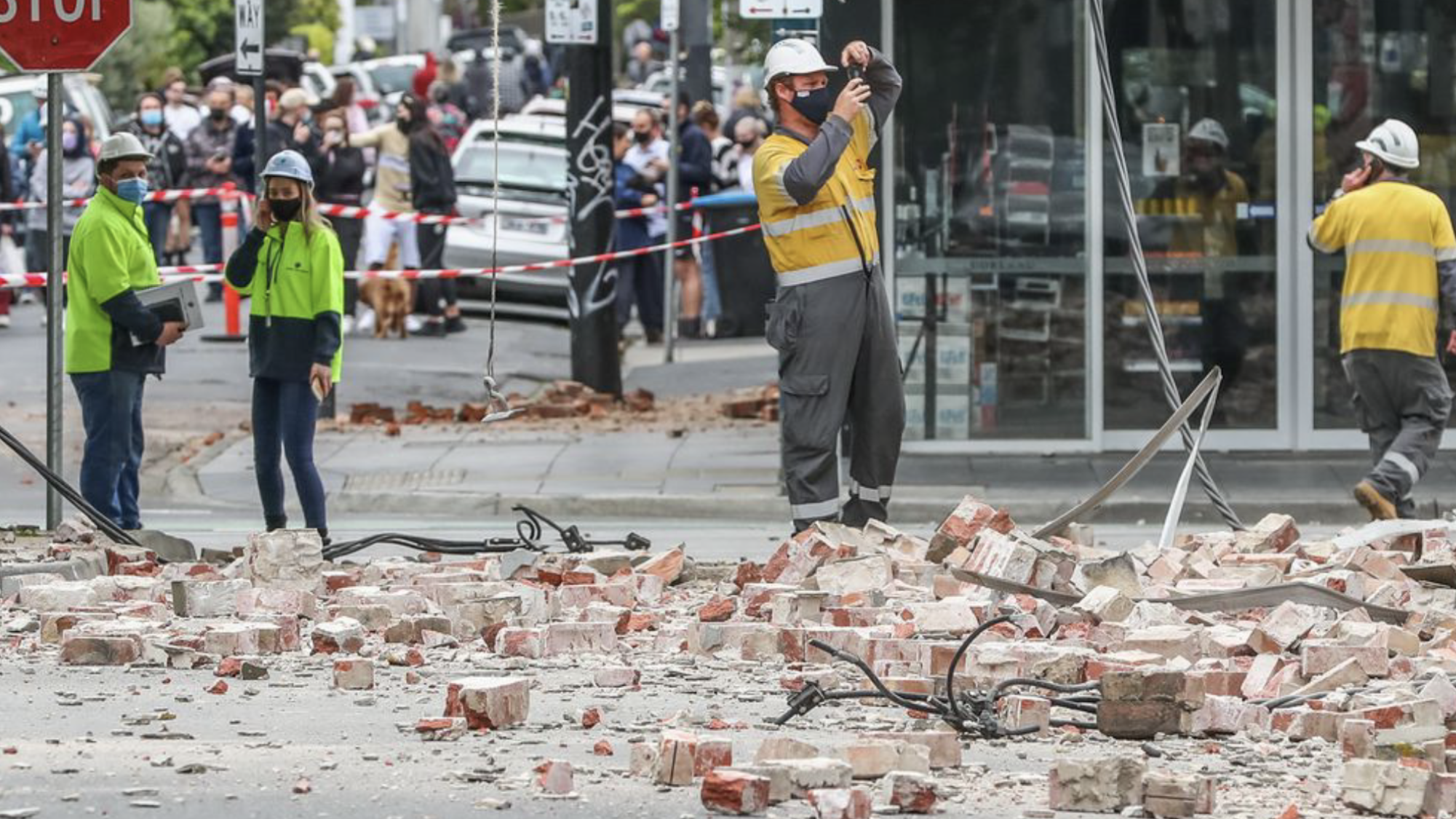
Most Australians have never experienced an earthquake and are glad of that fact. Our neighbours in New Zealand have not been as lucky. This is due to the geological situation where New Zealand is located on the boundary of two tectonic plates. Australia on the other hand is fortunate to be located in the centre of the Australasian plate and as such does not experience the magnitude or frequency of earthquakes as our neighbours across the ditch.
Australians however should not be complacent when it comes to designing for earthquakes. We have an Australian Standard called AS1170.4 which addresses the design of structures to accommodate earthquakes. Unfortunately, many engineers tend to not concern themselves with earthquake design due to infrequent earthquake experiences. As a result, most engineers focus on the Wind Code and the other Standards for their design process which leaves us vulnerable when the infrequent larger earthquake does hit us. This is markedly different in New Zealand where every engineer is familiar with NZS1170.5 (their EQ Code).
Australia has experienced many earthquakes over the period of measuring for such events in the past 200 years but the magnitude of our major earthquakes has primarily been in the 5.6 to 6.8 Richter Scale range. This is small compared to countries like NZ, Japan, Chile, USA, Japan where magnitudes of seven and eight can be recorded (these values being a logarithmic scale).
I personally have experienced two earthquakes in my lifetime – the first when I was a young lad living in the Western Suburbs of Sydney. The second one I felt was the Newcastle earthquake in 1989 (even though I was living in the northwest suburbs of Sydney, nearly 150 km from Newcastle). The magnitude of the Newcastle earthquake was 5.6 on the Richter Scale and resulted in 13 deaths and millions of dollars of damage to buildings and infrastructure that were not designed or built adequately to resist an earthquake of this magnitude.
Our current Australian Standards for Earthquake design uses ground accelerations rather than Richter Scale values to determine the forces liable to damage our buildings. The minimum acceleration coefficient (Z factor) prior to 2018 used to be 0.03 for cities like Hobart whereas in areas like the Gold Coast, Coffs Harbour, Lismore and even Brisbane it used to be 0.05.
In 2018 there was a revision of AS1170.4 whereby all cities and towns across Australia that had the previous minimum acceleration limits between 0.03 and 0.07, were now raised to a new minimum of 0.08. This may not sound like much of an increase but for areas like Brisbane and the Gold Coast an increase in the acceleration coefficient (ie Z factor) from 0.03 to 0.08 meant an increase in design force of 266% !
Buildings that were originally designed to withstand the force of an earthquake in those regions now have to withstand a force nearly 2.7 times higher than in the past. Many Council staff, Government official and even design engineers may not be aware of this change in the Code.
We at ETIA aim to educate the engineering, construction and building industry to ensure that designers know of these changes when designing their structures accordingly.
On Wednesday 16 November, we will conduct a basic course in Earthquake design (Module One) to the Australian Standard AS1170.4 (R2018). The speaker for this course will be the well-known and well-respected Professor of Earthquake Engineering, Mr John Wilson. John has had many years of research and practical input as chairman of the EQ Standards Committee. He has been invited to present papers in countries around the world that experience regular earthquakes (especially New Zealand).
For engineers who want to get more involved in the structural calculations required for earthquake analysis then ETIA will be conducting a separate course on Thursday 17 November (Module Two). This course will allow engineers to develop a better understanding of the theory and thus perform tutorial exercises addressing the various elements of earthquake design. Topics such as determination of natural periods of buildings and the soils they are founded on; centre of mass vs centre of rigidity of structures; structural design processes for mode of vibration and damage in buildings will all be covered. This course will be presented by Paul Uno, who is one of the authors of the textbook “Reinforced Concrete -The Designers Handbook”.
For further information on these two upcoming ETIA courses, readers should refer to etia.net.au/events/course-list