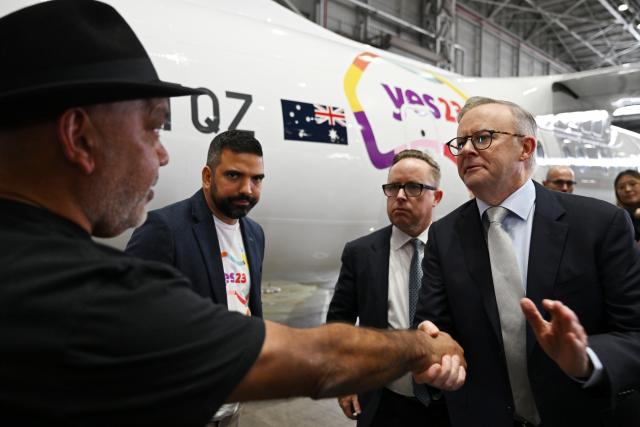
The Albanese Government now has its first black mark courtesy of last month’s decision to disallow Qatar Airways’ request to fly an additional 21 flight routes to and from Australia. The decision has triggered widespread criticism of its reformist credentials, and sowed the doubts in voters’ minds about the judgement of not only the Transport Minister but the entire leadership team.
The damage is multi-layered and cumulative. It’s not just about Qantas’ eye-watering fares that have upset voters in a country so reliant on air travel e.g. Sydney to Broken Hill return flights upwards of $1300, or Melbourne to Mildura return flights at around $800.
But the regular cancellation of services to our regional cities also gets noticed. As does the declining service and poor food offerings, the slot hoarding, the mass sackings during Covid despite a $2.7 billion government grant, the tardiness on redeeming Covid travel credits, and the difficulty in using Frequent Flyer points. These are classic indicators of monopoly power.
On top of all that is the news of Albanese’ son having Captain’s Club membership. And hours later numerous politicians at Senate Estimates were smiling when CEO Joyce was reminding them of their own Chairman’s Lounge membership.
The Chairman’s Lounge membership for politicians, departmental staff, etc., is an anachronistic arrangement that must cease. It is a low-level corruption. I’ve been with Ministers and MPs in an airport when they quietly peel off to the Chairman’s Lounge. The truth of the matter is that politicians have so much attention bestowed on them by departmental officials, the media and company executives that they really do become self-important. The Chairman’s Lounge is just another perk that massages their egos. Examples of those who didn’t succumb to schmoozing are, in my experience, Michael McCormack, Tony Burke, Kristy McBain, Bob Katter (yes indeed), and ex-deputy PM Brian Howe.
Strangely, Albanese keeps referring to Qantas as our national airline, which is surely now an outdated notion.
Competition policy
Andrew Leigh, Assistant Treasurer (with responsibility for competition policy), penned his thoughts in the Financial Review just prior to the Qantas debacle.
“It’s hard to ignore the growing body of evidence that excessive market concentration can lead to economic problems…market concentration tells us how much share the biggest players have. But it doesn’t tell us the extent to which they’re throwing their weight around.
“By contrast, mark-ups – the gap between firms’ costs and what they charge their consumers – impact directly on consumers. Mark-ups capture the market power of firms. For example, if there’s thousands of companies selling a similar product, there’s a going price. The market sets the price. By contrast, when only one company sells the product, they set the market price. The difference is between market pricing and monopolist pricing.”
Leigh goes on to argue that monopolies are thus the source of some very significant mark-ups, and that the evidence points to competitive pressure in the Australian economy having also declined over the past two decades. Firm entry and exit rates have also fallen. Job mobility has declined, and the largest firms have increased their market share. He concludes that the declining dynamism in both the product and labour markets has occurred simultaneously.
So what’s new, you might ask? Well with evidence like the above, you’d expect governments to be super-vigilant because of the market concentration in the telecoms, banking, energy and supermarket sectors. It’s a tricky area. A couple of my contacts in the federal sphere say that the Australian Competition and Consumer Commission has been reasonably diligent in advising the federal government on transgressions under the Act, but that ministerial advisers and/or departmental chiefs have been slow to act.
Intergenerational Report
The ‘Intergenerational Report’ (IGR) released last month by the Federal Treasury has sparked widespread interest about Australia’s long-term economic and social challenges viz. population ageing, balancing federal budgets, and addressing climate change.
The report is actually a rare document within the federal sphere because it goes beyond the day-to-day workings of government. Indeed, as Liz Ritchie (Regional Australia Institute) says, the report identifies policy blind spots, especially the role that regional Australia must play in transiting to net zero emissions, and its role as the engine room for productivity growth in agriculture, mining and manufacturing.
However to my mind the IGR missed a golden opportunity to ram home the need for strong policies on tax reform, urban housing supply and migration levels. These are the issues that the Morrison Government failed to address, and ushered in the current Labor Government.
Dutton has a softer side
The ascension of Peter Dutton to Liberal Party leadership was seen as many as a guarantee of two electoral terms for Labor. His Grim Reaper persona was seen as a massive liability.
But, his recent effort on the ABC’s Kitchen Cabinet was a huge turnaround in his image – he oozed honesty, empathy and wisdom. He was acting like a Labrador. My contacts say that Dutton’s performance has buoyed the Libs, and the Albanese camp would surely now be cogitating on things. An added problem for the ALP and indeed the coalition is that the Independents – Spender, Steggall, Chaney, Ryan, Daniel, Pocock etc. – are all addressing the big issues and carving out niches that augur well for their futures. It was refreshing to see Spender recently announcing the convening of a think tank on taxation reform with experts like Ken Henry. Even the Bush seats are no longer the preserve of the Nationals.
Ned Kelly lives on
News has arrived about Glenrowan’s new Ned Kelly Centre, designed to interpret his last stand. The cost was $5.5 million with the bulk coming from the Victorian Government and the balance from the local council.
The project idea had been around for some 12 years – the breakthrough came when the Victorian Government announced a funding program to help rural areas recover from Covid. The project still had to meet the project criteria against competition. Moral of the story? Be persistent, as the late federal Minister Simon Crean used to say.
Rod Brown is a Canberra-based lobbyist specialising in industry/regional development. Email apdcockatoo@iprimus.com.au