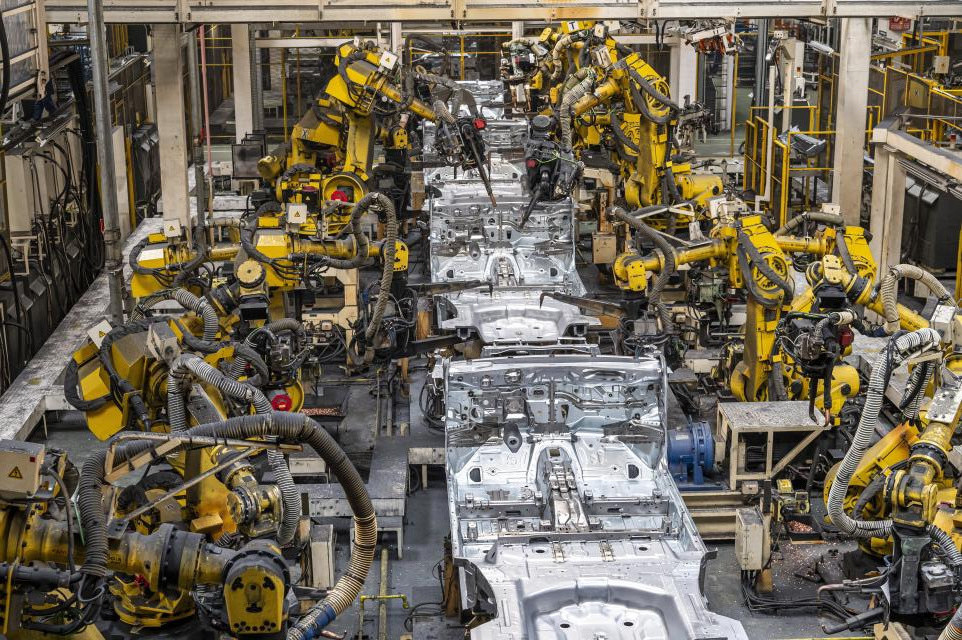
The world automotive industry is undergoing massive change, with industry development avenues emerging for Australia. And local government should be a key player.
The issue is brought into focus with news that US electric vehicle manufacturer Lucid Motors has opened a car manufacturing plant in Saudi Arabia, in line with its commitment to move into EV manufacturing.
As long-time business journalist Peter Roberts notes, Australia is now the only member country of the G20 that is not making its own cars. Even Ukraine, Serbia, Slovenia, Kazakhstan and Uzbekistan outside the G20 make their own cars. He says it’s shameful that Australia was once the 10th largest carmaker in the world.
The Productivity Commission has got wind of this and, true to form, it’s already denouncing such talk. In its annual review of trade and assistance (June 2023) it actually said ‘the presence of critical minerals mining in Australia suggests that there might be a cost advantage for processing in Australia’. What a ridiculous statement given that minerals processing is one area where we’ve excelled for more than a century. But the PC then warmed to its task by doubting our prospects of being competitive in battery manufacture, and it wouldn’t be drawn on EV manufacture.
But there is hope, because international investors wouldn’t be reading the PC’s prognostications. The logic is as follows.
1. Internal combustion engines will soon be a marginal proposition. Electric vehicles will become the norm.
2. The economics of EV manufacture are still being shaped. Admittedly large production runs – say a minimum of 500,000 units annually – are important for the big EV manufacturers like Tesla, BYD (China), Toyota, BMW, GM, Volkswagen, Nissan, Ford and Hyundai. But they also have plants operating on smaller numbers. Indeed the current move by most nations to support local manufacturing in the face of supply chain uncertainty works in favour of middling size plants.
3. There is still a significant group of business and government leaders who disagree with the decisions by successive governments to scrap support for local car manufacturing in Australia. Importantly, no one is talking about a return to import tariffs and massive government subsidies.
4. The new opportunity is to explore which of the above multinationals would see Australia as a straight market opportunity without big government subsidies, but instead leveraging our competitive advantages and technologies, viz.
– Large, quality reserves of the key minerals (lithium, cobalt, copper etc.).
– A battery plant in the pipeline in Gladstone.
– World-class CSIRO diecasting technology.
– Competitively-priced labour against most developed nations.
– A labour force with skills in vehicle manufacture and metal fabrication.
5. Our one competitive disadvantage is energy. It’s the only area where federal and/or state governments could justify a modest subsidy until we fix that problem.
In my experience, multinationals are continually looking for competitive locations, and Australia’s preeminence in critical minerals would mean that EV manufacturers would now be analysing Australia’s competitive advantage in that sector.
Toyota would surely be doing the sums because it wanted to keep making cars in Australia. Similarly, GM and Ford have a strong track record here and would now be wondering if they can create a business opportunity from our political love-in with the USA.
Local government role
A key part of multinationals’ analysis is locational advantage. They’d be wondering if a battery manufacturing capability in Gladstone could underpin the downstream manufacture of EVs, or whether locations further south would be better options.
Northern Adelaide and Geelong are the stand-outs to my mind. They have access to deep water ports, sufficient land for laydown areas (Gladstone has both). In addition they have a manufacturing tradition with strong labour pools and good education and training infrastructure, as well as the possibility of renovating unused buildings.
The role for local councils is thus to work with their state governments to market their locations to prospective multinational investors, and be ready to drive collaboration between their local players and the multinationals. And send welcoming signals. The state governments’ overseas investment offices would surely be fielding enquiries from multinationals. I suggest you make that link.
AIS judgement day looms
The Australian Institute of Sport was established in the northern suburbs of Canberra in 1981 by PM Malcolm Fraser. For the last 20 years it has been an embarrassing, hollowed-out remnant of its glory days – the basketball arena has been closed for some time, the aquatic centre regularly springs leaks, athlete patronage and events are down and spectator attendance is consequently down.
The core of the problem is the failure of successive federal governments to commit funds to repairs. The false hope has been that the private sector might fund some of the necessary work, but Canberra has insufficient big corporates to take an interest and the 400,000 population is too small to generate healthy revenue streams at events.
So the Albanese Government has ordered a review to ‘help guide investment’ and to consider its optimal location in the context of the Brisbane Olympic Games. The hint of its relocation sent shockwaves through the ACT Government. The review will only take a few months, so it will hardly be comprehensive.
This is going to be a tricky call for the feds. Cost estimates of around $300 million are being mentioned. To complicate matters, the option of a Canberra hub with spokes in various other cities has reportedly been canvassed by a group of local councils. The concern facing the feds is that such an arrangement would (a) further weaken the AIS headquarters, and (b) create more structures around the nation requiring federal funding.
My guess is that the feds will cough up $300 million.