In the 1990s, increasing pressure for coastal development, heightened community environmental consciousness and inadequate vital infrastructure became the catalysts for significant advances in Coffs Harbour City Council’s strategic planning for the city’s future.
As a result, Council has emerged as a frontrunner in managing environmental issues such as water and sewerage infrastructure, biodiversity protection, waste management, land use and water quality, energy efficiency, and sustainability.
Sewerage. Strategy
In 1997, Coffs Harbour City Council began the process to develop a strategy for the provision of sewerage services to meet the city’s future growth. In total, the Coffs Harbour Sewerage Strategy has involved capital works costing around $250 million.
The objectives of the Coffs Harbour Sewerage Strategy were to:
- afeguard public health
- provide sewerage to present and future urban
development - satisfy stringent environmental safeguards
- protect the coastal environment and the
Solitary Islands Marine Park - maximise the beneficial use of reclaimed water
- ensure the strategy is affordable for the Coffs Harbour community
- stage implementation to take advantage of
developing technology.
Regional Water Supply Scheme
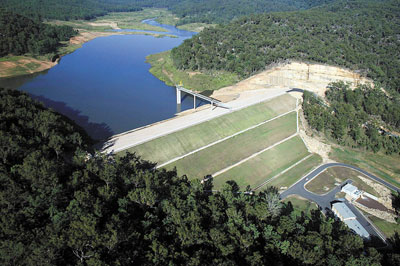
The $180 million Regional Water Supply Project links the Clarence Valley and Coffs Harbour bulk water supplies to meet the demand for water in the region up to and beyond 2030.
The population of the Clarence Valley and Coffs Harbour region, which will be served by the water supply, is expected to more than double in the next 50 years.
Two key elements make up the Regional Water Supply Strategy, a ‘non-build’ Water Efficiency Program and a $180 million ‘build’ Project which includes:
- a 30,000ML off stream storage at Shannon
Creek – currently being filled with water and
expected to be filled by November 2010 - 87 kilometres of underground pipeline
distribution system, linking the Nymboida
River to the Reservoir at South Grafton, the
Shannon Creek Storage near Coutts Crossing
and Karangi Dam at Coffs Harbour,
completed in late 2006.
Alliance contracting –
thinking outside the box
The enormous capital costs of the implementation of the Sewerage Strategy and the Regional Water Supply Scheme meant that Council had to give careful consideration to how these projects could move forward.
The method chosen was alliance contracting.
Coffs Harbour City Council has enhanced its ability to deliver new infrastructure and generated significant cost efficiencies by becoming one of the first local authorities in Australia to embrace alliance contracting on a major scale.
Alliance contracting is increasingly being recognised as an effective means to deliver much needed infrastructure to the public sector. Its popularity can be gauged by the fact that there has been rapid growth in alliance projects in Australia, with more than $10 billion of projects being developed or planned using such a model.
So what is it? Alliance contracting involves the formation of a team by the client and contractor to develop and complete a project, sharing the risks and the gains, with incentives for all parties to work together for optimum outcomes.
Coffs Harbour City Council was the first local authority in New South Wales to use alliancing on a major scale and it is estimated that it has, so far, saved around $5 million in project costs as a result.
In 2003, it began an alliance contract with Barclay Mowlem to build a $19 million Deep Sea Release for reclaimed water and, with GHD, Abigroup and Aquatec Maxcon, to upgrade its Woolgoolga Water Reclamation Plant at a cost of $16 million. The projects were a key part of the city’s $250 million Sewerage Strategy.
Reclaimed water is wastewater that has been given additional treatment so that it complies with the National Water Quality Management Strategy – Guidelines for Reclaimed Water. It is used locally for irrigation by 44 customers, including agricultural producers, schools, Council and sporting organisations.
During the building periods for both projects, more than 300 design or construction innovations were achieved and significant financial gains were realised.
As a result of the success of Coffs Harbour City Council’s first venture into alliance contracting, a new alliance project began in 2006 to design and build three major infrastructure projects, through the Coffs Infrastructure Alliance (CIA), a partnership with Abigroup, John Holland, GHD, Aquatec Maxcon and CFNA and Serck Controls. This new alliance contract included the building of the Coffs Harbour Water Reclamation Plant, construction of a new Water Filtration Plant and the construction of a new road bridge. In all, the projects were worth an estimated $160 million.
“Because of the size of the projects, Council was looking for the best way to provide these works with limited resources,” said Jason Gordon, Council’s Director City Services. “Realising that the construction industry was swamped with work at that time and contractors could choose which projects they wanted to do and how they would do it, alliancing was seen as the best way forward – particularly given the positive outcomes we had experienced on the earlier projects.
“By combining several projects, Council made the Coffs Infrastructure Alliance an attractive package to the contractors and ensured the commitment of their best teams. In addition, by combining several projects under one umbrella, the alliance partners can record significant gains in other areas such as administrative overheads, purchasing power, resource sharing, innovation and risk minimisation. It also eliminates the adversarial situations that can commonly raise costs in traditional contracts.”
For more information on Council’s experience of alliance contracting, contact Jason Gordon, Director City Services, on (02) 6648 4401.
|
Shannon Creek Dam facts
|