Every year, Councils across Australia are spending millions of dollars removing graffiti from public places. If we add to this the clean up for Federal and State Government bodies, as well as damage to residential and business property, the full cost to the community is huge and growing annually.
As a result of a recent campaign by Local Government Association of Queensland (LGAQ), a computer game – Contents Under Pressure – has been refused classification. The game, where players spray graffiti on buildings, had originally been given a MA15+ rating by the Australian Classification Board. Concerns raised by LGAQ, that the game could encourage an increase in graffiti damage to property, resulted in Attorney General, Philip Ruddock ordering a review of the classification.
In February, this appeal to the Classification Review Board saw the classification overturned effectively banning its sale in Australia. This move has been welcomed by Local Governments. Various Councils have put in place programs to try to curb the amount of graffiti vandalism as well as assist local residents and businesses in the clean up process.
‘Tagging’, the most common form of graffiti vandalism, is where taggers seek recognition from their peers through their unique signature or moniker. Highly visible public places are most susceptible, such as along railway reserves and near schools.
Quick removal, at least within 24 hours, is a great deterrent against taggers who soon discover their ‘handiwork’ washed off or painted over. Many Councils have programs to clean up graffiti as soon as it is reported on their property, as well as provide assistance for private property owners. Aside from the removal of illegal graffiti, some Councils have very successful programs to channel the skills of young people into designing and preparing murals in designated public places.
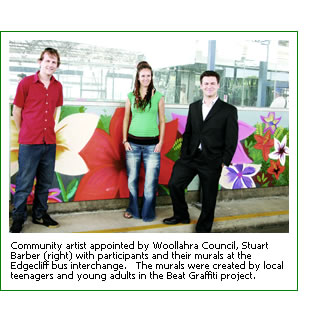
In Sydney’s Woollahra Council, the busy Edgecliff bus interchange has undergone a makeover with the installation of 27 murals created by local teenagers and young adults in the Beat Graffiti project. Funded by the NSW Attorney General’s Department and supported by RailCorp and Woollahra Council, the project involved 42 local teenagers and young adults. They created a series of murals depicting local landmarks and views along local bus routes, as well as the people and places of Woollahra.
Aiming to deter graffiti vandalism in a public space, the program has enhanced the appearance of Edgecliff bus interchange, given young people the opportunity to enhance their artistic skills and helped form more positive attitudes towards young people in the local community.
“The project has allowed the young people to enhance their artistic skills and to participate in a legal art project that they can take pride in,” said Stuart Barber, Community Artist appointed by Woollahra Council’s Community Services Department.
The Beat Graffiti project provided opportunities for young people to expand their skills in design, brushwork, aerosol techniques and teamwork in a fun and interactive environment. “The program was awesome and it shows the community that there is a positive side to aerosol art,” said one participant of the project.
The murals were officially unveiled at a ceremony at the Edgecliff bus interchange on 10 February. Melbourne’s Bayside City Council has allocated $100,000 to help clean up graffiti this year and will consider contributing ongoing funding in next year’s budget to continue the work and implement education programs.
An audit in July and August 2005 indicated an area of 12,600 square metres- equivalent to 9km of footpath – of public and private property had graffiti on it. Ongoing removal of graffiti at high priority sites identified through the audit commenced in November 2005 and will continue for the next eight months. These sites include the Black Rock shopping strip, the walkway to Middle Brighton Railway Station and further stretches on Nepean Highway.
“Ongoing rapid removal of graffiti along with long term strategies is the most effective graffiti prevention measure,” said Bayside Mayor, Councillor Craig Tucker. “Our Graffiti Management Strategy recommends a range of strategies to tackle the problem including a graffiti removal contract that would extend graffiti removal by Council to non Council assets, community art, vegetation treatments and education programs.”
He said that Council is also looking at management options with neighbouring Local Governments to try to gain a regional approach to this costly problem. In addition Bayside is undertaking work to introduce a Local Law to ban people under the age of 18 from purchasing aerosol paint cans from retailers within Bayside.
“Consultation with Bayside’s young people and traders selling aerosol paint cans shows there is support for reducing graffiti within Bayside,” Councillor Tucker said. “Both groups felt that banning aerosol paint cans sales to people under the age of 18 would be more effective if neighbouring municipalities also introduced a ban.”
To this end, Bayside Council will work with neighbouring Councils to promote a consistent regional response to banning aerosol paint can sales. An annual graffiti audit and ongoing monitoring of key sites will enable Bayside to measure the effectiveness of its graffiti programs.