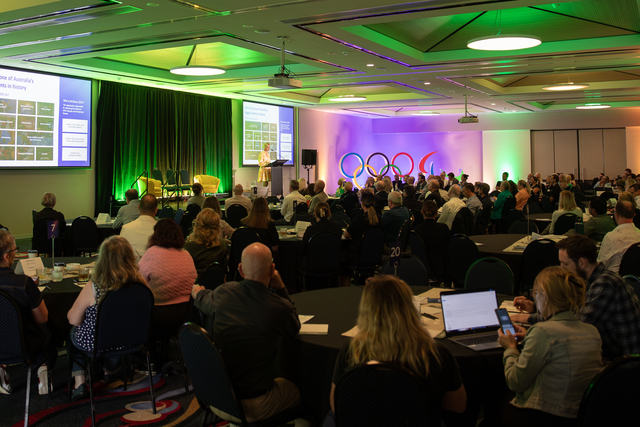
Local Government Professionals’ 2001 annual conference was held in Melbourne on 1-2 March. This event was preceded by a series of Best Practice workshops on 28 February.In his opening remarks, President, Lyndon Webb, highlighted the leadership role played by LG Pro in ensuring professionals across the range of Local Government services are connected to each other, to best practice and, most importantly, to their communities.
The Conference was officially opened by the Victorian Minister for Local Government, Bob Cameron. The Minister emphasised the partnership approach being pursued between the Government and LG Pro, particularly in areas such as the current review of the Local Government Act and in solving the ‘infrastructure gap’.
Bob Cameron stressed the importance of communities and the need for all those involved in government, in all spheres, to remain ‘connected’ to the needs of those communities.
Keynote speaker, Phillip Adams, also honed in on the theme of connections drawing delegates’ attention to the cultural impacts of global communications.
He said that Local Governments have the greatest potential to counteract negative influences because they have suffered less erosion of their base than the other spheres of government.
Phillip Adams encouraged Mayors and other community leaders to maintain strong connections to their communities through regular and interactive use of their local media and to establish a dialogue with their community on issues of concern. He said that Councils can be a powerful force in counteracting the views of extreme groups.
“LG Pro was pleased with the attendance of almost 400 people,” Lyndon Webb said. “We have received positive feedback on the issues presented, including leadership, electronic service delivery, sustainability and community.”
1994-2000 progress or marking time in Vic?
In this session speakers provided a range of perspectives concerning Victorian Local Government and how it had fared over the past seven years.Sheila O’Sullivan, from Socom Public Relations, looked at the two distinct periods – 1994-1997 under State Government appointed commissioners, and 1997 to the present with the return of democracy.
During 1994-1997, she pointed to the extremes of economic rationalism that saw the decimation of Councils’ capital budgets, the sale of public assets and reduction of public maintenance.
Alongside this, the introduction of Compulsory Competitive Tendering and the downsizing of Council staff resulted in standards of service being set without community consultation; the reduction in Local Government’s capacity to deliver some services; and the creation of the ‘superannuation’ black hole.
She described the notion of client/provider split as ‘managerialism gone mad’ and the then Government’s ‘league ladder’, that is the ranking of Councils from 1-78 irrespective of their diverse community needs, and all coming from a different base, as bizarre.
She said that the return of democracy was shaky to start but much has now been achieved. It has been a steep learning curve with Councils excelling particularly in the area of advocacy. Assisting this has been the reform of the Municipal Association of Victoria, and creation of the Victorian Local Governance Association and LG Pro, providing three very powerful lobby groups.
In the area of governance, Sheila O’Sullivan pointed to improved community consultation and Councils being clearer about their roles and responsibilities.
Also speaking during this session was Mary Crooks from the Victorian Women’s Trust. She said that the unbridled free market experiment in Victoria, and at the Federal level for the past two decades under both Labor and Conservative Governments, has created a deep malaise in the community and disenchantment with government.
Mary Crooks agrees with the view that ‘if markets alone govern a society they will destroy it’.
“As government closest to the people, you have the opportunity to rebuild people’s trust,’ she said.
However, Mary Crooks warned that once trust is breached, it is difficult to rebuild. She told delegates that it is vital to track what is happening in their community. Consultation needs to be ongoing and not a hit and miss approach once issues arise.
“Look at the various ways to stay in touch,” she said. “The job description of each staff member should include at least 20 hours per month out in the community listening to what people are saying.”
Chief Executive Officer at the City of Boroondara, Peter Johnstone, was the final speaker in this session.He said that over the seven years there has been plenty of action with many continuing challenges.
He listed these challenges as Best Value; clarifying strategic directions; community engagement; cost shifting from the other spheres to Local Government; fiscal equity and the need to have access to a growth tax; and Councillor/management relations.
Peter Johnstone criticised the fact that Local Government is still bogged down by prescriptive State legislation and lacks constitutional protection. He said that the Minister’s current ‘update’ of the Local Government Act will achieve little if the Act remains prescriptive rather than empowering.
e-business opportunities for Councils and communities
Director of IBM’s e-business Team, Ian Adair, said that by 2005 it is estimated that there will be one billion Internet users. Within Australia, by 2003, the number is expected to exceed 8.4 million.“Business and technology are certainly merging,” he said.
“Time and location is no longer important. At the same time, communication, information storage and processing costs are falling.“Fundamental business practices are changing. It is a global ‘marketspace’, with 24 hour service, end to end transactions and one to one marketing analysis.”
He acknowledged that electronic business to business (b2b) transactions were growing faster than business to consumer, however the Next Generation Internet (NGI) will see us simply turning on our mobile phone to be connected to the web. Access will be fast, always on, everywhere, have wider bandwidth and deliver greater confidence through increased security.
Faced with a downturn in key local industries and a high unemployment rate, particularly among its youth,Burnie City Council in Tasmania has developed an IT and Telecommunications strategy.
“We have created Burnie the Online City,” said Lionel Young, Manager Economic Development. “Our IT & T Small Business Incubator now has 50 people employed.”
Burnie has created an information hub through resource sharing with nine other Councils. Forming alliances with private sector providers, Council has created new and sustainable employment opportunities. Working with Sydney based company commerce@work, a new product, e-council, has been developed specifically for Local Government providing a payment gateway, knowledge management and web portal.
“Council’s aim is to move our internal IT services from being an expense to Council to a key income producing item,” Lionel Young said.
Whittlesea City Council is quickly establishing itself as IT leader.
Neil Hocking, Director Organisational Development, said that Whittlesea’s multimedia strategy is the result of two years work.
“We view e-service as a reality not just an option,” Neil Hocking said. “However, the key is that it is people that matter more than the technology, so we have not replaced face to face or telephone contact rather see e-services as an option to improve services.
He said that training for all staff to make use of the new technology is vital. As a result, PCs have been installed in the depot lunch rooms, IT trainers work with staff across the organisation and a staff IT café has been established.
“Training for business and community members is also part of the strategy,” Neil Hocking said. “With 54 percent of the community and business operators from non English speaking backgrounds, their specific needs are an important consideration.”