Funded under the Local Government Development Program, the Remote Area Management Project (RAMP) is a project which aims to develop the community management skills of elected members of remote Aboriginal communities. RAMP staff are working toward this by providing training for members from 25 remote communities over a three year period.
RAMP CD ROM
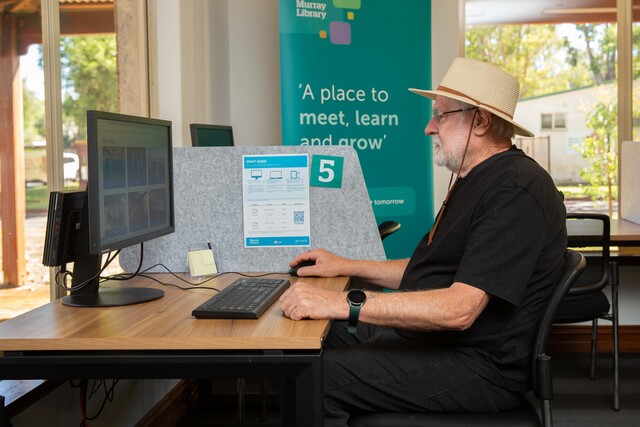
Remote communities might be ‘out bush’, but technology can bring information and training into the community without the high cost of travelling to the main centres.
Using the latest in technology, RAMP has developed a CD ROM training guide for elected members. Produced in ten Aboriginal languages and English, the RAMP CD ROM is an entertaining and user-friendly way for elected members to learn about their roles and responsibilities.
Animated characters take elected members through a number of problems commonly faced by remote Aboriginal councils and associations. The RAMP characters understand the problems that remote councils face and offer helpful suggestions to overcome these problems.
Topics covered in the training guide include:
- Managing Visitors;
- Local Government;
- Meetings;
- Money Story;
- Planning;
- Recruitment; and
- Representation.
Community Planning
A specific area of interest to most, if not all, communities is council and community planning. Over the last decade or so, community planning, or community development planning as it is also known, has become a popular tool of the bureaucracies which fund Aboriginal organisations.
Increasingly local community councils, Community Development Employment Program (CDEP) organisations and other Aboriginal organisations are being asked by either the Aboriginal
and Torres Strait Islander Commission, the Northern Territory Department of Housing and Local Government, or other funding bodies, to provide plans for their operations over a given period, ranging from one year to three years, often as a precondition of funding.
A range of community plans have been produced by Aboriginal community councils. These have been of varying quality. While some planners have made a genuine attempt to involve the community in their development and keep the plan accessible, others have consulted little with the community and plans have been prepared in a fashion which would prevent most local Aboriginal councillors from reading them.
Staff from RAMP have discussed planning with several communities. In general, they have found that community plans tend to be unread by council members and in some instances at least, councillors were not aware that their community had a plan.
Planning with Walangeri Ngumpinku Council at Yarralin
In early 1997, the Walangeri Ngumpinku council clerk asked RAMP to work with the council on planning. The community needed to complete a three year plan for its CDEP and wanted to be able to link this plan to wider community objectives.
The RAMP facilitator and the council met every month until the plan was completed. The planning began with the RAMP facilitator asking the council to list the things they wanted for the community.
A wish-list of about 35 ‘wants’ was created. At the next meeting, the wish-list was organised into six categories or projects with the council selecting the three most important aims in each project. Over the next six months there was a lot of discussion and the plan was written up in a form which was suitable for distribution to government agencies.
In order for the plan to be accessible to all community members, and to be useful to the council as a management tool for both councillors and council staff, the plan needed to be designed so that it was easily understood and in a format appropriate for non-literate people.
RAMP and the council discussed how to present the plan. It was decided to use photographs and computer graphics and drawings so that people could easily identify the projects and aims of the community plan.
The six projects were made into large posters showing photos and drawing of the main aims and strategies in each project. The three year CDEP operational plan is reflected in the community plan through these community projects, and through the delivery of council services such as parks and gardens, fencing, family support, rubbish collection and waste management.
At community meetings held before the end of the year, the Walangeri Ngumpinku Council presented the overall plan to the community for discussion and suggestions.
The meetings were well attended with community members participating in discussion about various aspects of the plan. At the end of the meetings, the councillors agreed that all their hard work had been worth it as the community members were happy with the plan.
What people want for their communities results from their world view, their circumstances (including their past history), and their value system. How they achieve the outcomes for their communities depends on their involvement, motivation and combined abilities. Successful planning, to a large extent, depends on building on existing strengths and capabilities.
For it is the people themselves who make the plans come true, through their involvement and motivation. For new projects, a step by step approach is necessary to ensure that community support and involvement stays with the plan. If it doesn’t, then it is safe to say that either the time is not right or the plan is headed in the wrong direction.
As we know, plans are not static. They are dynamic, and change and evolve in accordance with changing circumstances and needs. The community plan for Walangeri Ngumpinku provides a solid and substantial base for the future development and growth of the community.
RAMP is delighted to have been a part of the planning process with the council and wishes the council and communities of Yarralin, Pigeon Hole and Lingarra every success in the future.
For more details on RAMP, please contact Barbara Jackson, RAMP Project Manager on (08) 8941 1730.