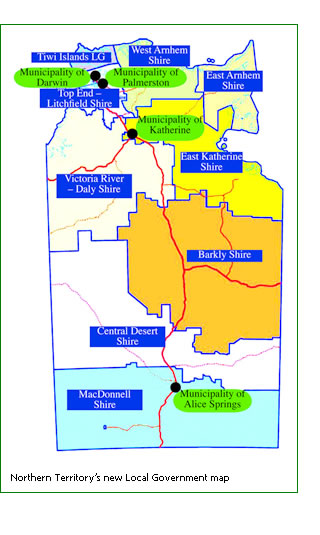
Under a far reaching structural reform program for Local Government in its regional areas, the Northern Territory Government has announced a new framework based on four existing Municipal Councils and nine new Shire Councils. The Territory’s current 57 Community Government Councils and ‘Association Councils’ will be replaced by these nine new Shire Councils.
A Local Government Advisory Board has been established to provide advice directly to the Minister for Local Government on the implementation of the reform process. The Board includes an independent chair and representatives from regional areas, the Local Government sector and industry stakeholders. The target date for implementation of the new framework is 1 July 2008.
President of the Local Government Association of the Northern Territory, Alderman Kerry Moir, welcomed the announcement by the Minister for Local Government, Elliot McAdam, on the boundaries of the proposed nine Shires as part of the Government’s reform agenda.
“At last we have something concrete to analyse and comment on,” she said. “Reform of Local Government has been on the NT Government agenda for over ten years. This announcement signals change is actually going to happen.
“While the Association and its members support reform, the challenge for all of us is to analyse the Government’s proposal to ensure it is the most workable arrangement. The Minister has set up a strong advisory board under the able leadership of Patrick Dodson. The board includes Local Government representatives currently working in all regions of the NT and within the Local Government Association itself. They have first hand experience of the actual problems confronting Local Government outside municipal areas. This proposal will see our membership reducing significantly from 63 councils to 13, but experience interstate shows the Association will play a very important role into the future as the voice for the sector.
“Everyone wants improvements and bigger Councils will have more capacity to deliver services and potentially be stronger advocates for their communities as well as becoming more financially sustainable.
We need now to focus on achieving these outcomes.”
While acknowledging the committed work of many elected members and staff, the NT Government says the current Local Government system has not worked well for many of its rural and remote communities and is unsustainable in its present form. In a nutshell, the financial and administrative complexities of modern Local Government have been too difficult to manage for many small Councils, lowering standards of governance and service delivery. There are basic structural problems with each small community, most with populations of less than 1,000 people, having separate Council administrations. As a result, they spend a large proportion of their funds on administration rather than service delivery to the community, and have limited capacity to raise revenue, develop infrastructure and are finding it increasingly difficult to attract and retain qualified staff.
The new Shire Councils will enable a regional approach to service delivery that will improve capacity and provide better opportunities for local people. The organisational structure for the new Shires will be similar to Local Government in the existing Territory Municipal Councils and regional Shire Councils in other parts of Australia. Elected members will develop the direction and policies of each Council and a chief executive and staff to implement the policies and deliver the services.
The new Shire Councils will operate on a democratic basis, similar to Local Government in the rest of Australia. However, the new Shires will not replace traditional decision making structures, which have existed for thousands of years, or make them any less important. It will be vital for the new Shires to consult with elders and traditional owners on certain Local Government matters. This will show proper respect and achieve a valuable exchange of information and ideas. This consultation may occur through the Land Councils, local boards and local ward Councillors.
In announcing the reform program at the end of January, Local Government Minister, Elliot McAdam, said that the boundaries for the new Shire Councils will deliver better funding, services and greater expertise to the bush.
“After much consideration and discussion, the new arrangements decided upon will consist of four Municipal Councils and nine Shire Councils,” the Minister said. “This will create greater efficiencies for bush Councils with a regionally coordinated approach when seeking funding and delivering services. “This major reform will mostly affect people in regional and remote parts of the Northern Territory, while there will be little change in Darwin, Palmerston, Katherine and Alice Springs.
“Chairperson of the Local Government Advisory Board, Patrick Dodson, has a wealth of experience working in administration, policy and Indigenous affairs and will help make the transition to the new model as smooth as possible. The Advisory Board he heads will work with people from all over the Territory as the new model is introduced.
“The new model will ensure strong local representation on each Shire. The new structure will improve life for people living in the bush by creating more opportunities. It will also give regional and remote Local Government access to increased funding and expertise, which will improve services, infrastructure and roads.”
The Local Government Advisory Board held its first meeting on 8 and 9 February in Alice Springs. “Clearly there is a lot of work to do between now and July 2008 when the new system of Municipal and Shire Councils will commence,” the Minister said. “As they work with their communities and organisations throughout the reform process, they will inform me on any issues that arise.
“The establishment of committees to advise on local issues in each Shire during the transition process is the next priority. Committees will include local elected Council members, representatives of community and regional services providers and the NT and Federal Government.
“Local expertise and knowledge will play a vital role in offering advice on planning and transitional issues within each new Shire.”
The next Advisory Board meeting will be held in Darwin in March.