Aceh’s local elections, held on 11 December 2006, were an historic event for the Indonesian province. The culmination of a two year peace process, it was the first time the Acehnese people were able to directly elect their own governor, and the first time independent candidates were permitted to run in the polls.
The Australian Government, through the Australian Agency for International Development (AusAID), was able to assist the Acehnese people in running a fair, democratic and transparent election process by working on the ground with local authorities, from helping set up a system to audit the voter list, to providing Australian observers to help monitor polling booths on voting day.
In 2006 AusAID and the Asia Foundation provided funding for 45,000 volunteers in the People’s Voter Education Network, an Indonesian coalition of civil society and non government organisations. The network has been actively working to change the culture of local politics to one of accountability towards the public, by informing and educating voters about candidate platforms and by leading debate on emerging issues on the Indonesian electoral process.
Over the coming four years, popular elections in Indonesia will replace all of the appointed provincial governors, district heads and municipal mayors. The network will play a role in monitoring a majority of district, municipal and gubernatorial (governor) elections during this period, and will provide training for partner organisations and local media in election result verification.
At last year’s Aceh election, AusAID, working with American donor agency USAID, supported Indonesia’s National Democratic Institute in the development of an election monitoring network to promote the accuracy of the voter registration list, as just one way of building public confidence in the election process.
The Voter Registration Audit provided clarification of the voting list, from voters who might be absent, relocated or deceased, or non existent voters who had previously remained on the list. The audit was conducted two months before the election by 479 volunteers, with the result that 86.9 per cent of voters were registered for the 11 December election.
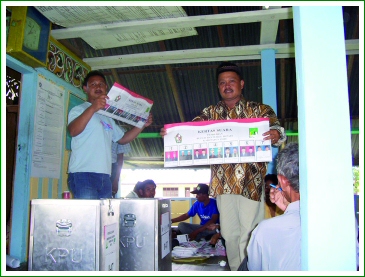
On the day of the poll, Australian Electoral Commissioner, Paul Dacey, led two observation teams that included Indonesia based staff from AusAID and the Department of Foreign Affairs and Trade. The teams visited 18 polling stations, and reported that the process unfolded smoothly, from the ordered flow of voters into the stations to the absence of intimidation or coercion of voters.
Such was the eagerness of the Acehnese people to cast their votes that most visited the polling booths in the morning, and many polling stations were largely quiet by 2pm.
While most feedback was positive, the observers did note some elements that required improvement. At some polling stations the placement of the voting compartments did little to ensure total secrecy of the ballot, while the inking of voters (once people have voted, they are stamped on their hand with indelible ink so that they cannot vote more than once) appeared to be haphazard in some polling stations.
However, the observation team judged these as irregularities that did not appear to damage the integrity of the ballot.
In his post election report, Paul Dacey noted that the recording of votes was particularly successful. At one polling station where observers attended the vote counting, there was an initial discrepancy of one vote which was quickly resolved. He said the observation teams were made welcome at all polling booths visited, and the high turnout indicated voters were keen to participate in the process. Other foreign observer teams expressed similar views about their experiences, and applauded the absence of overt intimidation of voters.
The on the ground work continues, with AusAID launching a number of pilot projects in 2007 to extend the People’s Voter Education Network’s monitoring and reporting capacity on all stages of the electoral process.
With Australia’s support, the network will continue to be a major advocate for citizens in Indonesia’s electoral system.