Last April, the Beattie Government commenced a review of Queensland Councils, scrapping the Local Government Association of Queensland’s self reform process and raising major concerns among many Councils and their communities. On 27 July, the report by the Local Government Reform Commission was released, recommending that Queensland Councils be reduced in number from 157 to 73 and halving the number of current Councillors and Mayors.
At a briefing on the report, Deputy Premier Anna Bligh said that Cabinet has accepted the Commission’s recommendations and will legislate the boundary changes in the next Parliamentary sitting commencing this month.
In response, Local Government Association of Queensland President, Councillor Paul Bell, said that Local Government has been replaced by regional government in Queensland.
“The commissioners have designed the wholesale slaughter of a system without reason,” Councillor Bell said. “Local Government as we know it will cease to exist. What we now have is regional government. Local communities with shared interests have lost the Councillors they relied on to represent their particular interests within the wider community. Instead, they will be left to deal with an unelected bureaucracy. In some cases, they will have to drive for hours to get to their local Councils –
and not only in remote areas. The average size of a regional council will be 25,000 square kilometres.
“The result was predetermined. From day one, given the terms of reference, we forecast the new boundaries would allow between 60 and 70 Councils. Now, there are 73 left standing from the original 157. The Government and the Commission have shown very clearly that neither has any respect for local concerns and communities of interest. The report contains the worst features of our State Government’s doctrinaire, reductionist, economic rationalist thinking.
“The ‘big is better’ argument has been discredited in every Australian State where Councils have experienced amalgamation. Bigger Councils have meant reduced services, rundown infrastructure and higher costs for residents.
“The entire State of Queensland is seven and a half times the size of Victoria and yet Queensland will have just 73 Councils, compared with 79 in Victoria.”
The Australian Services Union – Services Branch (ASU-Services) said that the extent of Council amalgamations recommended by the Queensland Local Government Reform Commission and the speed with which the State Government has accepted the recommendations and intends legislating for their implementation has shocked Local Government employees around the State.
ASU-Services is Queensland’s largest Local Government union, representing over 8,000 Local Government employees throughout Queensland.
“Today’s announcement that Cabinet has already accepted the recommendations and that parliament will legislate the boundaries, as recommended, during the next sitting, which is scheduled in two weeks, is inconsistent with timelines previously advised,” said ASU-Services Secretary, David Smith. “The significantly reduced timeframe allows no time for consultation with stakeholders about the recommended amalgamations and boundary changes.”
Local Government Minister Andrew Fraser has repeated the State Government’s threat to sack Councils if they go ahead with referendums on the mergers.
About 15 Councils have indicated they intend to hold ratepayer funded polls questioning if their residents want to be forcibly amalgamated.
The Minister said the Government could overturn Council motions and, if Councils continued regardless, they were acting unlawfully. It was then within his power to sack the Mayor or Council.
“The referendum serves no purpose,” the Minister said. “I don’t think it will happen – I think common sense will prevail. They should accept the umpire’s decision.”
Premier faces backlash in the bush
In Barcaldine for a ceremony marking the removal of the Tree of Knowledge, Premier Peter Beattie faced a hostile reception as a result of the recently released Queensland Local Government Reform Commission report.
The 200 year old Tree of Knowledge is known as the birthplace of the Australian Labor Party because it was here in 1891 that striking shearers held meetings under its branches which led to the formation of the ALP.
Much to the dismay of many, the famous ghost gum was poisoned by persons unknown around May 2006 and had since died.
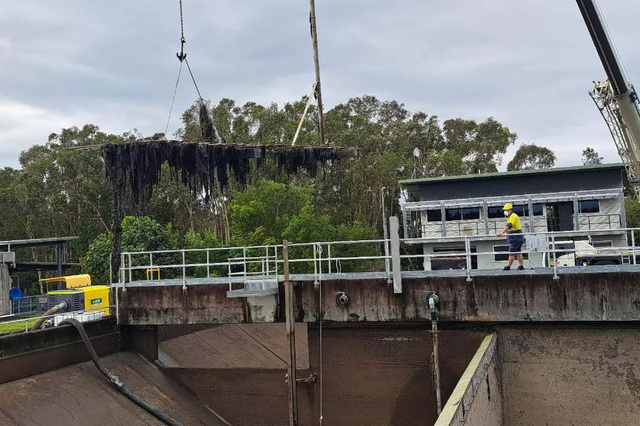
In late July due to its dangerous state, the tree was cut off at its roots. The trunk has been taken to Brisbane to be preserved and will be returned to Barcaldine as part of a planned interpretive centre.
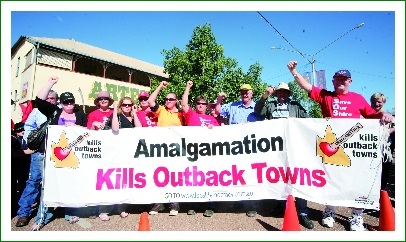
Hundreds of protesters took the Premier’s visit to Barcaldine as an opportunity to vent their anger at the Queensland Government’s overhaul of Councils.
Upset that their eight central western Councils are to be merged into three regional Councils centred on Longreach, Barcaldine and Blackall, the protestors booed and jeered Premier Beattie when he addressed the gathering.