Vandalism and graffiti impose huge costs to society, not only in dollars but also through danger to human lives, increased fear of crime, loss of services and a lowering of the quality of life in our communities.
Graffiti cleanup costs have risen by 500 per cent in the past decade, with Australian councils now spending approximately $260 million a year removing graffiti to deliver safe, friendly and clean environments. Together with countless work hours, this money and time could be otherwise spent on improving public services and infrastructure.
Many councils are involved in various activities aimed at the prevention and removal of graffiti throughout their local areas, but predominantly, the theory is that immediate removal, within 24 to 48 hours, is the most effective action in long term graffiti eradication. Research shows that offenders are often discouraged when their handiwork is quickly removed.
Not for profit organisation, Graffiti Hurts Australia, is a community educational organisation dedicated to raising awareness about the harmful effects of graffiti.
CEO Scott Hilditch said the presence of graffiti can trigger a decline in property values and cause potential homebuyers and businesses to look in other areas or communities.
“Its economic impact on local businesses can also be great, as customers decide to shop in other neighbourhoods where they feel and think they are safer,” he said. “What cannot be measured in lost dollars and business is the very real impact graffiti vandalism has on the fabric of the community and society itself. Left alone, graffiti vandalism is one in a sequence of events in the decline of pride within a neighbourhood known as the ‘broken window’ syndrome.
“According to sociologist George Kelling, if a window in a building is broken and left unrepaired all of the rest of the windows will soon be broken. One unrepaired window is a signal that no one cares and so breaking more windows costs nothing.
“Graffiti vandalism left untouched invites others to add their marks as well, because the property owners or neighbourhood has surrendered control to the vandal and lawbreaker.
“We would like to see councils beginning to seek restitution of clean up costs, so that they can undertake more of the services that communities are demanding from their governments these days.”
Alice Springs Town Council in the Northern Territory has a put in place a 24 hour turnaround time to ‘Wipe Out Graffiti’ on Council property.
CEO Rex Mooney said that while there is no silver bullet to stamping out graffiti, the longer it is there the more advertising and credence it gives to the offenders.
He said Council has had its immediate removal policy in place for several years now and believes it has reduced the occurrence of graffiti on its buildings.
“It has also had a positive effect on other businesses and residents, who have voluntarily taken on board the same approach,” Rex Mooney said. “The Northern Territory Government has committed to the 24 hour turnaround time to remove graffiti from its buildings in Alice Springs, so we have a whole of government approach.”
New South Wales’ Campbelltown City Council is also using prompt action in its continued effort to help combat graffiti across the City.
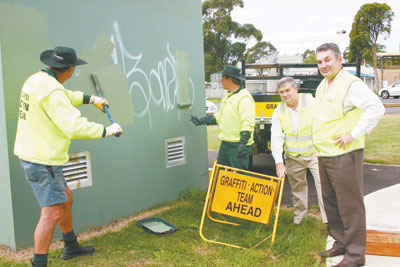
Council has two dedicated Graffiti Action Teams (GATs) that work together with specialist contractors and government agencies, including Juvenile Justice and Corrective Services.
Since the first GAT was launched in June 2008, it has removed more than 28,000 square metres of unsightly graffiti from across the City.
Campbelltown Mayor Russell Matheson said, with their brightly coloured vests and purpose fitted vehicle, the GAT teams are a visual deterrent for would be graffiti vandals.
Campbelltown also recently concluded the trial of a ‘graffiti E-Nose’, an electronic nose that detects aerosol paint in real time from up to 40 metres away. The technology, which was on trial at Campbelltown Skate Park during July, includes a chemical detector that can be set up to detect a range of chemical signatures, not just aerosol paint.
When a detection occurs, an SMS message can be sent to multiple mobile phones.
“For our trial, the SMS messages were sent to one of our staff, who is also on call at night, and to the Intelligence Unit at Campbelltown Police,” Councillor Matheson said. “Depending on available resources, an inspection was made as soon as possible in an effort to identify the offenders, and to also confirm that the alert was not a false alarm.
“During the trial, the system was triggered a number of times. However, observations indicate that the level of graffiti incidents decreased since the E-Nose was installed, possibly indicating a deterrent effect.
“Council is now undertaking a further review of the technology to identify the impact of the system prior to further possible installations.”
Meanwhile, the City of Melville in Western Australia believes community paintbrush murals are rarely attacked, and often create a sense of pride within the community. As such, it’s Adopt-a-Stop project encourages all residents, community groups, students and artists to participate in workshops culminating in the painting of a local bus stop.
The program is not only beautifying streetscapes, but is reducing Council’s financial expense in the removal of graffiti damage on bus shelters (see page 13 for more information).
However, Scott Hilditch warned that while the concept of ‘legal’ or ‘free’ walls have been trialled in many areas to direct graffiti into legal and meaningful art, councils should be wary of implementing them.
“Legal or free walls can send a mixed message to the very audience a community should be educating about respect for other people’s property,” he said. “Understanding that it is OK to ‘write’ on this wall but not another is a difficult concept for many people and confusing to the community.”
The City of Melbourne has engaged Warner Group Pty Ltd to address these problems early in young people’s lives. On behalf of Council, Warner Group is delivering ‘Do art not tags’ education presentations to Grade 5 and Year 8 students in schools within the City.
Lord Mayor Robert Doyle said, as part of the Warner Group workshops, actors visit classrooms and provide information about the differences between graffiti and street art and how different choices can lead to different consequences.
He said 95 per cent of students that have viewed the performance now better understand the costs and consequences of undertaking illegal graffiti.