Home » Barossa droughtproofs vineyards

Barossa droughtproofs vineyards

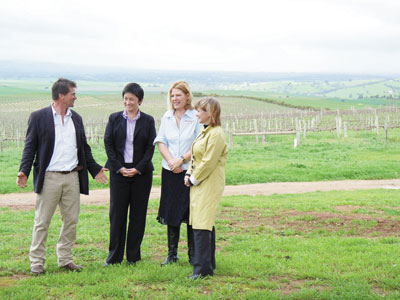
Each year, Barossa grape growers will now have access to 265 megalitres of treated wastewater for vineyard irrigation under a landmark partnership launched in August by Federal Minister for Climate Change and Water, Penny Wong.

“As we tackle the effects of drought and climate change, we need to look at new ways of using available water resources more efficiently,” Senator Wong said during a visit to the
Barossa.

“The Barossa Water Reuse Project is an excellent example of industry working with various levels of government to identify innovative solutions to local water needs.

“The project will reduce Barossa grape growers’ reliance on the River Murray and will provide an environmentally sound use for the treated water from Council’s Community Wastewater Management Scheme.”

Located 70 kilometres northeast of Adelaide, the Barossa is one of Australia’s prime tourism destinations, renown for its premium food, wine and natural environment.

With water the most important element in assuring a consistent supply and quality of wine grapes, this innovative $2.44 million joint project between Barossa Council and Barossa Infrastructure Limited (BIL) is part of Council’s commitment to support the local viticulture industry.

BIL was formed by the Barossa wine grape growers to provide a reliable and quality supplementary irrigation   water system   to   the River   Murray.

This will improve financial returns and expand the productivity capacity of the Barossa region in line with market demands.

The partnership project involves construction of
12 kilometres of connecting pipeline and a pumping station to initially take 265 megalitres per year of recycled water from a new treatment and storage lagoon at the Nuriootpa wastewater treatment plant to vignerons and irrigators.

This will eventually be increased to 600 megalitres per year.

BIL Chairman David Klingberg said the B class treated wastewater was previously channelled into the North Para River.

“Reclaiming and recycling this water for land based irrigation will reduce the draw on the depleted River Murray system, protect the fragile North Para River environment and contribute to BIL’s goal to support sustainable viticulture in the Barossa,” he said.

Barossa Mayor Brian Hurn praised the innovative partnership between BIL and Barossa Council, which he said represents best practice.

“In a difficult economic climate, this is a major step forward in droughtproofing viticultural activities in the Barossa, which represent more than seven per cent of the national wine grape area and produce some of the best wines in the country,” he said.

The Water Reuse Project has been supported with $599,000 of Australian Government funding from the Water Smart Australia program.

The scheme is due for completion by the end of this month.

For more information on the Water Reuse Project visit
www.environment.gov.au/water


Digital Editions


  • From books to bots

    From books to bots

    Tenterfield Library is proving that technology is more than just tools and devices. From coding and robotics to tech support, the Library has become a…

More News

  • Myers resigns for health reasons

    Myers resigns for health reasons

    Wollongong’s Councillor Tiana Myers has resigned, as a Ward Three Councillor for City Council due to health reasons. Cr Myers was elected to Council in 2024 with a focus on…

  • Acknowledging women’s role in councils

    Acknowledging women’s role in councils

    Council representatives from across the state gathered in Sydney today for Local Government NSW’s (LGNSW) International Women’s Day event. Mayor Darcy Byrne, President of LGNSW, said the event was an…

  • Kylie Davies beats strong field

    Kylie Davies beats strong field

    Flinders Shire Council is pleased to announce the appointment of Kylie Davies as its new Chief Executive Officer. Ms Davies will start in the role on 13 April following a…

  • Leaving on a high

    Leaving on a high

    Mount Alexander Shire Council’s Chief Executive Officer Darren Fuzzard will end his tenure at the council in July 2026, marking ten years of service to the organisation and community. Mr…

  • Safety first for transport corridor

    Safety first for transport corridor

    Traversing a major Townsville transit corridor spanning three suburbs will soon be safer for motorists, cyclists and pedestrians, with Townsville City Council commencing a $3.8 million upgrade of Hugh and…

  • Creating long-term employment pathways

    Creating long-term employment pathways

    The Shire of Carnarvon is creating long-term employment pathways and strengthening workforce capability through its participation in the Remote Jobs and Economic Development (RJED) Program, a national initiative designed to…

  • Cool summer plan for Campbelltown

    Cool summer plan for Campbelltown

    Extreme heat is the biggest killer of natural disasters in Australia, exceeding that for any other environmental disaster combined, including floods, storms, bushfires and cyclones. While high temperatures pose risks…

  • Bathurst has it’s scrap together

    Bathurst has it’s scrap together

    Bathurst Regional Council has successfully concluded its ‘Let’s Get Our Scrap Together’ campaign, launched on 1 September 2025 with funding from the NSW Government and delivered in collaboration with NetWaste…

  • Baw Baw acting CEO tenure extended

    Baw Baw acting CEO tenure extended

    Baw Baw Shire Council has extended the contract of Acting Chief Executive Officer Sally Jones until 30 June 2026. The matter was considered as a confidential item in the late…

  • Farewell to a much-loved bridge

    Farewell to a much-loved bridge

    Narrabri Shire Council hosted a special community farewell event in mid-January, Brekkie on the Bridge, ahead of the upcoming demolition of the Violet Street Bridge. The event brought together community…