The O’Farrell Government seems to be making a reasonable fist of things, but it will surely be judged on how it tackles three issues: Sydney’s transport system, electricity prices and urban and regional development.
Why urban and regional development? Well, Sydney’s traffic congestion, housing shortages and high rents are each a manifestation of past neglect of urban planning. But NSW policymakers simply don’t understand how its regions can help address Sydney’s problems.
By contrast, think for a moment of western Europe – regional cities in France, Spain, Denmark, Germany, Sweden, Italy and the UK tend to be bigger, more confident, more independent and they invariably host specialised industrial activity that defines them. And the European cities generally have fast and inexpensive air and train services connecting them to their world cities.
But back here Sydney sits like a seething blob on the edge of the Pacific, sucking in travellers from distant parts but exhibiting little business and cultural interaction with its regional cities, except for Newcastle and Wollongong.
So in one sense it wasn’t surprising when the NSW Department of Trade and Investment announced the closure of its offices in Goulburn, Broken Hill, Tweed Heads, Coffs Harbour and Parramatta.
Leaving Parramatta aside, this is a real kick in the guts to the regional cities affected. Coffs Harbour has a population of 70,000 and the second busiest airport in NSW. Goulburn is the anchor city of a rich agricultural region. Tweed Heads is part of a bustling cross border conurbation that is a long way from Sydney. And Broken Hill is home to world class mineral and environmental assets. So how can they be adequately serviced out of cities that are hours away, respectively, Port Macquarie, Wollongong, Lismore and Dubbo?
These new arrangements are not only insulting and send bad signals to investors, but they defy regional development best practice, which is that connectivity systems are critical. That is to say, regional officials have a critical role in connecting people and organisations, and connecting regions to potential investors and government officials in the major cities.
Goulburn will be a key test in changing this wrong-headed decision. Local state member Pru Goward is also minister for community services, and would appreciate the connectivity issue. And Goulburn’s sister city is Yass, where local state member Katrina Hodgkinson is also the minister for small business. Together they can hopefully point out the folly of this decision. Watch this space.
Clean Energy Investment Program
This is the hottest ticket in town. It is an $800 million competitive program to provide grants to manufacturers to invest in energy-efficient capital equipment in a carbon constrained economy: e.g. a shift from oil to gas, or oil/gas to solar.
Leaving aside whether you are a carbon action disciple, Federal support to reduce energy costs is a no-brainer. Councils with significant manufacturing activity should have a really close look because this program can support industry networks in your midst. And there is $200 million set aside for the food and foundry companies. The Cockatoo Network has experts to prepare the submissions on behalf of the companies, including the necessary energy audits. Please contact us for further information.
Food value adding
The Feds are currently preparing a National Food Plan, and as readers will know we’re often banging on about the importance of the food industry to regional Australia. We have thus been meeting with Federal agencies to garner support for action on five fronts; regional branding, product labelling, supply chain development, reinventing the Murray Darling Basin, and food clusters.
We figure that 100 councils at least should get involved in these agendas. Dick Smith, Maggie Beer, Jan Angas et al need support! We have started by identifying regions in each state that should be early adopters. For example, in Queensland our checklist is:
- Bundaberg (sugar, tomatoes etc.)
- Darling Downs (meats and grains)
- FNQ (vegetables, tropical fruit)
- Lockyer Valley (beetroot, tomatoes etc.)
- Logan (processed food)
- Rockhampton (beef especially)
- Stanthorpe/Granite Belt (grapes, stone fruit)
- Sunshine Coast (ginger, pineapples)
Please contact us for further details.
Flashback to the 1950s
If you yearn for the good old days, take the train from Canberra to Sydney.
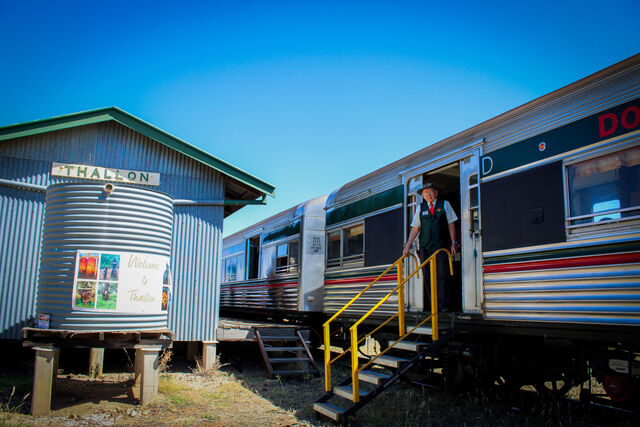
I caught the 6:43am service out of Kingston ACT recently to reacquaint myself with things – nice waiting room, a friendly station manager and a complimentary ‘Canberra Times’. A one way adult ticket costs $56.49; rounding up to the nearest dollar hasn’t yet dawned on the CountryLink marketing gurus.
Anyway, the four carriages trundled off to Queanbeyan and stopped there for 10 minutes. Then onward to Bungendore where it rested another 10 minutes while the driver rang ahead to get the points changed. I kid you not. Next stop Tarago to look at the platform and pretty flowers, then onto Goulburn for a five minute stop to boost the passenger list from 18 to around 25. We trundled on through the M&Ms (Marulan, Moss Vale, Mittagong) – four hours and 26 minutes later we arrived at Central Station after a trip of 285km (average of 63km/hour). This week’s schedule says the trip is taking four hours 59 minutes due to trackwork and ‘service alerts’, whatever that means.
By way of comparison, Bairnsdale and Wodonga are 280–300km from Melbourne and those trips take three and a half hours, courtesy of the Sprinter Train that is manufactured by Goninan & Co in Newcastle. The cost was $65 million in the mid 1990s, of which the Federal Better Cities Program stumped up $24 million.
But there is no Sprinter Train within cooee of Canberra, so the better alternative is a Murray’s coach, which costs $25 (special rate) or $39 (standard) and takes an hour less than the train. Or there is a Qantas Red-E-Deal at $179, reflecting the folly of short-haul air services and the lack of competition. Or you can drive yourself and become part of the M5 carpark.
The moral of this story? Bring fresh blood into CountryLink, and invest in Sprinter Trains. But my cynical mates say that this cannot happen because the NSW Government is hanging on for a Very Fast Train. I say to them: ‘Dream on!’
Rod Brown is a Canberra-based consultant specialising in industry/regional development, investment attraction, clusters and accessing Federal grants. He also runs the Cockatoo Network. He can be contacted at apdcockatoo@iprimus.com.au or phone (02) 6231 7261.
Go to the blog at www.investmentinnovation.wordpress.com for 550+ articles on issues relevant to Local Government.