Home » Smart procurement on the path to sustainable roads*

Smart procurement on the path to sustainable roads*

Roads perform an important connecting function for every community. Yet most current approaches to road construction and maintenance are unsustainable in economic, environmental and social terms.

With the challenge of population growth, road degradation, rising road maintenance costs and decreasing access to affordable resources, councils and civil road contractors must be innovative to play their role in our transition towards sustainability.

Construction materials comprise a large proportion of the enormous quantities of materials consumed worldwide. In fact, Australian construction material consumption is estimated to be 5.2 tonnes per person each year, a significant proportion of which is for road infrastructure.

Traditionally, roads have been constructed using high grade quarry products such as hard rock and gravel. These non-renewable resources are becoming more challenging to acquire in terms of cost and access. The process of quarrying and hauling the material incurs significant greenhouse gas (GHG) emissions, not to mention further damage to the haul route incurred during the transport of quarry materials to site.

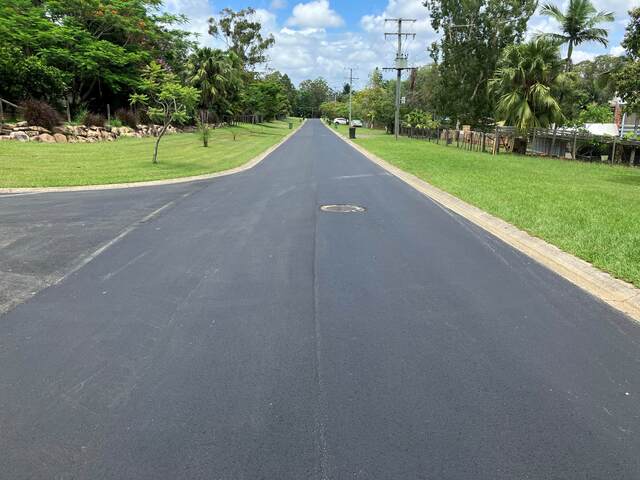
As pressure mounts to move towards a sustainable society, there is substantial progress in creating road networks and maintenance practises that are resilient to future environmental and resource related challenges. Councils across Australia are playing a key role in driving innovation in the road construction industry, with the procurement of an innovative yet simple new technology that is transforming their road maintenance practises and building stronger roads.

Road authorities procure PolyCom Stabilising Aid to upgrade road materials that would normally be deemed unsuitable for use. PolyCom is supplied in 2kg packs, a quantity that can stabilise 50m2 or 100 tonnes of road material – a stark comparison to traditional alternatives that would require significantly higher quantities of virgin material.

A recent lifecycle assessment of a road treated with PolyCom compared to an untreated section of the same road revealed a 90% cut in GHG emissions, 80% reduction in water usage and 70% financial savings on maintenance.

By recovering their roads with PolyCom instead of re-sheeting with virgin materials, councils are saving time, money and resources. This allows them to reduce their environmental footprint whilst turning their focus to other critical infrastructure projects.

It is pioneering, innovative solutions like PolyCom that are empowering the road construction industry to build sustainability into our roads – maintaining a stronger road network whilst minimising the impact on our environment and communities.

*Copy supplied by Earthco

Digital Editions


  • Change in the weather

    Change in the weather

    AUSSIE FLOOD RESCUE It’s obvious to everybody that we are seeing weather changes. It appears to be more erratic and frequent than ever before. Local…

More News

  • Unit demolished as Ipswich flood recovery continues

    Unit demolished as Ipswich flood recovery continues

    Ipswich Mayor Teresa Harding has welcomed the demolition of Mihi Grove, a flood-hit 42-unit complex in Brassall purchased as part of the Queensland and Australian Government’s Resilient Homes Fund Voluntary…

  • Fraser adopts tree

    Fraser adopts tree

    The Fraser Coast now has an official tree, with Council today adopting the Kauri Pine as a symbol of the region’s culture, history and natural environment. Fraser Coast Mayor George…

  • Council take on much-loved garden

    Council take on much-loved garden

    Glenorchy City Council will take on the administration of the Chigwell Community Garden, securing the future of the much-loved community space and supporting continued shared use by local groups. Glenorchy…

  • Fuel prices hurt country LGAs

    Fuel prices hurt country LGAs

    The fuel crisis is hitting remote, rural and regional communities hard, with farmers, freight carriers, tourism operators and local government all expressing concerns about the lack of supply and the…

  • Navigating grants

    Navigating grants

    How Administrative Complexity Is Eroding One of Local Government’s Most Powerful Tools Local government grants exist to create impact in communities. Yet across the sector, that purpose is increasingly being…

  • Looking to the future

    Looking to the future

    Flinders Lane will be abuzz for two days this month with Townsville Youth Council – supported by Townsville City Council – set to deliver a free festival focused on the…

  • WA leads the way as people to the regions

    WA leads the way as people to the regions

    Ten million people now call regional Australia home, and Western Australia is leading the way with its regional population growing faster than the cities, according to a deep dive into…

  • Sewer grant sought

    Sewer grant sought

    Fraser Coast Regional Council will seek Queensland Government funding for two major water and sewerage projects with capacity to support more than 11,000 new homes across the region. At its…

  • Mayors call for waste levy

    Mayors call for waste levy

    Mayors across NSW have called for waste levy to soften the blow of fuel price increases. More than 60 Councils from across NSW have issued a call for the NSW…

  • Lismore four years on

    Lismore four years on

    Four years on: How Lismore is building back and setting a national benchmark. When the 2022 flood inundated Lismore, it was not simply another extreme weather event. It became Australia’s…