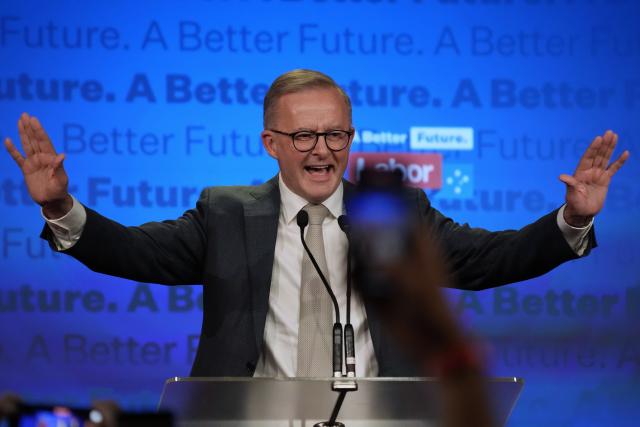
Labor’s federal election victory last month is going to create a seismic shift in the Australian political landscape.
But the effects won’t be apparent for some time because the Labor leadership needs to time to come to terms with the Budget mess and accommodate the role of the independents.
In the meantime, there are four areas among many that councils and local stakeholders might mull over.
1. Integrity Commission and Infrastructure Australia
Early action to establish a federal Integrity Commission is likely because of electoral commitments. The side benefit is that it will not only squash the shenanigans we’ve seen in recent times, but also provide the legal stick to usher in a new approach to grants administration and infrastructure spending in general.
And Infrastructure Australia’s stocks will rise as a result. The Morrison Government had largely ignored its role in prioritising large infrastructure projects. Its new relevance is because (a) it was Albanese’s brainchild back in 2008, and (b) the realisation that proper project evaluation might well be necessary to avoid a summons from the Integrity Commission.
A more effective Infrastructure Australia will provide councils and local stakeholders with a better idea of where their project proposals stand and reduce the chance of having their local projects bumped for less worthy projects.
It should be noted that small projects aren’t included in Infrastructure Australia’s evaluation work. The problem facing proponents of small regional projects with a level of public good (and hence the need for government grants) is the difficulty in finding the funds for the feasibility studies, scoping studies etc. Councils cry poor, the local project champions haven’t a brass razoo, and the feds and states say they only want to fund the project proper. We must lobby them on this!
2. Regional development
Albanese has already stated his intention to cut $350m of uncommitted funds from the Community Development Program, as well as $400m from the Regionalisation Fund. The rationale was that these programs were poorly designed and would lead to more pork barrelling.
What programs might come in their place is hard to say. Albanese has a good grip on regional development issues and will want something apart from infrastructure projects to remind regional Australia of Labor’s commitment. But the Budget deficit will ensure any regional development programs will be modest.
The Budget deficit is also bad news for Albanese’ pet project, the Very Fast Train. It surely cannot be advanced until the Budget is under control. One possibility is for the Albanese government to encourage union-based super funds to take an equity position, but this is doubtful.
3. Industry development
The rise of the Greens surely sees the eclipse of the coal and gas fracking lobbies, and a consequent rise in action to reduce emissions. The emerging green hydrogen and ammonia production hubs in the Pilbara, Gladstone and Whyalla will gather momentum.
Albanese has flagged the establishment of a National Reconstruction Fund, with $15 billion as a first step in rebuilding our industrial base. It aims to draw in $30 billion of private sector investment.
Sectors mentioned are transport, value-adding agriculture-forestry-fisheries, medical science, renewable technologies, defence capability, green metals, advanced manufacturing. It seems too good to be true. Councils should nevertheless track this initiative. I will keep you informed.
4. Political machinery
Albanese has declared that he wants to ‘change the way’ we do politics in Australia, and he talks about ‘community-led government’. The details are scarce. I hope it’s not simply rhetoric because some fundamental changes are sorely needed viz. less confrontational politicians, less gimmicks, more collaboration, increased focus on long term objectives.
The fascinating question is how local government might inject itself into some robust and workable form of community-led government. Numerous councils have a decent track record in convening community forums, think tanks etc. Hence there is a foundation to build on.
The tricky bit in my view is to get federal agencies to participate in those events. I took it upon myself to go bush when I was with the feds, but I was in the minority.
In fact I still encourage Canberra-based federal officials to get out to workshops and conferences organised by Cockatoo members, but the response is generally that it’s best left to officials in the field, or they’re too busy or their travel budgets are tight.
The problem is that under successive Liberal governments, the public servants have been neutered. Too much of the feds’ policy development has been the preserve of ministerial staffers – smart young jocks but with limited experience. Perhaps the independents can exert some influence, and get Canberra-based officials out into the mainstream?
The bottom-line is that federal public servants can be a powerful resource. The Morrison Government never appreciated that, which is why it couldn’t develop or deliver on long-term policy agendas.
Way Forward
Local councils can and must tap into this new political landscape. The Labor Government is stressing bottom-up processes, an enhanced role for women and increased attention to health and education where women are dominant. Add in the rise of the Teals.
As a Canberra colleague mused, ‘it basically boiled down to women, many of them former Liberal voters, deciding that the men’s right wing game is not for them’.
The truth of the matter is that Albanese is not a bullshit artist, and he doesn’t suffer fools. I believe he is genuine in searching for bottom-up processes. Local government therefore has an excellent opportunity to harness its local stakeholders – men and women – to change the way we do politics.
Accordingly some modest advice. When a federal ministerial staffer asks for a photo grab of a minister with your mayor, or seeks a 15 minute meeting – tell him/her to stop right there!
Suggest instead a day of company/community visits for the minister, followed by a workshop comprising local stakeholders plus relevant MPs of all political persuasions.
This is what collaboration is about. Any resistance from staffers should be relayed to the PM’s Office because if Albanese is true to his word, it should galvanise some action.