The lack of women at senior management level and as elected representatives is a weakness of local government.
The Australian Local Government Women’s Association (ALGWA) firmly believes that diversity is critically important and the lack of gender equity at a local government level must be addressed.
The current situation means that not only does the level of government closest to the people not reflect the community it serves, but it also means that councils are missing out on talented women.
The key corporate objective of ALGWA is to improve the number of women in local government in senior levels – as mayors, deputy mayors, CEOs, and as directors and managers of council programs.
Since the (ALGWA) National Framework for Women in Local Government 2001 was launched, attempts to improve the numbers of women in decision-making positions have resulted in little change from 2001 to now. In 2001, women made up less than 30 percent of all elected members, 15 percent of mayors and 10 percent of senior positions (CEOs, general managers and senior managers).
In 2009, women represented 28.4 percent of elected members, 21.6 percent of mayors and 7.4 percent of CEOs/general managers. The number of senior managers was not known. On the basis of this information, the Local Government and Planning Ministers’ Council endorsed the Women in Local Government Strategy 2009-2012 and set a goal of achieving a 40 percent female participation rate of elected representatives, 35 percent of mayors and 30 percent of senior managers by 2020. The latest data, compiled by our researcher, Denise Conroy, indicates that Victoria and the Northern Territory have achieved the 30 percent representation rate for elected members.
There is currently no readily available data source for women mayors, CEOs/general managers or senior managers either by State/Territory or nationally.
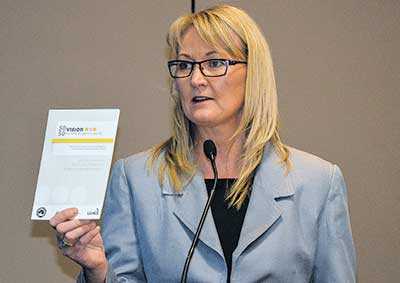
To help rectify this situation, ALGWA needs to get data on a regular basis and push an agenda for gender equality. We currently strongly support the 50:50 Vision Program and other programs in some states which are endeavouring to have more women in senior positions, but actual data on employment numbers by level (by gender) remains elusive for all 585 councils. The business case for having women in senior roles has well and truly been made; however, it seems that in the case of local government, the message is still not resonating.
The United Nations Convention on the Elimination of All Forms of Discrimination against Women (CEDAW) recent report on Australia identified a need for improved data through disaggregation and cross-tabulation by sex, ethnicity and geographical location to ensure that the needs of under-represented groups can be identified and interventions applied to eliminate inequalities and disparities. Such data is needed on women elected to, and employed in, local government.
ALGWA, along with our partners, are discussing ways in which national data collections might be improved to enable a more discernible analysis of local government election data as well as local government workplace gender equality data.
Through ALGWA’s 5050Vision Councils for Gender Equity Awards, councils are eligible to receive the nationally recognised 5050Vision Councils for Gender Equity Award in either Bronze, Silver of Gold levels.
Annual reviews of the awards ensure councils are maintaining their presence in the gender equity space. More than 180 local governments across Australia are currently registered for the program. The entire program is strongly based on resource sharing and networking, and the website has many resources and tools available to councils who wish to improve their performance in this area.
Among the online tools available are application forms and climate surveys, which can be used within councils.
Five councils have achieved silver status, and one will soon achieve gold status. www.5050vision.com.au.