In the northwest pocket of Bayside City Council’s municipal boundary, something very special is happening.
Yalukit Willam Nature Reserve is a transformative project. The former golf course-to-nature reserve conversion is a significant addition to the local open space network.
Through returning the land to be more reflective of its original natural state, the reserve is creating a refuge and place of tranquillity for both wildlife and people.
The 2.5km network of paths meander through the reserve, enabling visitors to explore the unique reserve elements. Wildlife sightings are frequent, with increased migratory small bush bird stopover-times already being observed.
The Grassy Woodlands is a terrestrial habitat, dominated by Eucalyptus canopy over an open grasslands’ understorey with clustered shrubs, providing important foraging, nesting, breeding,
and roosting habitat for a wide range of woodland birds, insects, and small reptiles.
The Wildflower Meadow incorporates more than 18 wildflower and 20 indigenous grassland species. Designed in collaboration with Melbourne University’s School of Design and School of Ecosystem Sciences, seasonal changes bring contrasting colours and abundant insect activity.
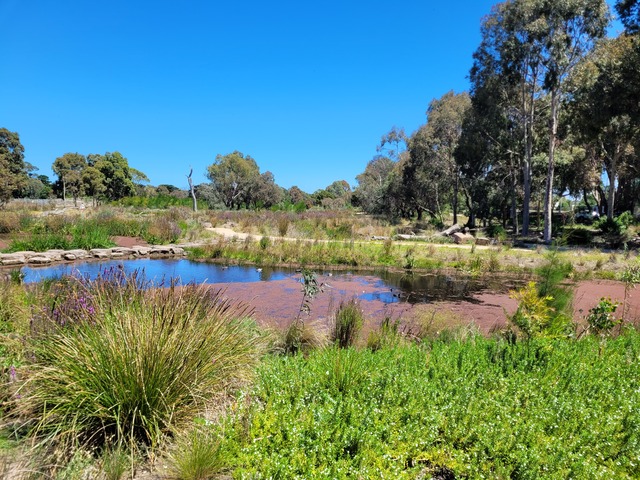
The expanses of open water flowing through the Chain of Ponds mimics the natural cycle, receding in summer and filling again in autumn and winter. The ponds, billabong, soaks and aquatic planting attract water and amphibious life, and insects to bolster the food source for wildlife.
The tranquil and stunning urban Wetland sits on 40 per cent of the southern reserve area, and will provide critical habitat for wildlife, and new vegetation habitat zones. Recently, Bayside City Council started releasing water into the remarkable urban wetland. With Elster Creek’s water flow restored, specialist horticulturalists are busy planting the reserve’s approximate 200,000 new terrestrial and aquatic plants, and 1,900 trees.
The wetlands act as a flood retarding basin helping to reduce flood risk, while naturally filtering pollutants and sediments from stormwater. By integrating sustainable water management practices, water quality is improved before its reuse within the reserve, irrigation for the adjacent sports fields, or release into Port Phillip Bay.
When the wetlands are holding adequate water levels, the beautifully designed cascades will create a waterfall between the two wetland ponds.
The wetland islands further support the reserve’s biodiversity, providing new habitat and refuge areas for local and migratory wildlife, including aquatic bird species most vulnerable to larger threats.
Works have recently commenced on the construction of a visitor centre (the Gateway Building) The visitor centre will include an exhibition space, a community room and café and kitchen facilities, with visitor information guides, interpretive signage landscaping and connectivity to the wider reserve.
Positioned as the major symbolic entry into the reserve, the Gateway Building visitor centre will provide a threshold as visitors move from the busy Nepean Highway into the unique tranquillity of the urban oasis.
Designed to be a welcoming meeting point and gathering space (and conveniently close to various public transport options), the innovative three-part pebble-like building design integrates the surrounding flora and fauna, and the sensitive ‘Caring for Country’ design signifies two key themes in the masterplan: ecology and connection.
The Wetland and Gateway Building projects at Yalukit Wilam Nature Reserve are led by Bayside City Council. The Australian Government is providing $10,000,000 towards the design and construction of the Gateway Building visitor centre.
For more information about the transformation, visit Bayside City Council’s project page.