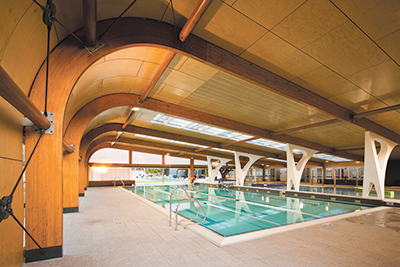
How wood can help councils to reduce carbon emissions and save money.
Timber is the only major building material that helps tackle climate change. It is both a naturally renewable and abundant resource. As trees grow they remove carbon dioxide from the atmosphere, known as carbon sequestration. When the tree is responsibly harvested the carbon is locked in the wood and remains there for the life of any products made with that timber. About half of the dry weight of timber is carbon.
In addition, the production and processing of wood uses much less energy – known as embodied energy – than most other building materials, giving wood products a significantly lower carbon footprint. As a result wood can be used as a low-emission substitute for materials that require larger amounts of fossil fuels to be produced. As a rule of thumb, if you convert one cubic metre of a solid material, such as concrete or brick, for a cubic metre of timber, you will eliminate approximately one tonne (1000kg) of carbon dioxide from being emitted into the atmosphere.
We also know that wood is good for our health and wellbeing – it effectively helps to bring the benefits of time spent in nature into the built environment – and can reduce stress responses including lower blood pressure and heart rate. It is strong and light – about one fifth of the weight of concrete, and it is durable – the oldest timber structure in the world dates back to AD 670! Wood is also a natural insulator – its thermal resistance is approximately 15 times higher than concrete or masonry – which will help to reduce the cost of heating or air-conditioning.
Most buildings using wood are prefabricated offsite and are much faster to build, which will save you time and money. So, by building in timber, not only do you reduce your carbon emissions but also reduce the time and cost of construction.
Why you should consider a Wood Encouragement Policy
Planet Ark Environmental Foundation’s Make It Wood campaign aims to encourage the increased use of responsibly sourced wood as a building material. A key part of this initiative is the adoption of Wood Encouragement Policies (WEPs) throughout Australia.
A WEP generally requires responsibly sourced wood to be considered, where feasible, as the primary construction material in all new-build and refurbishment projects. As such it is not intended to be a draconian, all encompassing dictum, but rather seeks to ensure that wood is at least considered as the primary structural component in these buildings.
There are now two Local Government Authorities and fourteen local councils that have adopted a WEP in Australia. In June 2017 Tasmania became the first state in Australia to adopt a state-wide policy, and in December 2017 the Town of East Fremantle in Western Australia became the first town or city council in Australia to adopt a WEP.
So, why don’t you consider adopting a Wood Encouragement Policy? For more information visit makeitwood.org or contact David Rowlinson, Make It Wood Campaign Manager, at david[@]planetark.org or 0400 474 412.
*Copy supplied by Planet Ark