With record high temperatures for August in northern New South Wales and south east Queensland, bushfires already on the south coast of New South Wales, the warmest winter on record for most of the southern regions of Australia and warnings of soaring temperatures and acute fire danger again this summer, whether you are a firm believer in climate change or a sceptic, extreme weather events – fires, floods or cyclones – are definitely happening around us.
When such events occur the impact on councils, their communities, and operations is far reaching. Recent bushfires and floods leave us in no doubt about this.
Climate change, preparing for it and responding to its impacts, is now high on the agendas of most Local Governments. In 2007 the Commonwealth Government identified the following areas of Local Government responsibility likely to be affected by climate change:
- infrastructure and property services –
road/pavement construction and
maintenance, stormwater/drainage, buildings
and coastal infrastructure - recreational facilities – provision and
maintenance - health services – community/workplace
health, emergency/bushfire management - planning and development approvals
- natural resource management – coastal
management, weed/pest management, biodiversity - water and sewerage services – stormwater,
wastewater and water supply.
In New South Wales a collective of 14 councils has been working together for many years under the Hunter and Central Coast Regional Environmental Management Strategy (HCCREMS).
In partnership with the University of Newcastle, it has recently completed a two year study titled the HCCREMS Regional Climate Change Project.
The 14 HCCREMS member councils see themselves as leaders in Local Government resource sharing having worked together on various environmental management initiatives for over 13 years. This Regional Climate Change Project is yet another example.
HCCREMS Program Manager Steve Wilson said that the Hunter and Central Coast region is characterised by considerable climate variability so it is unlikely that the impact of climate change on the region’s communities, industry and environment will be uniform.
As the current Global Climate Models do not provide information for specific regions or sub regions, the HCCREMS councils believe that this makes it difficult for individual councils, local industries and communities to accurately assess and prepare for the risks posed by climate change. And this is likely to be the case for most other regions.
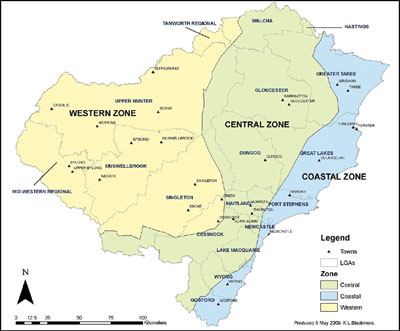
The HCCREMS project established three sub regional climate zones – coastal, central and western – providing projections for each zone for the period from 2020 to 2080. This is an Australian first and differs from other approaches in that projections of future climate change are based on changes to the region’s ‘weather drivers’. These weather drivers include 12 synoptic types derived from the sea level output of the CSIRO Mark 3.5 Global Climate Model.
Previous research on the predicted impact of climate change has primarily concentrated on the key climate variables – rainfall and temperature. From this project the HCCREMS councils now have projections based on a range of climate variables, including rainfall, temperature (minimum, maximum and average annual), humidity, pan evaporation, water balance, wind, sea level rise and extreme sea levels, wave climate and extreme events.
In addition to its research findings, the HCCREMS team will continue to develop a suite of case studies that tailor even further the results of the research to key sectors or issues of significance to the region.
Four case studies to demonstrate the applicability of the research results are currently being developed and will be released in October 2009. These include the Hunter Wine Industry, Bushfires, Extreme Events in the Coastal Zone and Human Health (Extreme Heat).
Additional products being developed during 2009 to further communicate the results of the research and to promote their application within the region include:
- detailed climate profiles
(historic and projected) for each of the coastal,
central and western climate zones - individual climate profiles for each of the
council areas within the study region - individual fact sheets detailing historic and
projected changes for each of the climate
variables, such as rainfall, maximum temperature
and water balance, for which an analysis has
been completed - additional case studies focusing on regional
biodiversity issues and additional agricultural
sectors.
More information on the HCCREMS research project and its findings can be found at
www.hccrems.com.au/climate_change/index.html or contact Steve Wilson on (02) 4978 4026.