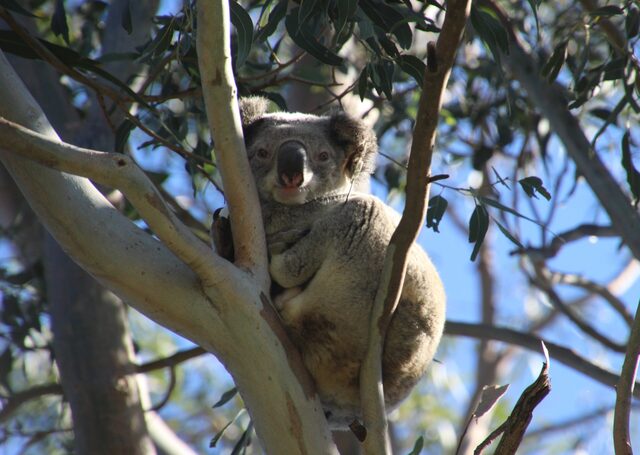
Redland City Council has become the first local government in south-east Queensland – and within the koala’s federally-listed northern endangered range – to report stabilisation of its city-wide koala population.
Independent analysis by both the University of the Sunshine Coast and Griffith University showed there was no evidence of continued population decline since 2018.
Mayor Jos Mitchell said the data referred to was an indication of the positive work being done by Council.
“Council’s officers have advised me that the investments made by Redland City Council in science-based conservation, innovative technology and community engagement and education have contributed to a stabilised population at this time,” the Mayor said.
“Council’s investment and strategic partnerships, along with the work being undertaken by our committed community in Council’s Koala Conservation Program initiatives such as Redlands Coast Koala Watch and Koala Safe Neighbourhood, have played a pivotal role.”
The Mayor said, despite positive signs, the Redlands Coast koala population remained vulnerable.
“There is an estimated 350 to 500 koalas on the mainland, facing threats such as urbanisation, habitat fragmentation, vehicle strikes, domestic dog attacks and disease,” the Mayor said.
“Increased state and federal government investment is needed to accelerate critical koala conservation work, including strategic habitat enhancements, advancing genetic connectivity and strengthening disease management.”
University of the Sunshine Coast Detection Dogs for Conservation co-founder Dr Romane Cristescu said the team had closely monitored the Redlands Coast koala population since 2018.
“Our work has included repeated population density surveys at more than 20 sites, three genetic surveys, over 1000 detection dog surveys, and genetic analysis of more than 1500 scats,” Dr Cristescu said.
“Our key findings show the estimated effective population size has remained stable since 2018, despite increasing urbanisation pressures.
“Chlamydia infection prevalence – an escalating threat across Queensland – has also remained unchanged, though it continues to be the primary threat to Redlands Coast koalas.
“Importantly, signs indicating genetic erosion observed in 2018, compared to the 2006 Redlands Coast koala population, have not been detected when comparing 2018, 2021 and 2024 genetic surveys.”
Griffith University Senior Research Fellow Dr Douglas Kerlin from the Applied Transport Ecology Group said his team assessed available koala hospital care records and sightings data as a proxy measure to assess trends or changes in the Redlands Coast koala population from 2013 to 2024.
“Since 2020, there has been a significant increase in the number of koalas entering care alive, receiving treatment and successfully being released back into the wild, allowing them to continue contributing to the population,” Dr Kerlin said.
“We attribute this positive trend to heightened public awareness, facilitated by Council’s Koala Conservation Program initiatives such as Redlands Coast Koala Watch and Koala Safe Neighbourhood.
“While there is evidence of recent population stability, koala abundance on Redlands Coast remains severely diminished compared to the 1990s.
“The population remains at risk, particularly from major random events such as drought, flood or bushfire, which could easily send this population into a downward spiral.”
Environment Portfolio representative Cr Julie Talty said the reported stabilisation reflected the work undertaken by Council since 2018 to address threats facing koalas.
“We know that disease and fragmentation in urban areas are the main threats and our programs since 2018 have been tailored to track and treat ill koalas,” Cr Talty said.
“To this extent, Council’s koala conservation program has established strategic research partnerships with four universities to integrate cutting-edge science and technology into conservation efforts.
“This includes groundbreaking work on koala food tree nutritional ecology and seed propagation, koala genetics and disease monitoring, and strategies to reduce road mortality.
“Council has also championed using technology and applied science such as Bluetooth koala ID tags, drop-off high-fix GPS collars, koala scat detection dogs and AI-powered koala recognition software.
“The work of our community has also played a pivotal role in this success, with residents empowered to become active custodians of their local koalas through initiatives such as Koala Safe Neighbourhoods, Redlands Coast Koala Watch and citywide campaigns during dispersal and breeding seasons.”
The Mayor said Council remained committed to ongoing work.