by Bruce Rowse*
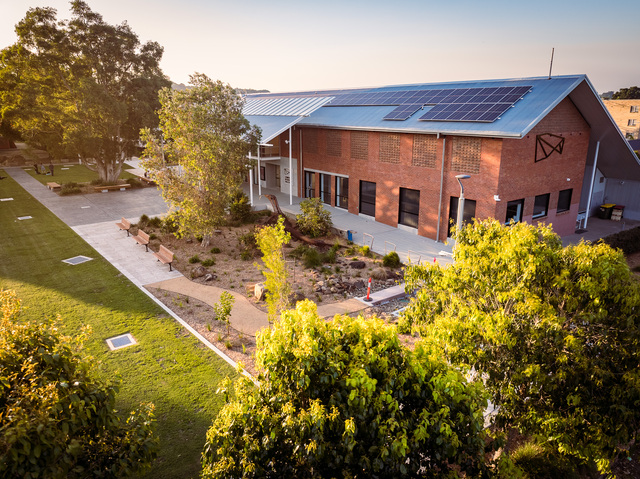
A zero net energy office building is one that consumes no net energy. It is an office that uses very little energy and has some form of renewable energy onsite to generate all the power it requires.
For a single storey building keeping office energy consumption to 100 kWh/m2 is not hard, and in fact I have audited quite a few small offices that are nothing special but only use in the order of 100 to 120 kWh/m2/year.
With ‘low cost’ solar technology – presuming little or no shading – its now possible to get around 100 kWh of energy per year per square metre of solar panels in southern Australia and more in the north. It is therefore now possible to have a single storey zero net energy office building.
However, possible does not mean affordable – a grid connect solar system costs in the vicinity of $700 to $1,000 per square metre, which is pretty expensive, so there are very few zero net energy offices in existence. With aggressive energy conservation and use of off the shelf technology like skylights, single storey office energy consumption can be kept even lower than 100 kWh/m2.
For example, we are energy police in our slightly shaded office and use only 30 kWh/m2/year. We could make it energy neutral now just by covering around half of the roof in solar panels. But that is still very expensive.
Technological advances, however, are happening rapidly and I believe that by 2020 a zero net energy lowrise office may be affordable. And importantly this should be achievable by retrofitting an existing office building, with no need to especially construct a new building.
Some of these technological changes are:
- emergence of LED lighting – if efficiencies
and prices keep improving at current rates, by
2020 LEDs should be more than twice as
efficient as the best lighting today (fluorescent),
with further savings from improved control - computer efficiency improvements – with thin
client architecture, high efficiency monitors
and server virtualisation, by 2020 office IT
systems could be using around 20 per cent of
the power of a typical office of today - heating, cooling and ventilation (depending on
climate) – many gains will come from being
more intelligent with the movement of air,
heat and cold. Coupled with improved control
and the emergence of retrofit building
materials to improve thermal mass, insulation
and sealing and to control heat gain, we
should be able to have offices using 10 to
20 per cent of the energy currently typically used
for heating, cooling and ventilation - reduction in the energy consumption of
miscellaneous loads, such as fridges, office
equipment, hotwater services, with energy use
potentially around one third to half of
current.
This will result in total office energy use of around 30 kWh/m2/year. Add to this aggressive energy conservation and occupants should be able to get down to about 15 kWh/m2/year.
At current trends we can assume that solar panel efficiency will be more than double current efficiency and the installed price per watt of a grid connect system one third of the current cost. This will provide, say 260 kWh/m2/year at a cost of say $500 per square metre.
A single storey unshaded office where aggressive energy conservation is practised will then need only around eight per cent of its roof covered with solar panels. A three storey half shaded office building would need most of its roof covered.
It should be possible to have a seven storey building energy neutral if not shaded and the roof is covered with solar panels. Of course if additional solar panels can be added to walls it should be possible to get even taller energy neutral buildings, depending on shading.
By 2020 the net zero energy lowrise office building should be easily affordable, and in fact it may well be standard good financial practice to convert existing office buildings to energy neutral ones. So even building owners with no interest in acting to slow climate change will have energy neutral buildings. And most lowrise office buildings then – whether they are 100, 50 or one year old – could be energy neutral.
I say “should” and “may” because I have assumed significant technological advancement and lowering of prices. As more of us demand better energy performance from our buildings I believe that this will continue to spark the innovation needed to make zero net energy office buildings commonplace.
You can help make this a reality by acting now to make your buildings more efficient. Do what is affordable now. Then repeat regularly, as technology is now advancing quickly.
Local Government can play a leadership role that will help create the demand that will drive the innovation that will create the technology that will make energy neutral buildings commonplace.
*Bruce Rowse, energy efficiency engineer, is director of CarbonetiX, an engineering consultancy specialising in carbon reduction. Contact Bruce on 0438 878 311 or post a comment on his blog at www.carbonetix.com.au/blog