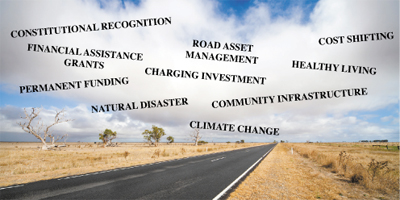
The Australian Local Government Association (ALGA) has identified 10 national issues of priority for local government in 2013 that reflect the challenges and concerns of the sector and provide a platform for advocacy and leadership at the national level.
1. Constitutional recognition of local government
In 2012, the Federal Government responded to ALGA’s request for a parliamentary committee to consider the timing of a referendum on the issue of constitutional recognition of local government and the wording of the constitutional amendment by establishing a Joint Select Committee on constitutional Recognition of Local Government.
The Committee will be conducting public hearings in early 2013 and ALGA, state and territory governments and state and territory local government associations are expected to appear.
ALGA acknowledges the need for support from all sides of politics to ensure the best chances of success for a referendum proposal and the Association is seeking to ensure that all parties support direct funding of local government.
2. Financial Assistance Grants and financial sustainability
2013 will be a significant year for the issue of local government finance, with the first phase of the long-needed Commonwealth review of the Financial Assistance Grants (FAGs) system underway.
There is hope that this review will trigger the conversation about the true financial situation of councils across the country and the various imbalances that have emerged during the past two decades.
Local government is facing increasing demands for its resources while, at the same time, has seen the proportion of funding that comes from the Commonwealth drop by almost 30 percent in the last 15 years. This is a genuinely unsustainable situation in the long-term and if this review is to have a significant impact, then the discussion about under-resourced councils has to be had.
3. Permanent funding of the Roads to Recovery Program
Local government roads make up more than 80 percent of the national road network and have an estimated value of many tens of billions of dollars. For many councils, especially those in rural and regional areas, expenditure on roads is their largest single outlay. For this reason, councils rely heavily on the Australian Government’s Roads to Recovery (R2R) program, which provides direct funding to local government for local roads. The R2R program is currently funded to 2019 at a rate of $350 million per year.
Research commissioned by ALGA in 2010 indicated that current levels of expenditure would need to increase by an average of $1.2 billion per year to avoid deterioration of the local road network. In 2006, the results of a study undertaken by PricewaterhouseCoopers found that the potential aggregate backlog for all Australian local councils was approximately $14.6 billion, with an annual sustainable funding gap of $1.1 billion.
ALGA will be advocating for increased and permanent funding under the R2R program to provide certainty to local governments in maintaining local roads to the standards necessary to ensure transport safety.
4. Natural disaster arrangements
Natural disasters are occurring more frequently in Australia with more severe and longer-term consequences, resulting in significant economic, social, environmental and political impacts on communities.
Local government has been a strong supporter of the Natural Disaster Relief and Recovery Arrangements (NDRRA), under which the costs of restoring government infrastructure are shared across the levels of government, with the Commonwealth committing to meet up to 75 percent of those costs. However, given the extent of recent natural disasters, it is unlikely that the current NDRRA arrangements will adequately assist councils with the restoration of local infrastructure.
To this end, ALGA has argued that more needs to be done in the areas of mitigation and establishing and implementing a national disaster recovery capability to assist local government to support communities in their recovery. In 2013, ALGA will continue to advocate for a dedicated program for local government to help build resilience.
5. Road asset management
Local government owns and manages billions of dollars worth of public assets in local roads and transport infrastructure. To assess the management of these assets nationally, ALGA has published a pilot study into the feasibility of the compilation of a national report on local government assets.
The National State of the Assets Report is expected to be a crucial tool in assisting local government to assess the quality of local roads infrastructure, its functionality, and its capacity to meet community expectations and report on the long-term financial sustainability position of councils, particularly with respect to the maintenance of local infrastructure.
ALGA continues to seek support from the Federal Government to assist councils to improve asset management by implementing a national reporting framework for councils to adhere to.
6. Heavy Vehicles Charging Investment & Heavy Vehicle Regulator
ALGA plays a key role in a range of government initiatives related to roads and transport infrastructure where there is likely to be an impact on local government. Such initiatives include a new national Heavy Vehicle Regulator regime, which is to take effect in January 2013, and the work associated with the Heavy Vehicle Charging Investment project that is progressing under the auspices of the COAG road reform agenda.
While trucks are recognised as an essential element of Australia’s economic system, they can cause problems related to safety, noise and pollution. About 75 percent of all freight is carried by road and the total freight task is estimated to almost double by 2020.
ALGA and state and territory associations are currently working with ARRB Group Ltd and the Heavy Vehicle Regulator to develop systems of support to assist councils to manage local roads assets effectively.
ALGA is also working through the Ministerial Standing Council for Transport and Infrastructure to ensure that funding from road pricing reforms flows appropriately to local government in order to maintain roads used by heavy vehicles.
7. Climate change adaptation
Climate change and adaptation measures will be a key focus for ALGA in 2013. Local government activities that are likely to be directly impacted by climate change include planning future developments and road infrastructure, which will be affected by sea level and water table rises and storm surges.
Councils responsible for past development decisions that have since been affected by climate change, including coastal erosion and inundation, may now be at risk of legal action. In some states, councils are protected from legal action relating to past development decisions, but in others they are not.
ALGA has engaged the help of legal firm Baker & McKenzie to undertake an examination of these protections. Their recommendation was to use the Council of Australian Government (COAG) process to ensure all councils across the country are given the same level of legislative protection.
In 2013, ALGA will continue its work through COAG to develop a national standard to protect councils from legal liability for development decisions made on best-advice and in good faith.
8. Community infrastructure
In addition to roads and transport infrastructure, local government is responsible for the maintenance of more than $12 billion in community infrastructure.
Well-located, well-designed and properly maintained community infrastructure helps to produce better quality outcomes for Australian communities and facilitates social inclusion. It also helps to achieve other important social and regional policy outcomes, including attraction and retention of skilled workers, healthy living, social cohesion and enhanced social capital and learning opportunities.
ALGA continues to urge the Australian Government to provide further local government community infrastructure funding. In the 2011-12 Budget submission, ALGA argued that local government required at least $300 million per annum over the next four years. This would assist local councils to plan and deliver adequate and appropriate community infrastructure across all areas of Australia and enhance their resilience in the face of less favourable economic conditions.
9. Healthy living initiatives
The Planning Institute of Australia (PIA), the National Heart Foundation (NHF) and ALGA formed a unique collaboration to develop a national planning guide to encourage the design and development of built environments that foster physical and mental health and general wellbeing outcomes for all Australian communities.
The planning guide includes practical tools, case studies and guidelines to support relevant professionals such as planners, engineers, architects and decision-makers alike to implement the ‘healthy spaces and places’ planning and design principles. The initiative is supported with funding from the Commonwealth Department of Health and Ageing.
Given the Australian Government’s constructive leadership in health policy, and its desire to address the significant pressures on the public health budget caused by illness, obesity, diabetes, cardiovascular disease and pollution, ALGA believes that further funding from the Commonwealth for healthy spaces and places would align well with other whole-of-government policy initiatives, and would be a prudent investment of Commonwealth funds.
10. Cost shifting
ALGA is pursuing a revised Intergovernmental Agreement with the Commonwealth, state and territory governments outlining principles guiding intergovernmental relations on local government matters to address cost impacts of Commonwealth and state and territory government decisions on local governments within each jurisdiction.
In 2006, ALGA signed an Intergovernmental Agreement with the federal and state and territory governments following a recommendation from a report into fair and responsible local government produced by the House of Representatives Standing Committee on Economics, Finance and Public Administration.
The Intergovernmental Agreement was due to be reviewed in 2011. Local government ministers met in 2011 and discussed the review and agreed on a process to take the matter forward.
ALGA will be advocating for a strengthened
Agreement as local government is increasingly being required to undertake roles and responsibilities on behalf of other levels of government and the Agreement is an important vehicle to ensure that councils are appropriately resourced to undertake additional functions.