Home » Risk in an asset’s lifecycle – By John Hunter*

Risk in an asset’s lifecycle – By John Hunter*

Risk and asset management commences during an asset’s pre acquisition lifecycle phase, that is the concept, design, procure, construct, commissioning and handover activities, rather than when an asset is handed over.

Early risk identification can improve an asset’s functionality and reduce future operating and maintenance costs. After pre acquisition, many future risks and costs are locked in.

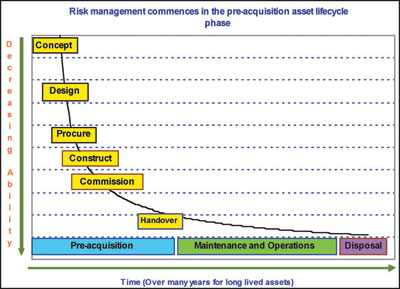
The activities are shown in the graph. A summary of risks in these activities are:

  • Concept – A non asset solution may be more suitable and beneficial in terms of cost, maintenance, service delivery and risk to deliver the required service
  • Design – A well designed fit for purpose asset may prevent an expensive retrofit to correct defects after an asset is handed over and operational
  • Procure – It is important to avoid risks such as dealing with disreputable manufacturers, poor quality assurance practices, lack of spare parts with long lead times
  • Construct – This may include confirming the constructor’s financial stability, such as the bankruptcy of a builder has the capacity to derail projects and to add future costs
  • Commissioning and handover – It is important to identify and rectify commissioning issues.

Asset functionality may become locked in during pre acquisition, sometimes being irreversible and ultimately affecting an asset’s:

  • capability – to provide the required services
  • capacity – to facilitate ramp up in capacity
  • efficiency – to provide efficient service delivery, performance and output
  • quality – to minimise work health and safety issues with back up support from the constructor
  • reliability – to provide consistency under the planned maintenance schedule.

The costs to rectify potential performance and functionality issues of an asset in its pre acquisition phase could also be plotted – in most cases this could be an upward sloping line in the graph (with costs on the Y axis).

Depending upon the asset, the gradient of the cost line would increase as irreversible processes are applied and in most cases, the gradient will reduce after an asset’s handover and acceptance.

If the asset is damaged during the operational phase, the gradient of the cost line would rise again.

*John Hunter is the Asset Policy and Governance Coordinator at the City of Brisbane.
 

Digital Editions


  • Lockyer send flood expert north

    Lockyer send flood expert north

    Lockyer Valley Regional Council has answered the call for assistance from a community impacted by Ex-Tropical Cyclone Koji, with a staff member from Council’s Disaster…

More News

  • Lockyer announce Scott Greensill as CEO

    Lockyer announce Scott Greensill as CEO

    Lockyer Valley Regional Council has appointed Scott Greensill as its new Chief Executive Officer. Councillors formally approved the appointment of Mr Greensill at a Special Meeting of Council in February.…

  • Myers resigns for health reasons

    Myers resigns for health reasons

    Wollongong’s Councillor Tiana Myers has resigned, as a Ward Three Councillor for City Council due to health reasons. Cr Myers was elected to Council in 2024 with a focus on…

  • Acknowledging women’s role in councils

    Acknowledging women’s role in councils

    Council representatives from across the state gathered in Sydney today for Local Government NSW’s (LGNSW) International Women’s Day event. Mayor Darcy Byrne, President of LGNSW, said the event was an…

  • Kylie Davies beats strong field

    Kylie Davies beats strong field

    Flinders Shire Council is pleased to announce the appointment of Kylie Davies as its new Chief Executive Officer. Ms Davies will start in the role on 13 April following a…

  • Leaving on a high

    Leaving on a high

    Mount Alexander Shire Council’s Chief Executive Officer Darren Fuzzard will end his tenure at the council in July 2026, marking ten years of service to the organisation and community. Mr…

  • Safety first for transport corridor

    Safety first for transport corridor

    Traversing a major Townsville transit corridor spanning three suburbs will soon be safer for motorists, cyclists and pedestrians, with Townsville City Council commencing a $3.8 million upgrade of Hugh and…

  • Creating long-term employment pathways

    Creating long-term employment pathways

    The Shire of Carnarvon is creating long-term employment pathways and strengthening workforce capability through its participation in the Remote Jobs and Economic Development (RJED) Program, a national initiative designed to…

  • Cool summer plan for Campbelltown

    Cool summer plan for Campbelltown

    Extreme heat is the biggest killer of natural disasters in Australia, exceeding that for any other environmental disaster combined, including floods, storms, bushfires and cyclones. While high temperatures pose risks…

  • Bathurst has it’s scrap together

    Bathurst has it’s scrap together

    Bathurst Regional Council has successfully concluded its ‘Let’s Get Our Scrap Together’ campaign, launched on 1 September 2025 with funding from the NSW Government and delivered in collaboration with NetWaste…

  • Baw Baw acting CEO tenure extended

    Baw Baw acting CEO tenure extended

    Baw Baw Shire Council has extended the contract of Acting Chief Executive Officer Sally Jones until 30 June 2026. The matter was considered as a confidential item in the late…