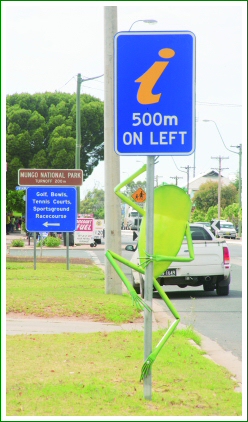
Balranald Shire – a gateway to spectacular national parks
Balranald Shire covers approximately 21,400 square kilometres and includes Balranald, the township of Euston and the localities of Kyalite, Oxley, Hatfield, Clare and Penarie. It is situated between Hay and Wentworth Shires in the Western Division of Outback New South Wales. The Shire’s major business centre, Balranald, is located 440 kilometres northwest of Melbourne on the Sturt Highway.
Balranald
A riverfront oasis surrounded by saltbush and mallee plains, Balranald was the original settlement on the lower Murrumbidgee River.
In 1830, Captain Charles Sturt and his party became the first Europeans to pass the site and in 1836 Major Thomas Mitchell and his party stopped in the area.
Commissioner for Crown Lands and a Scotsman from the small town of Balranald in the Outer Hebrides, George James McDonald, named the area ‘Balranald’ in 1847/48.
The third exploring party was Burke and Wills, who crossed the Murrumbidgee on 17 September 1860 and camped in front of the Balranald Inn.
With the advent of Cadell’s ‘Lady Augusta’ and Randell’s ‘Mary-Ann’ in 1853, the river steamboat trade commenced and Balranald became an inland paddle steamer port.
Several historic buildings of the former port are now incorporated into the town’s Heritage Park, including the start of the town’s Heritage Walk.
Today, with a population of 1,300 people, Balranald is a thriving service centre for traditional pastoral activities, along with viticulture and horticulture reliant on Murrumbidgee water.
Increasing tourism opportunities are evolving through the Shire’s two local national parks and World Heritage Area.
The red gum industry is the biggest employer in the area. Most red gum is cut from regrowth forest that evolved along the Murrumbidgee after first settlement, and is used for firewood and sleepers.
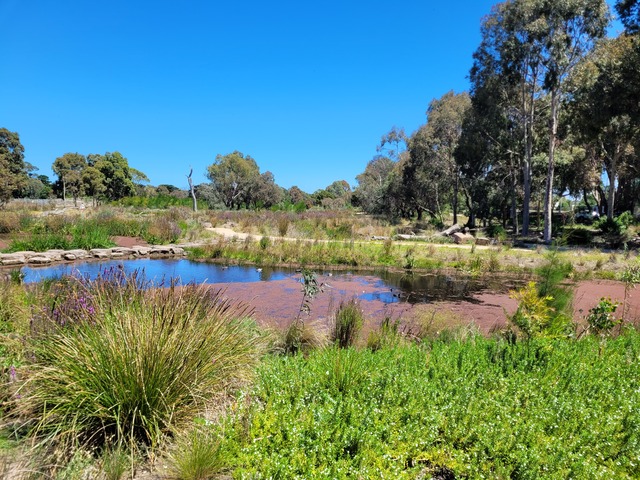
Located on the southwest corner of the lower Murrumbidgee floodplain, the Balranald Common Bird Trail has remnant black box, red gum and lignum vegetation habitats and is an ideal place to see the unique local bird life.
Euston
Euston is located 80 kilometres west of Balranald along the Sturt Highway on the banks of the Murray River.
The Euston Club stands on the site of the original Shailer Hotel.
Prior to the opening of an old lift bridge in 1924, which was recently replaced by a new two lane bridge, a punt ferried people across the Murray River from this location.
River barges carrying hundreds of bags of wheat and bales of wool from outlying stations would stop at the site of Berrits Park.
Weir Lock 15, located downstream from Euston, includes a fish ladder, enabling migratory fish species to navigate the dam. A series of small pools, each slightly higher than the one below it, simulates the flow of a natural river. Driven by instinct, fish leap from one pool to the next
until they eventually bypass the dam entirely.
The Weir Lock can be reached via bush tracks from Euston or through a parkland setting from the Robinvale southern side of the river.
The lock was built in 1934 and allows passage for paddle steamers and houseboats.
The Euston Court House was established in the early 1850s. It was recently restored and is a credit to those involved in its restoration.
Approximately 13 kilometres east of Euston is Lake Benanee. The lake is fed by the Murray River and provides an idyllic setting for motor homes and caravans, which park on the foreshore reserve year round.
Mungo National Park and Willandra Lakes World
Heritage Area
The acclaimed Willandra Lakes World Heritage Area is located northwest of Balranald.
At the centre of this series of dry lake beds is Mungo National Park – famous for an amazingly eroded dune named the ‘Walls of China’ by early Chinese workers who built dams and woolsheds for early pastoralists.
Aboriginal occupation of the area extends back at least 50,000 years.
Artefacts and remains have been well preserved among sediments in and around the lake beds of the region’s major ancient lake systems.
Fossil records suggest an interaction of the Aboriginal population with an environment that underwent rapid change as the lakes filled, reached peak capacity, intermittently drained and filled, and then finally dried out in response to climatic changes.
They buried their dead in the sand dunes, with the oldest funeral ceremonies recorded in the world, cremating and then covering the deceased with powdered ochre.
The traditional owners of the land include the Mutthi Mutthi, Paakantyi and Ngyiampaa Tribes.
Some 40,000 years ago the Willandra Lakes area was a Garden of Eden, a lush paradise teeming with wildlife. Now it is a parched semi desert landscape attracting many visitors from around Australia and the world.
Yanga National Park
Yanga Station was originally taken up by William Charles Wentworth circa 1843. He named it ‘Tala’ as the original property included Lake Tala as well as Yanga Lake.
Approximately 15 kilometres in circumference when filled, Lake Yanga is fed by the Murrumbidgee River.
Yanga Station covered approximately 210,000 acres and was the largest privately owned station in the southern hemisphere.
Yanga homestead was built around 1870 by the new owner, Dr (Sir) Charles Nicholson, for the station manager.
Located 10 kilometres southeast of Balranald, the homestead is Georgian bungalow style with typically 1830s and 1840s features. It is situated on a rise looking eastward over terraced gardens and Lake Yanga.
Yanga is recorded as being the first private property in Australia to have a telephone.
Installed by the nephew of Alexander Graham Bell, the telephone line was connected between the shearing shed, the men’s living quarters and the homestead.
Yanga Station was purchased by the New South Wales Government in 2005 and proclaimed a National Park in March 2007.
The National Park includes approximately 140 kilometres of Murrumbidgee river frontage and 17,000 hectares of red gum forest, as well as wetland areas and significant wildlife habitat.
The New South Wales Government has indicated that refilling Lake Yanga is considered a priority.
Initially limited areas of the National Park are expected to be opened to the public around September this year.
Economic development and tourism
People are attracted to retire, settle or return to Balranald because of the facilities and infrastructure already available. This is creating opportunities in the Aged Care industry.
Council has also approved several major development proposals for Euston, which will support the extension of the horticulture sector. Most are extensions of Management Investment Scheme developments in the Robinvale area.
Extensive mineral sand exploration is also taking place in Balranald Shire, with mining likely to commence in five to ten years.
Council’s Tourism and Economic Development Committee is using the significance of the Willandra Lakes World Heritage Area, Mungo and Yanga National Parks and proposed Aboriginal cultural developments to attract more visitors.
Council recently approved development plans for a sixth motel in Balranald and invested in a new swimming pool and cabins at the Balranald Caravan Park.
A new, Five Rivers Fishing Trail brochure, is also promoting the local Lachlan, Murrumbidgee, Murray, Wakool and Edward rivers to keen fishing folk.
These efforts are being supported through Council grants to four local fishing clubs, to maximise dollar for dollar funding for native fish restocking.
Balranald’s medium term planning includes the construction of a new Interpretation Centre, which will act as a window on the Shire’s two national parks, World Heritage Area and broader Aboriginal heritage. It will also provide information on bird life, local organic farming and the presence of the endangered Southern Bell Frog on the Lowbidgee wetlands.
The frog story
The Southern Bell Frog (Litoria raniformis), also known as the Growling Grass Frog because of the sound of its call, was once widespread and abundant. It is now listed on the New South Wales Endangered Species list and its distribution in the State is restricted to a few areas along the Murrumbidgee and the lower Murrumbidgee floodplain around Balranald.
The large, handsome frog lives in semi permanent wetlands and is closely related to the Green and Golden Bell Frog, which halted work on the Olympic Village at Homebush Bay.
In response to local recognition of this frog, an increasing number of frog sculptures can be found in Balranald and outside the Balranald Visitor Information Centre.
The Visitor Centre also has a large number of frog souvenirs for sale.