In lead up preparations to our Centenary of Federation celebrations it became evident how little people knew about Federation and our system of government. A positive spin off is that situation seems to have been rectified. Many more people can now name our first Prime Minister, are likely to have some knowledge of the Constitutional Conventions leading up to nationhood and that the new Federal Parliament first sat in Melbourne for a number of years before moving to Canberra.
People are aware that the nation was formed with the six Colonial Governments agreeing to give up some of their powers so a new Commonwealth or Federal Government could be established. It is probably less well known that the original intension of our constitutional founders was that the Colonial, now called State Governments, would retain the bulk of the powers and the dominance, while the fledgling Commonwealth Government would control only a few areas deemed to be of ‘national’ interest.
However, over the last century, largely as a result of High Court decisions and, to a lesser extent, some referred powers from the States to the Commonwealth, the notion of strong States and a weak Federal Government has well and truly been reversed.
Moreover, in any discussion about ‘over’ government, too many tiers or duplication, the finger of redundancy is usually pointed at the State Government level.
Although State borders have become less important, it was interesting that at the Federation Parade, in Sydney last New Years Day, there was only one float representing communities on a cross state border level. Eight Councils from New South Wales and Victoria had joined forces to create the very colourful Albury Wodonga Region float.
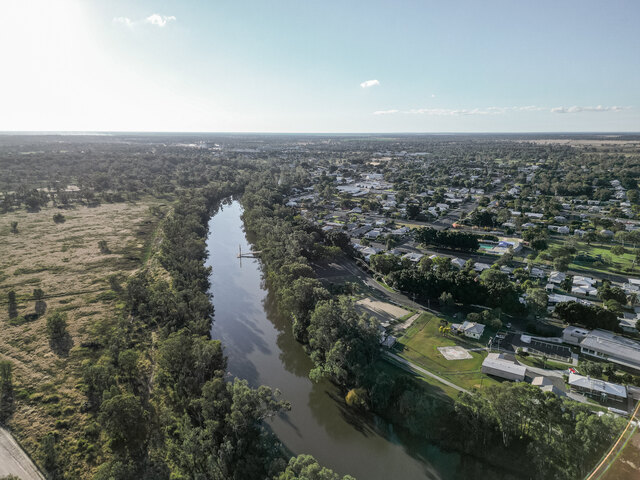
National attention is again focused on this region as moves are afoot to merge this area’s main population centres, Albury (43,000 residents) and Wodonga (32,000), into what would be our first cross border Local Government unit.
Such a merger has been raised numerous times in the 150 years since Victoria and New South Wales separated. However, as Local Government remains under the legislative control of State Governments, for a cross border municipality to be formed, the two relevant State legislatures would need to agree.
The Victorian and New South Wales Governments have now instigated a process to bring about such a merger. They are to be congratulated on this, but at the same time they must ensure that there is strong local involvement in both the process and deciding the final structure of what has been deemed Australia’s first ‘regional city of national standing’.
As planner and futurist, Steven Ames, asserts, the key to the success of change is to ensure all stakeholders sponsor the process (refer page 16). He says by gaining the permission of the community to have the dialogue, you will have belief in and ownership of the outcomes.
Although community consultation is soon to commence in Albury Wodonga, some mending of bridges is already required, as many local people feel that to date they have not been party to the merger decision.
Care must be taken so that the merger is not seen as being forced by the two State Governments. Lessons from the recent failed Republic referendum should not be ignored, that is, in spite of the majority of people being in favour of a change to our own head of state, because they did not like the model proposed, they voted ‘No’ in their droves.
In the Albury Wodonga situation, the two State Governments have the legislative power to force through this change, but if local people are not supportive of this, or the model adopted, the full benefits and opportunities of such a merger will not be realised.