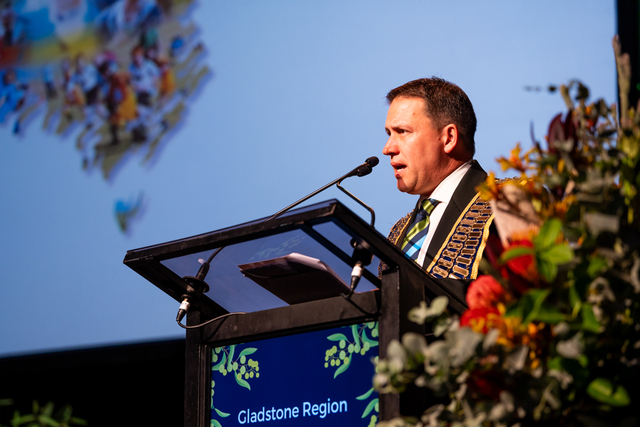
In each edition we feature the views of a Local Government Association President. The following is from Councillor Mike Montgomery, President of the Shires Association of New South Wales.
The momentum generated at the 2002 National Local Roads Congress in July at Toowoomba is continuing with Councils across Australia still pushing the Federal Government as hard as ever to urgently fund improvements to our rural roads. We all know that without an adequate transport system our communities, cities, towns and regions cannot survive.
The road system in regional and rural Australia is an example of the conflict we are all experiencing between globalisation and localisation. At the local level, the evolution of land use from grazing to cropping and increased export production has dramatically impacted upon the use of our roads. The standard of these roads directly influences our global trade competitiveness.
Failure in the regional road network means that agricultural, mining and timber products do not get to the railway or airport on time, if at all. The flow on effect of this is increased costs to primary producers, and barriers to wealth creation in regional areas and the nation.
What the roads congress showed clearly was that it remains up to Local Government to be responsible for providing efficient and effective transport solutions to our communities. Local Government is responsible for 84 per cent of the total length of road in Australia. Sixty per cent of the national road system is not sealed, and most of this system is maintained by Councils. The efficiency of the road network also impacts on education, healthcare and social services, all basic aspects of our society. That is why empowerment and control at the local level is so important. And that is why Councils are so passionate about roads and road funding.
As Chair of the newly formed ALGA Roads and Transport Advisory Committee, immediate priorities will be AusLink, a national land transport plan, continuation of the Roads to Recovery program and development of a national asset management framework. We are pleased that the Australian Transport Council has agreed to consult with Local Government prior to development and release of the Green Paper outlining the framework for AusLink. This additional consultation is likely to result in a later release of the Green Paper than anticipated, expected to be mid to late October.
AusLink presents a number of issues and concerns for Local Government. There is no guarantee that Roads to Recovery and Black Spot Program funding will continue in the current form. It is possible that the Commonwealth will seek to roll them into AusLink. This may mean that future funding would target strategic transport outcomes as opposed to the current formula based approach of Roads to Recovery. Councils may have to justify and compete for their funding.
What this means is that we must have planning processes, asset management strategies and a clear definition of our community’s needs and expectations to protect local road funding for Councils. For AusLink to work, there must be a major injection of funding into the land transport system. Local authorities are encouraged to make submissions on the Green Paper.
Looking forward, there are certainly many challenges ahead for Local Government in the management of roads and transport infrastructure before the 2003 Roads Congress to be held in June at Kalgoorlie in Western Australia.
On a final note, the Shires Association of NSW and the Local Government Association of NSW jointly launched a new unincorporated joint venture, Lgov NSW, on 1 August. The introduction of Lgov NSW is a means of bringing the two Associations closer together with a cooperative body representing the common interests of both groups. It shows our commitment to raising the profile of Local Government in NSW, not only to other spheres of Government, but also to industry and the public.