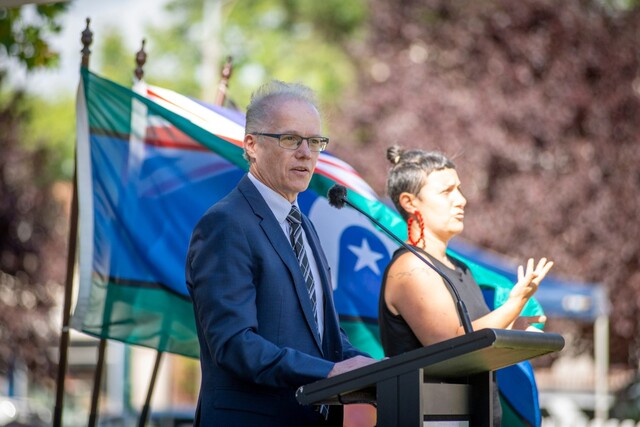
A regular feature this month profiling two Councillors fromthe Northern territory
Councillor Ed Ah Toy, Pine Creek Community Government Council, Northern Territory
Q. How long have you been on Council?
I was a member of the Pine Creek Progress Association for 30 years and President for 10 years. When Pine Creek Community Government Council was formed in 1987, I was elected as the first President. I held that position for two terms, then another two terms as Vice President.
Q. You must have seen incredible changes in the time you have lived at Pine Creek?
I was born in Pine Creek, in the building now known as the National Trust Museum, and all of my primary schooling was done in Pine Creek. My family was evacuated to Adelaide after the bombing of Darwin in 1942 and we moved back when the war was over. I returned to Pine Creek after completing High School in 1955 and have been here ever since. At that time there were no paved roads in town, no town power or sewerage, and a limited water supply. The town was a centre for pastoralists, crocodile and buffalo shooters, and the Northern Hercules Mine. Frances Creek Iron Ore Mine opened in 1966, and that brought a lot of people to town. Town power was finally connected in 1964 and brought an end to generators thumping through the night. A new Town Hall was built in 1973.
The Darwin wharf was destroyed during Cyclone Tracy in 1974 and that led to the closure of the Frances Creek Mine in 1975. The following year, the North Australian Railway closed, and Moline Mine was abandoned in 1978. Many people left the area and the town was in a downturn until 1985, when Pine Creek Goldfields opened a huge open cut mine to the west of town. The workers lived in Pine Creek and the population reached a high of 750 in the late 1980s. The 1990s saw a real boom in the town, with many new businesses starting up and sporting facilities established. New Council infrastructure was also being built. When Pine Creek Goldfields closed in 1995, the workers from the new Union Reefs Gold Mine moved into town to take up positions at that mine.
For nearly 20 years, the town went through an economic boom, many houses were built and school numbers were high. Union Reefs mine will close later this year, and more than 150 people are expected to leave town, bringing our population down to around 300.
Q. What are the area’s demographics? Is the population changing?
Basically the economy is made up of mining, tourism and Government facilities. The population will change later this year when the mine closes. There were once 25 students on the bus to Katherine High School each day and now there are only four. Young people aren’t staying in the town after graduation and jobs are becoming harder to find.
Q. What are some of the challenges you’ve faced in Local Government?
Our biggest challenge has been the way the Northern Territory and Federal Governments are cutting back on funding, and the NT Government is pushing for the amalgamation of smaller Councils. As the population decreases, so does our funding, but we will have to maintain the services, facilities and buildings with a smaller budget.
Q. What are some important issues to you?
I want to see the long term economic survival of the town, its establishment on the tourist route, employment for everyone, and maintenance of the town’s existing infrastructure and roads.
Q. What are some unique issues facing your Local Government area?
There are a lot of small mining and pastoral leases in our area, but under current legislation we are unable to levy rates on them. A local Aboriginal community, although in our Council area, receives its funding separately and this leads to a duplication of services and administration.
Q. Does your Council play a role in managing Top End tourism?
The Council produces a tourist brochure each year, organises the annual Goldrush Festival, which includes the Northern Territory gold panning championships and the Didjeridoo Festival, and has now taken over the role of the now defunct Tourist Association.
Q. What are the key aspects of being a good Councillor?
You have to be able to devote the time and commitment to meetings and briefings, to listen to the residents and their views on local issues, and be able to see the wider picture and how Council’s responsibilities will change in the future.
Q. How do you foresee the future of Local Government in Australia?
Local Governments are taking on more and more of the State and Territory Governments’ functions, which places huge responsibilities on them. Smaller Councils may be forced to merge in order to reduce costs and duplication of services and plant and equipment.
Q. What qualities can young people offer Local Government?
Young people can bring new ideas and enthusiasm to Council, and their energy and commitment can infuse new life into weary Councillors.
Councillor Mary Walshe, Litchfield Shire Council, Northern Territory
Q. How long have you been on Council?
I am a relative newcomer to the Local Government arena. I was elected as Councillor for East Ward of Litchfield Shire in the Local Government elections of May 2000. I stood for President in a by election in August 2001 and this accidentally made me part of history in the NT, maybe Australia, when the ballot was declared exactly drawn. There was an additional bit of real rural intrigue surrounding the matter of a stolen ballot box too, but I was finally elected, with a clear majority and all the ballot boxes accounted for, at another by election in December 2001!
Q. What are Litchfield Shire’s demographics? Is the population changing?
The Litchfield Shire was proclaimed by an Act of the NT Parliament in September 1985, with an influx of residents moving out to the ‘sticks’ after Cyclone Tracy struck Darwin on 24 December 1974. The establishment package was designed around roads, rubbish and recreation and a flat rating system, which would provide minimum rates for minimum services, and the motto ‘Community Effort is Essential’. With an area of some 3,100 square kilometres, the Shire of Litchfield has as it boundaries the Adelaide River to the east, Channel Island to the west, the Darwin River and Manton River dams to the south and Gunn Point to the north. The western boundary butts onto that of the Darwin City Council and skirts around the then new town of Palmerston (now a City).
With a population of approximately 17,000 residents the Shire has maintained a growth pattern of over 6.5 per cent in the last 18 years. With a number of large subdivisions at planning stage and the availability of land, I believe this trend will continue. The population is vibrant, multicultural and has as the majority young families mixed with enough older blockies to maintain the laid back rural lifestyle. The majority of essential Government services are provided for in both the Darwin and Palmerston Cities, which are both in relatively close proximity.
Rural residential living, small scale agriculture and large scale horticulture, in particular mangoes and Asian vegetable crops for the southern and international markets, comprise the majority of the Shire’s utilised areas with large tracts of pastoral and open conservation areas. The Council is responsible for maintaining some 450 kilometres of sealed roads and approximately 240 kilometres of gravel roads. Both will steadily increase as new subdivision develop. To date over 66 per cent of the Shire’s roads have been sealed. In addition, we maintain seven large acreage recreation reserves, three rubbish transfer stations and one dump site within the Shire area.
Q. What are some of the challenges you’ve faced in Local Government?
The continual challenge of balancing the needs of the entire Shire with the urgent urban wants of a few and maintaining the efficient delivery of the services we provide throughout a rapidly growing Shire with a low rate base.
Q. What are the important issues to you?
People originally came out to the rural area to enjoy the rural lifestyle and to maintain a good quality of life with relative freedom from the shackles and restrictions which bound them in urban areas. Maintaining this rural lifestyle, yet balanced with the provision of the essential amenities, is the most important issue, not just to me but to all Shire residents.
Q. What are some unique issues facing your Council area?
The lack of responsibility for planning, as with all Local Government in the NT, drainage design around/through older subdivisions, the protection of waterways and wetlands and three distinct district centres. This Shire is unique in that it bounds and acts as an accommodation and residential base for a large proportion of the workforces of the Darwin and Palmerston areas. One of the nation’s largest Defence Force bases at Robertson Barracks lies within the Shire boundaries and road use and access are matters that frequently demand liaison.
Q. Does your Council play a large role in managing Top End tourism?
The Shire has a slowly developing tourism industry, mainly along the Arnhem Highway, the route to Kakadu National Park.
It encompasses Indigenous art and the production base for the tool of the Territory’s, maybe primary addiction, Barramundi fishing lures! We have tourist home stays, crocodile farms, fruit farms, several well established caravan parks and one of the major NT tourism icons, the Jumping Crocodile tours on the Adelaide River. All of these are supported and nurtured by Council.
Q. What are the key aspects of being a good Councillor?
To me personally, first and foremost, a Councillor has to be approachable and available to constituents from all walks of life and all ages. Also having the ability to put yourself in the shoes of your constituents and look at life from their angle, maintaining a sense of humour and proportion are the foundations of a good Councillor.
Q. What qualities can young people offer Local Government?
A fresh view of the future, which is going to be what they make of it, and the ability to learn from the mistakes or successes of their older predecessors, not repeating the former but building on the latter.