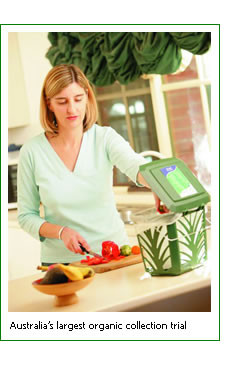
In an effort to reduce the amount of household organic waste going to landfill, 4,000 residents in the City of Burnside in South Australia are participating in a large scale organic waste collection trial.
“Approximately 54 per cent of Burnside’s municipal waste is currently recycled and diverted from landfill each year,” said Burnside CEO, John Hanlon. “But as a Council we are committed to continually improving our performance. The involvement of our residents and the outcomes derived from this trial may help shape the way organic waste is collected in South Australia in the future.”
The six month trial, which began last month, also aims to provide Council with an understanding of the community’s use and acceptance of new technology. While the system is already successful in Europe, this large scale trial will help fine tune the system to Australian conditions, and ensure any permanently introduced system is sustainable, effective and has community understanding and acceptance.
An extensive monitoring and auditing program will be used to gather data and feedback across all stages of the trial.
Each of the 1,800 households involved in the trial were supplied with a small ventilated bench top container called the Burnside Bio Basket and a supply of compostable liner bags. Made from biodegradable material based on cornstarch, vegetable oil and compostable polyester, the bags completely break down in approximately 30 days when commercially composted with other organic materials.
CEO of East Waste, Geoff Johnston, said that up to half the contents of an average household rubbish bin is food waste or organic material.
“If placed into landfill, this will break down without oxygen, producing unwanted leachates and greenhouse gases,” he said. “However, if extracted and composted, it can be used as a high nutrient resource that can enrich soils, reduce evaporation and conserve water.”
Throughout the trial, residents will put all waste items into the Burnside Bio Basket. Every two to three days, the bag is then tied off and placed into the household’s green organics bin for collection. All food and meat scraps, peels, bones, teabags, coffee grounds, egg shells, dairy products, hair, shredded paper, tissues and paper towels can be placed into the basket.
The expected cost of the trial is $170,000. Zero Waste South Australia is contributing $75,000, with Burnside Council, East Waste and Jeffries, a leading environmental company, all making significant contributions.
In the long term, Council plans to build a fully enclosed system treatment facility that will rapidly pasteurise, stabilise and homogenise the material. This will occur for a seven to ten day period before being placed into the open for further composting and screening. While a concrete plan for the compost has not yet been decided, it is likely that it will go out to local industries, with some available for Council reserves and residents.
For more information contact John Hanlon on (08) 8366 4205.