By Peter Diprose*
In the early 1900s Helen Keller, rendered deaf and blind at an early age, wrote, “Science may have found a cure for most evils; but it has found no remedy for the worst of them all – the apathy of human beings.”
In spite of increasing optimism in and acceptance of stormwater as a potential re-use resource, horror stories from stormwater practitioners still abound. A recent Stormwater Industry Association Bulletin article, “From Dirty Stormwater to Cleaner Waterways: In Three Easy Steps”, presented chilling information and revealing insights, counter pointing a letter asking if water sensitive urban design (WSUD) had lost the plot.
Until recently employed by a gross pollutant trap (GPT) Manufacturer, now by a cleaning contractor in a role that includes GPT maintenance I had expected my perspective to alter or change dramatically. In reality it has not – very little has changed from one side of the table to the other to alter my original perspectives. I have long advocated the need to implement the best available forms of stormwater treatment and maintain them rigorously. Representing a cleaning contractor I now find myself saying and doing virtually the same things all over again albeit with the emphasis on maintenance. Unfortunately, the basic advice provided in technical manuals like the Urban Stormwater and WSUD Guidelines regarding the need to implement stormwater treatment of one kind or another and maintain it rigorously to retain operational functionality still goes largely unheeded.
At a time when stormwater is hailed as the newest and hottest prospect for re-use, Michael Galloway’s statistics on stormwater quality in Manly sends a clarion call to all. Pollutant concentrations in waterways exceeding ANZACC Guidelines by factors of between two and 168 do not auger well for stormwater harvesting and re-use and it is unlikely that Manly is a case in isolation.
Why does it take the death of thousands of fish, scores of birds or the flooding of a village in South Australia to bring these issues to light and make us pay attention? Surely it isn’t institutional inertia and apathy? I frequently wonder if it would take so long to get the stormwater industry, Local Government and utilities responsible for stormwater attuned to stormwater pollution if they were subject to the regulatory and operating requirements of the USA and Europe.
When considering the effort, energy and capital expended to date on improving the quality of stormwater discharge such as the $80 million NSW EPA Stormwater Trust, the $22.5 million Victorian Stormwater Action Program and the over $1 billion funding under National Heritage Trust’s Coast and Clean Seas program, I wonder why so many seem to have difficulty getting stormwater treatment right.
My own experience and research suggest that there are a number of reasons for current predicaments:
o Changing the traditional view of stormwater from a disposal problem to a potential resource recovery opportunity is taking longer than expected because of institutionalised attitudes to stormwater. o Existing Council boundaries maintain the fiction that stormwater pollution is the problem of the end of line owner instead of a whole of catchment issue. o Seed funding may provide the impetus to get stormwater treatment on the agenda and on the map but it does not generally extend to cover ongoing maintenance requirements. o The words sustain and sustainable have become over exposed buzzwords – their true meanings largely ignored or forgotten. o Stormwater tends to be the domain of champions and there are too few champions around.
I believe much of the problem stems from a lack of focus and frequently to a general lack of cohesive approach by involved stakeholders when considering best whole of life stormwater treatment options, weighing capital and maintenance considerations against acceptable discharge quality.
Talking specifically about GPTs, when cost is the primary driver, I think it unlikely that many Councils ever achieve the levels of confidence required to make stormwater harvesting and re-use achievable. It has been demonstrated in the past that there are direct correlations between capital cost, performance quality and operating costs and they are broadly speaking – the lower the capital cost, the poorer the performance of the GPT, the higher the ongoing maintenance costs.
A good example of this is the side entry pit trap basket (SEPT). Studies in the 1990s indicated that SEPTs returned a 60 per cent removal of particulate larger than the smallest orifice at best and required minimum 10 day cleaning cycles to retain those efficiencies. Typically located under concrete lids weighing more than 30kg, cleaning SEPTs is a two man job. Vacuum cleaning is preferred to reduce OH&S risks like needle-stick injury. This seems neither an attractive option nor a good return on investment.
As an example, I am aware that one Council with 4,000 to 6,000 of these devices already installed seems trapped in an upward spiral of increasing operating costs. There are suggestions that the original cleaning rate of $15 each is to inflate to $45 each. That is a projected increase of 200 per cent on an original $90,000 per cleaning round!
Not knowing the specific cleaning frequency but assuming four cleans per year (which is fairly standard for GPTs) implies a prospective annual cleaning bill of $1,080,000. Chances are that pits are not being cleaned that frequently, in turn suggesting that they may not be overly effective in preventing pollution downstream of the catchments involved. In retrospect, had Council considered whole-of-life implications of these ‘low-cost’ GPTs it might have seen that there was no long term gain in it for them and chosen differently.
It is important, when considering costs, to note that the direction ‘lowest-dollar wins’ has equally disastrous results when applied to GPT maintenance requirements. Manly Council invested an additional $30,000 annually in street sweeping and GPT maintenance to meet viable, achievable stormwater harvesting goals.
Effective GPT maintenance regimens, implemented by diligent cleaning contractors can provide Councils with information necessary for reviewing polluting trends and implementing at source prevention strategies. Such strategies when nurtured and sustained can reduce pollutant loads and ongoing maintenance costs, improve stormwater quality and identify harvesting opportunities. In a regulated market where cleaning contractors operate under license and are subject to scrutiny by licensing authorities that would be the simplest of tasks.
In a society where lowest dollar wins customers ultimately lose because inconsistent and parsimonious approaches to GPT installation and maintenance result in poor performance and stormwater quality. It is a ‘no-win’ situation that is not sustainable where everybody involved and the environment looses.
Water is a precious and increasingly scarce commodity. It is high time we got serious about all aspects of stormwater treatment if we are to realise its true potential as a substitute for potable water in non essential applications.
It costs nothing to pollute it, yet it must be obvious to all that once stormwater is polluted it will cost something to render it fit for purpose again. We should be prepared to pay the going rate to achieve the best result. We accept treatment as a matter of course for sewage, why should stormwater be any different?
First principles would suggest that if we invest in effective measures for removing pollutants from stormwater, we must expect and be prepared to maintain systems in optimum operable condition to remain effective. To expect otherwise would seem ridiculous.
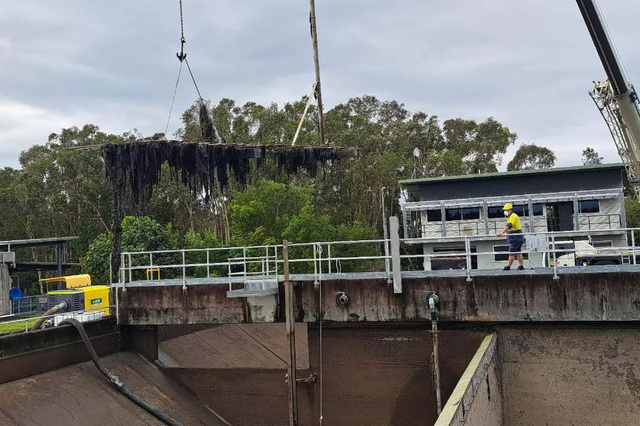
I frequently survey GPTs that are full to overflowing, un-maintained for long periods of time (some for two years and more) and quote to clean them. I reject the speculative suggestion that cleaning them less frequently, while expensive, is a better return on investment. It is true that significant quantities of pollutants can be removed in bulk for a relatively modest investment; what is unclear and can only be conjectured is what pollutant loads bypass or resuspend from full GPTs, escaping downstream to pollute the environments they supposedly protect or what the long term implications of that neglect are.
I find it difficult to be told that Councils cannot afford to maintain their GPTs in this or the next financial year because there are not enough funds in the budget. Why build or install counter pollution measures if you don’t mean to maintain or sustain them?
Any GPT if installed properly and maintained at optimum levels of efficiency and effectiveness can become an audit point for the catchment, presenting the owner with snapshot views of how the catchment functions.
Pollutants removed provide information needed to formulate strategies within catchments for at source pollution prevention and control. Monitoring changes in pollutant characteristics provides information on the effectiveness of the strategies and allows them to be fine tuned.
Publicised cleaning exercises provide Councils with opportunities to demonstrate to their communities that stormwater pollution is an issue that involves us all. This negative aspect of our society can be used to engage the community positively and educate them toward the need for behavioural changes to assist in pollution prevention.
We need to focus less on capital costs, cheaper and less frequent maintenance and more on desired outcomes – preventing stormwater pollution at source, changing community attitudes and behaviour, identifying and implementing harvesting opportunities – if we do that we may just achieve a sustainable outcome within a realistic and affordable timeframe.
* Peter Diprose is a past President, SIA Victoria, and Business Development Manager – Water Utilisation with Barry Bros Specialised Services Pty Limited.