Home » Victorian Councils tackle weeds

Victorian Councils tackle weeds

Victorian Councils have become more involved in weed management over the past three years, according to a new study by the Municipal Association of Victoria (MAV). Weed management is now seen as an important issue in rural and urban areas. More than half of Victoria’s 79 Councils are developing specific weed management strategies and one third adopting local laws to assist land managers.

The Local Government and Weed Management 2006 report was compiled by the MAV, with funding from the Victorian Government’s Tackling Weeds on Private Land Initiative. It has identified several barriers to weed control, including capacity and resource limitations, confusion over roles and responsibilities and few opportunities for information sharing between municipalities, State agencies, the community and industry.

Weeds cost Australia $3.9 billion a year in lost farm production. They are a significant threat to the environment – altering ecosystem function, contributing to land degradation, reducing amenity, and increasing fire risks and infrastructure maintenance costs. Responsibility for weeds rests primarily with landholders, but all levels of government have a weed management role.

The report identified several factors that influence Local Government participation in weed management, including Councils striving to be seen as good land managers, the level of commitment from Councillors and officers, community expectations and the availability of financial assistance.

Councils considered education more important than enforcement in driving a sustained behavioural change through community participation. They also felt local laws were an effective vehicle to address local weed issues and complement State enforcement responsibilities. Case studies were compiled to guide weed management activities, focusing on strategies to guide Council actions, community incentive programs, partnership approaches, mapping programs and local laws.

Targeting processes for successful project development and delivery, the case studies explore risk management, resourcing, implementation, monitoring and review issues. They also highlight examples of successful collaboration, innovative approaches and information sharing between all levels of government.

The Victorian weed management report will be available on the Municipal Association of Victoria website at www.mav.asn.au in July.
Digital Editions


  • Lockyer send flood expert north

    Lockyer send flood expert north

    Lockyer Valley Regional Council has answered the call for assistance from a community impacted by Ex-Tropical Cyclone Koji, with a staff member from Council’s Disaster…

More News

  • Lockyer announce Scott Greensill as CEO

    Lockyer announce Scott Greensill as CEO

    Lockyer Valley Regional Council has appointed Scott Greensill as its new Chief Executive Officer. Councillors formally approved the appointment of Mr Greensill at a Special Meeting of Council in February.…

  • Myers resigns for health reasons

    Myers resigns for health reasons

    Wollongong’s Councillor Tiana Myers has resigned, as a Ward Three Councillor for City Council due to health reasons. Cr Myers was elected to Council in 2024 with a focus on…

  • Acknowledging women’s role in councils

    Acknowledging women’s role in councils

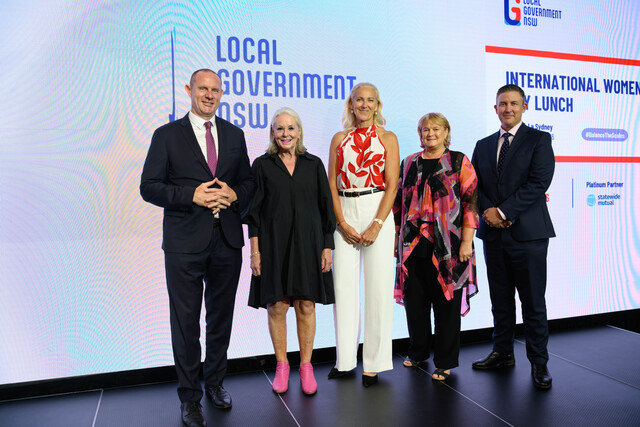
    Council representatives from across the state gathered in Sydney today for Local Government NSW’s (LGNSW) International Women’s Day event. Mayor Darcy Byrne, President of LGNSW, said the event was an…

  • Kylie Davies beats strong field

    Kylie Davies beats strong field

    Flinders Shire Council is pleased to announce the appointment of Kylie Davies as its new Chief Executive Officer. Ms Davies will start in the role on 13 April following a…

  • Leaving on a high

    Leaving on a high

    Mount Alexander Shire Council’s Chief Executive Officer Darren Fuzzard will end his tenure at the council in July 2026, marking ten years of service to the organisation and community. Mr…

  • Safety first for transport corridor

    Safety first for transport corridor

    Traversing a major Townsville transit corridor spanning three suburbs will soon be safer for motorists, cyclists and pedestrians, with Townsville City Council commencing a $3.8 million upgrade of Hugh and…

  • Creating long-term employment pathways

    Creating long-term employment pathways

    The Shire of Carnarvon is creating long-term employment pathways and strengthening workforce capability through its participation in the Remote Jobs and Economic Development (RJED) Program, a national initiative designed to…

  • Cool summer plan for Campbelltown

    Cool summer plan for Campbelltown

    Extreme heat is the biggest killer of natural disasters in Australia, exceeding that for any other environmental disaster combined, including floods, storms, bushfires and cyclones. While high temperatures pose risks…

  • Bathurst has it’s scrap together

    Bathurst has it’s scrap together

    Bathurst Regional Council has successfully concluded its ‘Let’s Get Our Scrap Together’ campaign, launched on 1 September 2025 with funding from the NSW Government and delivered in collaboration with NetWaste…

  • Baw Baw acting CEO tenure extended

    Baw Baw acting CEO tenure extended

    Baw Baw Shire Council has extended the contract of Acting Chief Executive Officer Sally Jones until 30 June 2026. The matter was considered as a confidential item in the late…