At the 2006 Local Government Managers Australia National Congress in Perth, FOCUS invited delegates to nominate individuals or teams from their Council who are improving their Council’s operations and meeting community needs. In this edition, we showcase the first two of our high achievers for 2006.
Paul Molan, Director Environmental Amenities, Manningham City Council, VIC
Manningham City Council is located just 12 km east of Melbourne’s CBD, yet many of its residents enjoy a sense of living ‘out of the city’. With plenty of bush, open spaces and views of the surrounding ranges, Manningham is defined by the natural boundaries of the Yarra River and Koonung Creek. At the same time, it has a thriving local economy serviced by more than 12,600 businesses. It is the job of Environmental Amenities Director, Paul Molan, to ensure strategic, environmental and economic planning works smoothly across the City’s diverse urban and rural areas.
Starting as a graduate design engineer at the former City of Doncaster in 1974, Paul Molan became the City’s subdivision engineer during the 1980s building boom, when the suburban fringes of Melbourne crept outwards. In December 1994, Doncaster joined with parts of the former municipalities of Templestowe and Lillydale to form the City of Manningham.
Paul Molan’s responsibilities include building inspections and surveying, heritage, health bylaws and economic, strategic and environmental planning.
Manningham Councillor, Patricia Young, nominated Paul Molan to appear in FOCUS because he is “an outstanding head of planning”.
“He is patient, able to meet and talk with residents in their language, always tries to explain regulations but also suggests alternatives,” she said.
But Paul Molan simply says: “I’ve been lucky enough to have some excellent staff working for me.” He attributes much of the City’s planning success to its Sustainable Design Taskforce, which gives applicants an opportunity to talk directly with Council and independent architects before an application goes to a Council meeting.
Since its inception six years ago, Council has had no planning appeals on grounds of urban design or sustainability.
“The opportunity is there for applicants to bring their proposal in at an early stage to run their questions past us and discuss any issues that may become problematic later on,” Paul said. “We’ve actually had some applications for subdivisions that have been changed around completely by this process in a way that keeps the applicant, Council and the public happy.”
Paul Molan’s department completed a Sites of Biological Significance study in 2004 to protect the municipalities green wedge areas. Council also runs land management courses for residents in rural areas to carry out improvements on their property.
“We’ve got a good network of open space in our City, which we’ve been improving in recent years,” he said. “We’ve been purchasing a lot of land around Mullum Mullum Creek and Ruffey Creek to create new bike paths and wildlife corridors.”
In stark contrast, Doncaster Shoppingtown – a large indoor complex located near the Council offices on Doncaster Hill – will double in size next year.
“Council’s Doncaster Hill Strategy is about creating a sustainable urban village,” Paul Molan explains. “We’re trying to encourage an active street frontage around a major intersection so that people will feel more comfortable walking around Shoppingtown. The entire food court will be brought to the front of the building so the cafes can be seen from outside.”
The strategy includes plans for 4,000 mixed use apartments, which will house 8,000 new residents. Council has developed an Activity Centres Strategy to ensure the survival of strip shopping centres in the face of an expanded Shoppingtown.
“It was always known that there would be a drop in retail activity at some of those smaller shopping centres,” Paul Molan said. “We have recently beautified the streetscapes and are focusing more residential development around those centres to ensure their ongoing success.”
So the future at Manningham looks bright for Paul Molan, after a long history of working for the municipality and its residents.
Team Winner – Works Department, Meander Valley Shire Council, Tasmania
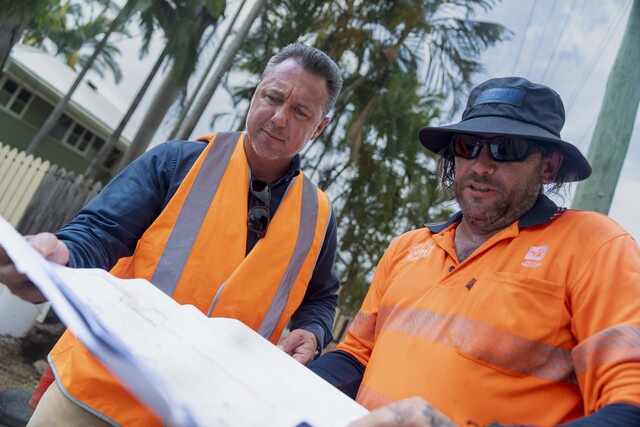
It took just eight weeks for the Works Department of Tasmania’s Meander Valley Council to design and implement a totally new approach to roadworks. The team, operating from Deloraine and Westbury, is led by Works Manager, Dennis Hampton. It has replaced a reactive maintenance program with a proactive system of inspections to provide better road safety for residents.
Meander Valley Council, located in northern Tasmania, has more than 800 kilometres of roads to maintain.
Now, instead of reacting to reports of road damage, Council has a continuous inspections program to ensure all roads are properly maintained before they break down.
“It minimises the risk to the travelling public,” Dennis Hampton said. “We may pick up on bad edge breaks or shouldering and that might save an accident, or even a fatality. It is also cheaper to repair a road if it is not let go.”
The Works Department set up a hierarchy of ‘priority one’ roads to be inspected yearly and ‘priority two’ roads to be inspected every two years. The team then designed a proforma containing assessment criteria that could be used for all inspections. Two customer request officers were trained to conduct the inspections and Council is now storing the data electronically while carrying out the identified roadworks.
General Manager, Greg Preece, nominated the Works Department to appear in FOCUS for successfully incorporating risk management. into their daily work practice.
When Greg Preece joined Meander Valley Council last September, he brought with him a particular interest in risk management and occupational health and safety.
“When I arrived, Council had been operating an Occupational Health and Safety Committee and we formed a new Risk Management Committee,” he said. “In developing a new risk management strategy we needed to become proactive in inspecting our assets, with roads being our main priority. Within eight weeks inspections were underway and we found there was a lot of new road maintenance work being generated. I gave the Works Department an undertaking that if they needed extra resources to do the work, it would be provided. To date, they have conducted inspections and completed the extra roadworks with the same resources and within their existing budget.”
In addition, all Council staff underwent risk assessment training in January and the Works Department now conducts a risk assessment of every maintenance or capital works project.
“I came to Council with a range of things I wanted to achieve and the Works Team has certainly helped me do this,” Greg Preece says. “They are a fantastic group. They’re the sort of people I like to work with.”