Home » Latrobe technology a first for maintaining road safety signs

Latrobe technology a first for maintaining road safety signs

Victoria’s Latrobe City Council has successfully pioneered the Australian development and use of a testing procedure for assessing road signs and their retroflectivity.

Council’s Senior Manager Infrastructure Operations, Stephen Howe, said road signs are an essential part of a community’s transport infrastructure.

“They guide, inform, warn and control road and pedestrian traffic, helping to maximise safety,” he said.

“Unless they are correctly maintained, signs can fade to the point where they cease to serve their purpose.”

The night time luminance of a sign is measured by a scientific property of the sign sheeting known as retroflectivity. This can diminish and the sign can become virtually invisible at night, even though it looks perfectly functional by day.

In Australia, only the initial manufacture and installation of road signs is covered by industry standards, with no guides as to when signs in service should be replaced.

Stephen Howe said in the past, Latrobe Council would only assess a sign’s day time suitability, against factors such as traffic accident damage, rust, grime or graffiti.

The few documented approaches to night time testing were simplistic and subjective.

“This was odd, as sophisticated and scientific methods existed in Australia for testing road pavement markers and edge delineators, but not for signs,” Stephen Howe said. “We therefore set out to find and implement a practical way of assessing road signs for their night time performance during the day.”

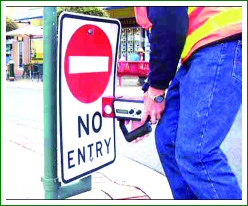
Council is now using a portable retroflectometer, along with a GPS data logger and a laser range finder to conduct scientific testing in daylight.

“The mobile GPS unit allows us to record where signs are and log data against each sign,” he said.

“The laser range finder enables officers to measure the distance between themselves and a sign without having to get out of the car and physically measure it.

“This information is then used to compare results against appropriate visibility and legibility standards so signs are replaced only when needed.”

The system was implemented during the 2005/2006 summer.

It builds on the latest complex research and testing from around the world, as well as established methods used by Australian traffic engineers.

“As a result of this technology, Council is improving the safety of its road network, particularly for older drivers, who have been shown from research to need an average of three to four times as much reflected light as other drivers in order to drive safely,” Stephen Howe said.

For further information contact Stephen Howe on (03) 5128 5470.
 

Digital Editions


  • Together Butchulla Talk

    Together Butchulla Talk

    A new Indigenous book celebrating the Butchulla language and local animals was launched at Hervey Bay Library earlier this month with storytime, language, dance and…

More News

  • A creative future for Kingston

    A creative future for Kingston

    The community has been invited to help shape Kingston’s creative and cultural future. Kingston residents are being invited to help finalise the city’s cultural roadmap, with the Draft Creative and…

  • Tweed residents gunking up wastewater

    Tweed residents gunking up wastewater

    Tweed Shire Council is urging residents to rethink what they flush down the toilet and pour down the drain, after revealing that crews remove around 156 tonnes of rubbish and…

  • In memory of Chris Quilkey

    In memory of Chris Quilkey

    It was with great sadness that we learned that former Blacktown City Deputy Mayor and Councillor Chris Quilkey has passed away. First and foremost, our thoughts are with Chris’s family,…

  • Unit demolished as Ipswich flood recovery continues

    Unit demolished as Ipswich flood recovery continues

    Ipswich Mayor Teresa Harding has welcomed the demolition of Mihi Grove, a flood-hit 42-unit complex in Brassall purchased as part of the Queensland and Australian Government’s Resilient Homes Fund Voluntary…

  • Fraser adopts tree

    Fraser adopts tree

    The Fraser Coast now has an official tree, with Council today adopting the Kauri Pine as a symbol of the region’s culture, history and natural environment. Fraser Coast Mayor George…

  • Council take on much-loved garden

    Council take on much-loved garden

    Glenorchy City Council will take on the administration of the Chigwell Community Garden, securing the future of the much-loved community space and supporting continued shared use by local groups. Glenorchy…

  • Fuel prices hurt country LGAs

    Fuel prices hurt country LGAs

    The fuel crisis is hitting remote, rural and regional communities hard, with farmers, freight carriers, tourism operators and local government all expressing concerns about the lack of supply and the…

  • Navigating grants

    Navigating grants

    How Administrative Complexity Is Eroding One of Local Government’s Most Powerful Tools Local government grants exist to create impact in communities. Yet across the sector, that purpose is increasingly being…

  • Looking to the future

    Looking to the future

    Flinders Lane will be abuzz for two days this month with Townsville Youth Council – supported by Townsville City Council – set to deliver a free festival focused on the…

  • WA leads the way as people to the regions

    WA leads the way as people to the regions

    Ten million people now call regional Australia home, and Western Australia is leading the way with its regional population growing faster than the cities, according to a deep dive into…