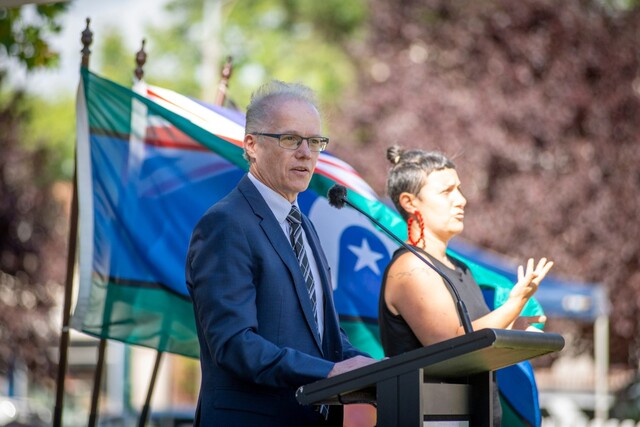
In opening the 95th Local Government Association of Tasmania (LGAT) Conference, President Mike Gaffney said the theme, ‘The Art of Survival’, is crucial in Local Government. “Art refers to the way we prepare for life, while survival indicates we can do this despite change,” he said. Staged in Hobart from 30 May to 1 June, the conference program enabled delegates to investigate means of effectively managing limited resources – both financial and environmental.
In his keynote address, ‘Climate Change: Global Threat, Local Opportunity’, Professor Ian Lowe from Griffith University in Brisbane said that ‘carbon neutral’ is the way of the future. He referred to the UN report ‘Confronting Climate Change: Avoiding the Unmanageable and Managing the Unavoidable’.
“Some climate change is unavoidable,” he said. “But the task is to manage it. Some is avoidable and we need to avoid it.”
Professor Lowe said despite 20 years of scientific effort, Australian Government initiatives, such as promoting population growth; the use of fossil fuels, including coal and coal fire; and a lack of serious renewables targets, are all working to speed up climate change.
“If we continue as we are, we will be 85 to 90 per cent above Kyoto targets in the next couple of years, when we should be aiming towards 60 to 90 per cent below,” he said. “The global average surface temperature has already risen 0.8 degrees above pre industrial levels. Avoiding temperature increases greater than two to 2.5 degrees would require very rapid success in reducing emissions of methane and black soot worldwide.”
Professor Lowe said the best possible result we can hope for is a temperature increase of only 1.5 degrees in the next 100 years.
“Once carbon dioxide is put into the atmosphere, it remains there for the next 80 years,” he said. “Therefore, even if we slashed our emissions this century, temperature and sea levels will continue to rise for the millennium. This means there will be more very hot days with more people dying from heat stress, changing rainfall patterns leading to problems for food production, more frequent extreme weather events such as cyclones, bushfires and local flooding, as well as rising sea levels. While this is inevitable, Councils need to reduce and offset their own emissions and encourage the community, as well as the State and Federal Governments, to prevent more serious dangers.”
Professor Lowe said our communities could live at the same comfort level using a quarter less energy with technology and products available today.
“Policy makers need to act quickly to make a bigger investment in public transport and develop better walkways and bike paths to promote cycling,” he said. “A bigger effort also needs to made in coordinating incentives for efficient appliances and fittings such as rain water tanks and vegetation programs to offset carbon emissions. If our communities are informed and engaged, locals will exemplify sustainable lifestyles. Our communities will be safe and healthy and seen as leading in CO2 sustainability.”
Also speaking at the conference was Art Historian and Honorary Fellow of the Australian Institute of Architects, Pamille Berg, who addressed Public Art and Council Policy. She said that limited funding and few specially trained staff in Councils should not be barriers to the effective incorporation of the creative work of artists, craftspeople and communities within Council projects each year.
“We no longer have true local reflections of our surroundings and environments,” she said. “We need to stand up for uncommon elements, such as one off park benches and individual bollards.We need to find ways for artists, craftspeople, designers and communities to take part and use their skills. Stop refusing what is unthought of or not done before and link architecture with community planning.”
Pamille Berg said landmarks such as Coffs Harbour’s Big Banana, and Goulburn’s Big Marino are items that reveal what that society is about.
“They show our past and contemporary layers of society,” she said. “It is vital that we use public art not for a quick fix or theme, but to acknowledge what interests us and matters in our community.”