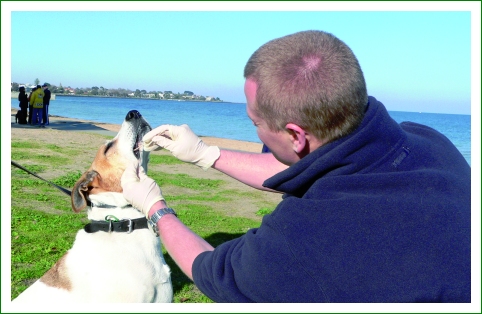
In June the City of Port Phillip began trialing a new DNA dog attack kit that enables animal management officers, livestock owners and police investigators to collect DNA evidence from saliva, blood and hair at dog attack crime scenes.
This can then be used to link dog suspects to a specific dog attack.
The kit was developed by Melbourne based firm, Genetic Technologies. It is Australia’s leading DNA testing company and is the only laboratory in Australia accredited by the National Association of Testing Authorities for the profiling of canine DNA for criminal or forensic investigations.
Port Phillip Councillor, Janet Cribbes, said that Council was pleased to be the first Council in Australia – and, indeed the world – to trial the kit over the next three months.
“Back in 1998, the City of Port Phillip achieved national and international notoriety when it was the first Local Government in Australia to propose using DNA technology to prove dog poo cases,” she said.
“Two years ago Port Phillip was the first Council in Australia to use DNA testing in a dog attack prosecution.”
Recent DNA tests using the new kit proved beyond reasonable doubt that two particular dogs were responsible for attacking a pensioner’s dog in Port Melbourne and this was seminal in the decision to have the dogs put down.
“We welcome the chance to use DNA testing as it can provide the proof positive for prosecutions,” Councillor Cribbes said.
“Dogs don’t have fingerprints but they do leave behind saliva, hair and poo.”
More than 100,000 dog attacks occur in Australia each year, with many going unresolved.
According to research undertaken by Genetic Technologies, almost 50 per cent of dogs involved in attacks have been involved in previous attacks. DNA can be taken from dog saliva found on the skin or wound of a dog or other victim, dog saliva found on a victim’s clothing, fence palings or other objects, dog blood, dog hairs and dog poo.
Where dogs are involved in aggressive acts where no harm is done, a precautionary DNA sample can be taken and stored indefinitely.
On average, one dog attack a week is reported to the City of Port Phillip.
“These can range from minor ‘dog takes child’s ice cream at picnic’ incidents or jumping up, through to injuries requiring surgery to humans or animals and even, sadly, the death of much loved family pets,” Councillor Cribbes said.
“Around three quarters of those reports relate to attacks on animals, the rest are on humans. About 15 to 20 attacks are resolved through fines for infringements for dogs being ‘at large’, but only about six a year are prosecuted in court, because proving which dog was responsible for the attack can often be too hard. Some owners simply deny their dog’s involvement in attacks and, without witnesses, it sometimes impossible to show otherwise. Others are in denial about their dog’s behaviour.
“Where a dog owner has more than one dog of the same breed, DNA testing can also allow the identification of the correct dog.”
According to Genetic Technologies, DNA testing is extremely accurate, with the chances of a second dog selected at random from the dog population having the same DNA profile as obtained from the crime scene sample being around 1 in 80 million.
For further information, contact Everard Hunder at Genetic Technologies on (03) 9415 1135 or Carmel Shute at the City of Port Phillip on
(03) 9209 6163.