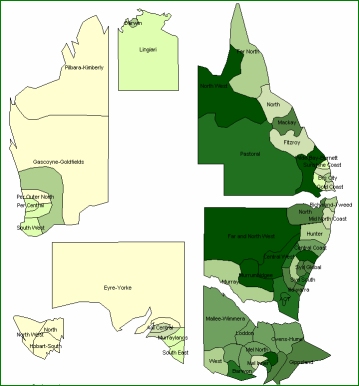
The combined impact of the cost to households from climate change, increasing household debt and the fact that international standard telecommunications – particularly high speed broadband – are still not available in many regions is widening the gap between the most affluent and poorest of Australia’s 64 regions.
The latest State of the Regions, report launched in Darwin on 26 November at the National General Assembly of Local Government, presents yet another sobering snapshot of the nation. The State of the Regions Report for 2007–2008 prepared by National Economics for the Australian Local Government Association (ALGA), sets out:
- that Government is lagging on facing climate change, causing real risks for the wellbeing of Australia
- the attendant crisis with our river system
- the level of household debt is becoming unsustainable
- broadband must be boosted to make Australia internationally competitive
- the lack of spending on infrastructure could send regions to the wall.
“This year’s report looks at 64 regions and focuses on the overarching theme of better understanding the impacts of climate change on Australia’s regions,” said ALGA President, Councillor Paul Bell. “We cannot afford to miss the train on this one. Local and regional communities are already bringing in mitigation and abatement measures which must be supported by Government.”
The report’s modelling estimates the up front costs to Australia’s households from climate change at $14 billion – $17 billion annually (up to $60 weekly for rural households and $32 for metropolitan). This includes carbon price, loss of farm income and water security operating costs. The carbon price component of this is around $8 billion based on a $33 per tonne carbon price/tax. The $33 per tonne benchmark is probably the minimum required to make a significant impact, that is, approximately a 25 per cent reduction in emissions from business as usual levels. When exactly this carbon price is reached will depend on political will and urgency. Based on the recent Intergovernmental Panel for Climate Change (IPCC) report, urgency has a high priority and therefore one would expect that this carbon price would be reached sometime between 2012 and 2020. If the climate continues to deteriorate rapidly, a carbon price of double this level is not out of the question.
“The key issue to address is that these costs will fall disproportionately on the regions that can least afford them,” Councillor Bell said.
The report singles out Local Government for praise for its practical environmental moves.
“The report for 2007–08 contains cogently argued evidence that Local Government and regional communities are leading the way when it comes to acting on the climate change crisis and the greenhouse effect,” Paul Bell said. “In particular, broadband will have a stunning effect on the ability of regions to boost exports, as well as doing its bit for climate change by managing energy use through video conferencing, e-health and providing education, business and entertainment online and giving all Australians the choice of not needing to undertake unnecessary travel.”
Local Government strategies to assist in reducing carbon emission and hence the rate of climate change include:
- widening building regulations to require best practice in terms of reducing household energy use via double glazing, standards of insulation and so forth
- planning in terms of adapting to climate change
- informing the community and local business to change behaviours to assist in reducing greenhouse gas emission at the local level
- to lobby the State and Federal Governments to ensure Local Government gets the financial support it needs to implement climate change strategies and absorb additional climate change costs.
At the Federal level, government must implement, as a matter of emergency, a raft of measures, which include an emissions trading scheme to change behaviour of major emitters and to reduce their carbon footprint.
The report can be ordered from the ALGA website at www.alga.asn.au