Home » Climate change

Climate change

Responding to sea level rise

The expected rate of sea level rise will have a significant impact on the infrastructure of Australian coastal and tidal councils. This will present significant infrastructure challenges for Local Government.

In Australia, average temperatures have already risen by around 0.7 degrees over the last century; and average sea levels have risen 120–160mm. Future climate change will bring higher temperature and less rainfall, and more frequent extreme weather events.

Globally, the last ten years include the warmest years on record. The past 30 years has seen acceleration in the rate of warming to almost 0.2 degrees centigrade per decade.

Responding to sea level rise:
a national event

The Institute of Public Works Engineering Australia (IPWEA) is holding a national conference, on
3–5 August 2008 in Coffs Harbour, New South Wales, to provide an opportunity for all coastal and tidal councils to learn about innovative responses and adaptations to sea level rise across different types of coastal regimes.

The conference theme is ‘Responding to Sea Level Rise: Engineering Practical Climate Change Solutions’. The focus is specifically on what different coastal councils are doing, and can do, to address sea level rise impacts on council infrastructure. The aim is to share ideas and to learn how other council staff and consultants are innovating and developing adaptation responses to sea level rise.

Keynotes will address international perspectives and the ‘Vulnerability of the Australian Coastline to Climate Change’. This will also be put into the context of the National Climate Change Adaptation Framework.

Two streams of papers will be presented addressing the key elements of response and adaptation:

  • extent of sea level rise
  • impacts and risk assessment
  • planning responses
  • council responses
  • site and locale responses
  • adaptation strategies
  • wider impacts and responses
  • land use planning
  • storm tide and emergency management
  • community impact and engagement.

Infrastructure that we are building now will most likely still exist in 2020, 2030 and 2050. Decisions made today need to occur in a way which ensure that the outcomes of those decisions are robust enough to cope with, or adapt to, changing climatic conditions into the future.

The significant variety of local communities across Australia means that we need to consider many different approaches to addressing climate change. This conference will report on the many different approaches and experiences of Local Governments along our coastlines.

The conference will provide an opportunity for engineers and technical staff, consultants, planners, CEOs and elected members to share ideas and to learn how others are innovating and developing adaptation responses to sea level rise.

Visit the IPWEA web site at www.ipwea.org.au/coffs08 for further information and to download the conference brochure and registration form.
 

Digital Editions


  • Lockyer send flood expert north

    Lockyer send flood expert north

    Lockyer Valley Regional Council has answered the call for assistance from a community impacted by Ex-Tropical Cyclone Koji, with a staff member from Council’s Disaster…

More News

  • Lockyer announce Scott Greensill as CEO

    Lockyer announce Scott Greensill as CEO

    Lockyer Valley Regional Council has appointed Scott Greensill as its new Chief Executive Officer. Councillors formally approved the appointment of Mr Greensill at a Special Meeting of Council in February.…

  • Myers resigns for health reasons

    Myers resigns for health reasons

    Wollongong’s Councillor Tiana Myers has resigned, as a Ward Three Councillor for City Council due to health reasons. Cr Myers was elected to Council in 2024 with a focus on…

  • Acknowledging women’s role in councils

    Acknowledging women’s role in councils

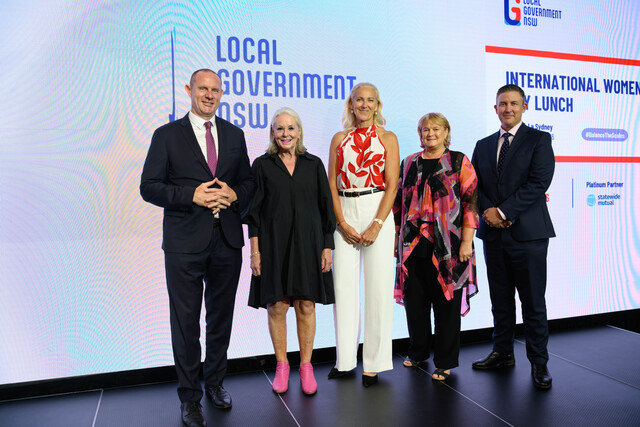
    Council representatives from across the state gathered in Sydney today for Local Government NSW’s (LGNSW) International Women’s Day event. Mayor Darcy Byrne, President of LGNSW, said the event was an…

  • Kylie Davies beats strong field

    Kylie Davies beats strong field

    Flinders Shire Council is pleased to announce the appointment of Kylie Davies as its new Chief Executive Officer. Ms Davies will start in the role on 13 April following a…

  • Leaving on a high

    Leaving on a high

    Mount Alexander Shire Council’s Chief Executive Officer Darren Fuzzard will end his tenure at the council in July 2026, marking ten years of service to the organisation and community. Mr…

  • Safety first for transport corridor

    Safety first for transport corridor

    Traversing a major Townsville transit corridor spanning three suburbs will soon be safer for motorists, cyclists and pedestrians, with Townsville City Council commencing a $3.8 million upgrade of Hugh and…

  • Creating long-term employment pathways

    Creating long-term employment pathways

    The Shire of Carnarvon is creating long-term employment pathways and strengthening workforce capability through its participation in the Remote Jobs and Economic Development (RJED) Program, a national initiative designed to…

  • Cool summer plan for Campbelltown

    Cool summer plan for Campbelltown

    Extreme heat is the biggest killer of natural disasters in Australia, exceeding that for any other environmental disaster combined, including floods, storms, bushfires and cyclones. While high temperatures pose risks…

  • Bathurst has it’s scrap together

    Bathurst has it’s scrap together

    Bathurst Regional Council has successfully concluded its ‘Let’s Get Our Scrap Together’ campaign, launched on 1 September 2025 with funding from the NSW Government and delivered in collaboration with NetWaste…

  • Baw Baw acting CEO tenure extended

    Baw Baw acting CEO tenure extended

    Baw Baw Shire Council has extended the contract of Acting Chief Executive Officer Sally Jones until 30 June 2026. The matter was considered as a confidential item in the late…