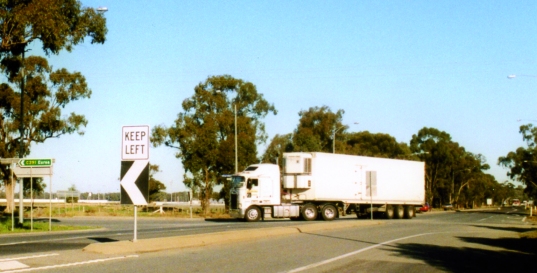
The Australian Local Government Association’s 2008 National Local Roads and Transport Congress was held in Greater Shepparton on 16 and 17 June.
Greater Shepparton, situated in the heart of the Goulburn Valley, has a population of around 59,000 people, and is the fourth largest provincial centre in Victoria.
A communique covering the key congress deliberations was presented to the Minister for Infrastructure, Transport, Regional Development and Local Government, Anthony Albanese, on 19 June. This communique has reaffirmed Local Government’s commitment to the Local Government’s Roads and Transport Strategy 2006–2016, and emphasised the importance of sustainability of the local road network and the Roads to Recovery and Strategic Regional Programs.
It stated, “As owner and manager of more than 80 per cent of the nation’s road network on which more than 25 per cent of vehicle kilometres are traveled, Local Government acknowledges it has an important part to play in the delivery of the ‘first and last mile’ of this vision, in its own right and in partnership with other spheres of government through land use planning, community engagement and in the provision of transport infrastructure.
“While local roads and transport are core deliverables for Local Government, they can not, however, be viewed in isolation from the broader issue of Local Government financial sustainability. As a result delegates continue to call for long term financial sustainability for Local Government by the provision of a fair share of at least one per cent of Commonwealth taxation revenue (excluding GST) to Local Government as an untied intergovernmental transfer.”
The full text of the communique can be viewed at www.alga.an.au/newsroom/communiques/15.nlrtc/20080617.php
In his speech at the Congress, ALGA President, Councillor Paul Bell, said that Australia’s current freight task is predicted to double by 2020 and most of these journeys will begin and end on a local road.
“Road transport will continue to be the major mode but further linking of road and rail will be vital,” Councillor Bell said. “Local Government cannot afford to be seen as the problem here or we will be bypassed and ignored.”
He said that any new levies or charging arrangements for heavy transport must take account of local road use.
“Local Government stands ready to work with the other spheres of government to deliver for our communities in the area of roads and transport needs,” he said. “We all need to understand the task before us and take this message to our State and Federal MPs that Local Government is a critical part of the solution but it needs the resources to be able to fulfil its role and there must be no more cost shifting.”
Keynote speaker and former Deputy Prime Minister, Tim Fischer, said that more than ever we need to achieve a balance of good roads and good rail.
“Yet the 20th century saw the near death of rail,” Tim Fischer said. “With oil now peaked out, worldwide there has been a swing back to rail with more and more fast train routes and the introduction of double stack container trains.
“In infrastructure maintenance and renewal terms, a steel wheel on steel track creates one seventh the friction of rubber on bitumen. And rail is more greenhouse friendly – using less fuel and creating less emissions. Transport inefficiencies have greatly increased our carbon footprint.”
CEO of Transport Certification Australia (TCA), Chris Koniditsiotis, outlines the Intelligent Access Project (IAP). He said IAP aims to facilitate the more efficient movement of freight through local communities.
“It is all about getting the right vehicle on the right road at the right time,” he said.
GPS systems mounted in heavy vehicles can track vehices to ensure they stay on agreed routes to hubs, the time they travel and vehicle speeds. Vehicles are monitored every 30 seconds.
“TCA acknowledges the important role Local Government plays in maintaining and managing the road network and believes IAP presents Local Government with a tool and opportunity to work with road authorities to better manage local roads,” Chris Koniditsiotis said.
IAP ensures that heavy vehicles travelling to a freight hub stay on their approved route, and helps to ensure that access conditions designed to protect vulnerable infrastructure, such as ageing bridges, are complied with.
IAP is administered by TCA and is a voluntary program that provides heavy vehicles with improved access to Australia’s road network in return for monitoring of compliance with specific access conditions using vehicle telematics solutions.
Further information on IAP is available at www.IAP.gov.au