The Local Government Managers Australia (LGMA) National Congress was staged from
24 to 27 May. With the theme ‘Creating Our Future – Messages with Solutions’, this was the first time LGMA had selected Darwin as the venue.
In opening the Congress, Administrator for the Northern Territory, Tom Pauling, said that Local Government, however competent, cannot predict the future.
“Creating our future requires balancing questions of infrastructure, demographics and economics,” he said. “Innovation is critical for the future, as against closed mind opposition.
“Cooperation, informed design and proper respect for the exchange of ideas are critical for the future.”
Keynote speaker Natasha Stott Despoja, former Senator and Leader of the Democrats, told delegates that after 16 years of economic growth and now close to recession, Australia needs diverse and visionary leadership to tackle the social and economic challenges ahead.
“Australians are looking for leadership to provide sustainable solutions,” she said. “They are looking to governments and particularly Local Government to do this.
“You describe yourselves as community leaders. From reconciliation to climate change you have already demonstrated this. You are on the front line in providing a raft of essential services from meeting the needs of an ageing population, youth and family services, to the e-revolution.
“You are expected to show leadership on the national stage. Surveys have found that you are held in higher regard by people – considered to be more honest and trustworthy – than your State and Federal colleagues.”
She said that with the quantity of information readily available, the public have become players in a digital democracy and this unprecedented level of scrutiny has led to short term and poll driven responses – that is what politicians think will get them elected.
“But many issues need long term solutions,” she said. “Climate change does not fit into a government’s term or a manager’s contract period.”
Demographic trends forecaster Bernard Salt told delegates that there are three key issues shaping our nation’s future. These are:
- Australians are resettling the continent with
seachange and treechange shifts in
population - there has been a shift in thinking of baby
boomers as they move towards retirement - the global economic crisis is changing our
cultural values and our mindsets.
Looking at where Australians are now living, Bernard Salt said that in recent years Wyndham and Melton on the western rim of Melbourne have joined the list of the ten fastest growing Australian municipalities, ranked fourth and ninth respectively.
“The reason is the completion of the Western Ring Road making the commute much faster,” he said. “Once this happens Australians will always put lifestyle before other considerations as to where they will live.
“Mount Barker in the Adelaide Hills is also experiencing rapid growth, with the completion of a new tunnel reducing the commute into Adelaide to around 20 minutes.”
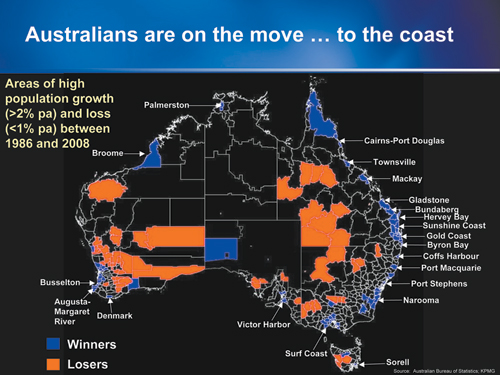
He said that since 1986 many Australians have been on the move, with people shifting from the land resulting in the amalgamation of farms into larger holdings, and a rapid growth in coastal areas. Some areas are benefiting from the treechange phenomenon but the drought is impacting on the ability of some inland centres to grow.
“Treechange and seachange councils will come under pressure with an increased demand for services,” he said.
“With baby boomers the fastest growing age group all councils will be under pressure for increased services, such as financial security seminars, opportunities for preventative health programs, security and safety within the community, and connectiveness (particularly a sense of worth and being needed).”
He said that over the past 80 years there has also been a major change in life expectations and councils need to be aware of this in planning their services. In 1929 average life expectancy was 63 years. You were a child until you reached 14 years then an adult until 50. At 51 you were considered old age.
By 1969 life expectancy had incrased to
71 years. You were a teenager from 13 to 19 years, then an adult, and by 60 had reached old age.
In 2009 life expectancy is now averaging
82 years. Adolescence is now much longer, from 13 years to 29 years, and adulthood from 30 to 54 years. Between 55 to 64 years is considered your lifestyle years, 65 to 74 retired and over 75 years old age.
“But with the current economic climate many baby boomers are discovering they have not enough money to support the lifestyle they want in retirement,” Bernard Salt said. “But they are organising work around their lives, working more years but less hours per week.”
He said that in 2011 the first of the baby boomers will turn 65, and from then with a steady decline of people in the 15 to 64 years age group – the tax base group – there will be more power to employees to pick and choose and less for employers.
“Local Government is the seventh fastest growing industry sector, but with one third of all staff aged over 50 years, councils need to be preparing now for their imminent retirement,” he warned.