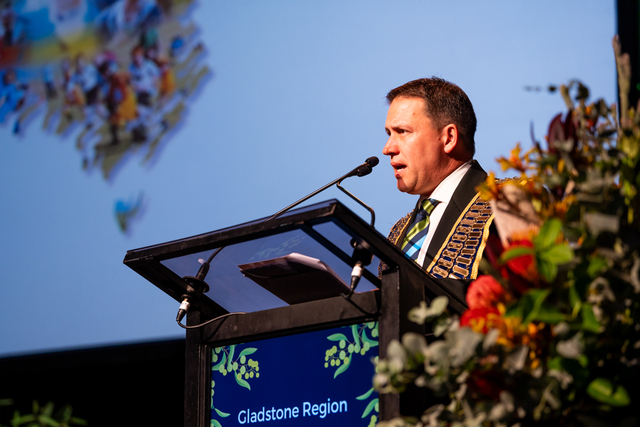
The Regional Economics Conference in Parkes last month covered some very interesting topics, including the declining population of inland New South Wales.
I spoke about the ‘Out of Sight – Out of Mind’ syndrome, or how the Sydney–Canberra–Melbourne triangle forgets those outside it.
Other speakers in my session, demographer Bernard Salt and RDA Chair Sandy Morrison, ran complementary themes.
My basic proposition was that the population and output stagnation of inland New South Wales can be turned around. To explain it away to the drought, the lure of the big cities and the sea change effect is simplistic and defeatist.
The Inland Rail project is a test case. Before I headed to Parkes, I quizzed some Federal officials and bystanders.
The preliminary analysis shows that a Melbourne–Brisbane inland railway is “Not financially viable as a standalone commercial entity”.
Minister Albanese has now asked the consultants to examine how to:
- generate additional
tonnages - lower capital costs
- identify funding from
different sources.
Regarding the low rail tonnages, this is no surprise.
The trucking industry doesn’t pay its way on long haul routes. And there is a serious lack of value adding capacity in agricultural regions – check the trade statistics, or the imported foods on the supermarket shelves!
I suggested at the conference that councils along the route build an agenda with Federal and State Governments around:
- inwards investment
missions - global supply chains
- infrastructure and industry
portfolios talking to each
other - development zones and
locational incentives (these
are not heretical concepts).
Regarding lowering capital costs, the cost of the Inland Rail project is around $2.8 to $3.6 billion.
Perhaps the figure is nearer to $2.5 billion if you weed out the tendency towards ‘cost plus’ in such costings.
It’s also opportune to revisit the railroad tax regimes.
If heavy trucks paid full tote odds for the road damage, deaths, pollution and congestion they cause, rail MUST be more attractive.
Regarding the identification of funding from different sources, the Building Australia Fund and the superannuation funds are loathe to finance the public interest.
The appropriate step is therefore to measure the public interest, and then determine an equitable share for each level of government.
As a hypothetical example, let’s say the public benefit of the Inland Rail was assessed at $500 million, and that local communities and Local Government would derive $200 million of this via rising land taxes, property valuations, investment, incomes and jobs.
A cost sharing formula might then determine the liability of the benefiting towns and cities along the route.
Imagine Wangaratta ($10m), Albury-Wodonga ($25m), Wagga Wagga ($25m), Junee ($5m) Parkes ($15m), Narromine ($5m), Dubbo ($25m), Moree ($10m), Toowoomba ($25m) etc. Then imagine a special session of COAG with 20 to 25 Mayors putting the deal on the table –
three Premiers shell shocked, and Rudd and Albanese wetting themselves.
Costa the Good
In some circles, Philip Costa, the New South Wales Minister for Water and Regional Development, has the moniker of Costa the Good.
Well, Phil does come across as a fair minded, attentive bloke. A former Mayor and head of MACROC, he was a highlight of the Parkes conference. He bought into the water buyback program, a very hot topic because numerous towns in the Murray Darling Basin look like being seriously affected by the program. For example, as irrigators sell their entitlements and take the Surfers Paradise option, the region’s economic activity weakens, as does the reason these communities exist.
The purist line is that jobs will be created elsewhere by the invisible hand of the market. But nothing is offered to the local community before the water entitlements go.
The rural sector’s mistrust is well founded given that while the Productivity Commission was asked last month to investigate the buyback mechanism, there was no mention of any community assistance or steps to create jobs. Phil Costa says he’s onto it. A very important issue, so good luck Minister.
The Sigrid Effect
Much of the McKinsey and OECD thinking is about regional communities needing to find their own niches, and developing distinctive capabilities around these niches.
Indeed, overseas visitors often refer to a lack of distinctiveness of our towns.
It was thus interesting to hear Bernard Salt speaking at Parkes about how population growth of towns can be triggered by events. For example, Echuca benefited from the Sigrid Effect (that is Sigrid Thornton and the ‘All The Rivers Run’ series) because it marketed the area as a tree change destination. He similarly referred to the impact of the North West Shelf on towns in the Pilbara and so forth.
It does get you thinking. Torquay (Rip Curl, Quiksilver), Wahgunya (Uncle Toby’s), Shepparton (food), Armidale (education) got their kickalong via company investments or public infrastructure. And now Industry Minister Kim Carr is funding the development of precincts, such as minerals processing in Mackay, defence in Dandenong, clean energy in Newcastle and creative industries in the Sydney CBD.
Local councils are well placed to develop precincts with the support of Federal and the New South Wales Governments. What about Parkes–Forbes–Orange–Blayney–Dubbo as a mega food processing precinct?
Contact us to learn how.
Sister Cities
A growing number of councils are reportedly winding back their involvement in sister city relationships, mainly due to the costs of sending council representatives on overseas trips.
Agreed that councils must not waste ratepayers money, but most councils are saying that cultural and social links with the Third World must continue.
One means of reducing the costs of international tie ups is to ask council representatives to meet say 50 per cent of the costs, given that such trips often involve a fair pleasure component. It also stops any sneering about junkets.
Another suggestion is to work with AusAID. Noosa, Campbelltown (SA) and Leeton Councils are three examples.
*Rod Brown is a Canberra-based consultant specialising in industry/regional development, investment attraction, clusters and accessing Federal grants. He also runs the Cockatoo Network. He can be contacted at apd@orac.net.au or phone (02) 6231 7261. Go to our blog at www.investmentinnovation.wordpress.com for 550+ articles on issues relevant to Local Government.