By Ross Larsen*
Activity centres are the core areas of a city or town that accommodate a concentration of retailing, business offices, personal and professional services, community facilities and services, urban public open space, and higher density housing.
Activity centres play a significant role in creating strong and robust economies, fostering high value jobs and supporting a variety of commercial sectors contributing to economic output and development.
Key activity centres also often play a vital function in supporting regional activities, providing avenues for trade, finance, business services, and office space required by a broad range of industries within the region.
The economic performance of activity centres depends on a range of factors including market forces, governance, human capital, and financial capital. However key influences on the economic performance of activity centres include a synergistic network of centres, mix of uses, density, range of services and facilities, and liveability.
Therefore it is critical that the relevant authority uses planning tools, as well as broader policy and business tools, to encourage economic development.
The following sections of this article focus on some of the key elements of activity centres where urban planning can facilitate the desired economic performance and development.
Regional planning
A well functioning network of activity centres is vital for a region in order to avoid unnecessary duplication of services, and provide a diversity of employment choice, services and retail.
There must be a mix of higher order centres with a broad catchment, balanced by local centres reducing travel requirements. Major centres in particular must be allowed, and encouraged, to reach levels of agglomeration where economic benefits are realised. This can be difficult to achieve when a metropolitan region is governed by a number of Local Government authorities.
Regional planning initiatives in recent years have seen State Government agencies put in place either statutory regional planning instruments or regional planning policy. An example is the statutory South East Queensland Regional Plan 2009–2031 which includes an “Activity centres network” including Primary, Principal regional, Major regional, Principal rural, Major rural, and Specialist centres.
The focus is on ensuring that these centres have the necessary level of employment and services, and that the regional roles of these centres as economic and social hubs are not compromised by other development such as in other lower order centres or out of centre.
Concentration and linking
of activity centres
Cities develop out of the benefits of networking and economies of scale for businesses, and activity centres rely on a similar concept at a smaller scale, as a major city may have numerous activity centres including the CBD. These benefits require significant density of development to allow for effective interchange of ideas, human capital and services.
Research by SGS Economics and Planning has gone further in examining the concept of “effective density – the number of suppliers and distributors a business can reach within a given travel time”. See www.sgsep.com.au/urbeconv42009article1
This work demonstrates the clear link between higher job density and increased business productivity.
Achieving the desired density can be facilitated by a number of land use planning instruments including allowance of high plot ratios, significant height, and mixed use development within a single site or even a building.
Local authorities should consider not only allowance of high density development but may also consider incentives which encourage high density development to occur, and restrict low density, low activity uses.
Low density uses that should be restricted include retail warehouses, car parking, and outdoor large format retailing. Along with higher density, it is important that design considerations assist in maintaining a higher level of amenity, comfortable open space, and active streets.
Efficient transport
Major activity centres require a highly efficient transport system in order to facilitate economic development through higher effective density.
In order to function effectively activity centres need to be accessible to employees, residents and those accessing services and doing business. In particular “high quality commercial development must focus on areas of high accessibility because these thrive on the ability to attract the highest quality employees” (refer Keys, E. and Tivendale, K. (2008). “Transport…the catalyst for economic development: Melbourne Docklands”. Australian Planner, 45 (1), March, 22-23).
At the desired level of concentration for activity centres this requires a mass public transport system and ideally includes a number of transport modes and effective interchange between them.
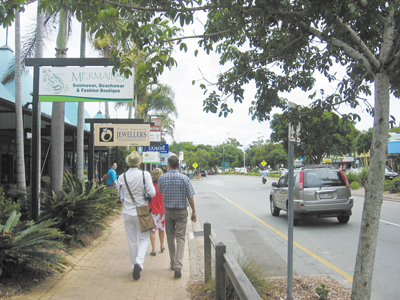
It is also important to ensure that walking and cycling is facilitated around activity centres, and streets maintain a social and casual business function. Planning instruments should be aligned with infrastructure planning to boost development densities around high quality public transport, while maintaining effective road networks, and requiring walking and cycling links and end of trip facilities.
Mix of uses
An activity centre as an attractive economic hub needs to have a range of uses that will attract workers, investment and enhance productivity. The range of uses will support each other and offer an efficiency of access that provides a range of opportunities, services and experiences in a single, multipurpose trip.
The desirable range of uses to be allowed under planning schemes should include retail, office, services, community facilities, public space, entertainment, dining, recreation, and housing. The effective linkage of various activity centres is also vital in maintaining a mix of uses across a number of regional activity centres.
Lifestyle
In order to facilitate economic development skilled workers need to be attracted to an area through the provision of high quality of life and opportunity for personal development (refer Lennon, S. (2008) “Promoting Sound Principles in Planning for Economic Development” Australian Planner, 45 (1), March, 28-29).
High value business opportunities exist in knowledge based industries and these rely on workers to which lifestyle is a particularly important consideration in choosing where to work. Apart from natural attractions, workers are also heavily influenced by the lifestyle attractions of particular activity centres, and these can be influenced by planning controls.
Some of the elements that can be facilitated by planning instruments include compact development, a range of transport options, a mix of uses, active street frontages, and cultural and recreational facilities.
Infrastructure
To facilitate economic development, activity centres need to have high quality infrastructure in place. This should be addressed in strategic planning policy and supported through statuary planning and committed funding.
Infrastructure essential for economic development includes:
- transport (particularly public transport)
- high quality telecommunications and
internet connections - access to airports, ports, and long distance rail
- water, sewerage, and electricity
- community facilities and services.
Sustainable urban design
and building design
Environmental impacts are becoming a more important consideration for businesses, from a viewpoint of corporate responsibility and the impacts on customer perception, but also in view of reducing carbon emission targets, and the reducing ongoing operational costs. Therefore activity centres with “green” credentials will be better positioned to attract investment.
Planning instruments should be active in facilitating development that reduces environmental impacts in the short and longer term. This can include such things as sustainable building design with Green Star ratings, sustainable transport options, and an urban form which encourages walking and cycling, including mid block linkages, shelter, active streets, and adequate road/footpath space.
Conclusion
All the factors outlined above are important to consider in planning for activity centres. These issues should be addressed firstly at a higher strategic level including planning strategies, corporate plans, and economic development plans. However, this must also flow through to planning schemes and development assessment that facilitates the desired uses, infrastructure, facilities and urban form.
If activity centres can address these issues, and provide the right framework, they will be well placed to support economic growth, along with environmental and social benefits.
*Ross Larsen is a Brisbane-based Senior Consultant with SGS Economics and Planning Pty Ltd. He can be contacted on ross.larsen@sgsep.com.au or go to www.sgsep.com.au