Local Governments right across Australia continue to bear the brunt of high population growth as a major think tank has revealed that Australia will face greater population pressures over the coming decades. The population growth ratchets up demand for services, creating a raft of political and social pressures for Local Governments leading to increased demand for parks, roads, planning pressures, and environmental issues.
Advocates of a ‘small Australia’ argue that migration should be reduced to 70,000 a year. But even after such drastic cuts, if Australia’s fertility remained constant, we will still have a population of 29 million by 2050.
The Federal Government has responded to the issue with a Sustainable Population Strategy which aims to address these population pressures.
The Chair of the Council of Capital City Lord Mayors and Lord Mayor of Hobart, Alderman Rob Valentine, cautiously welcomed the release of the Strategy as an important mechanism to deal with a growing population and changing Australian demographic.
“The Sustainable Population Strategy provides an important new mechanism for Australia’s three spheres of Government to engage with one another and with the community to explore issues driving population changes and the impacts associated with that change” he said.
“It’s important that we have this information and this discussion as a country, and as a community. However, we are concerned that the Strategy misses the mark in terms of preparing our cities for the future.
The Strategy appears to support settlement through urban sprawl rather than optimising existing infrastructure in existing suburbs.”
Alderman Rob Valentine welcomed the Federal Government’s investment in assisting communities to prepare for population change. He was disappointed that none of these funds will directly assist communities in inner city or middle ring suburbs cope with growth.
“We think these need to be balanced with programs targeted at directly addressing the barriers which inhibit access to reliable public transport and affordable housing citywide.Ideally we’d like to see similar assistance directed at tackling issues facing Australia’s most densely populated areas, easing traffic congestion and providing more access to affordable housing.”
The Centre for Independent Studies has already released a report ‘Populate and Perish? Modelling Australia’s Demographic Future’, by Research Fellow Oliver Marc Hartwich and Policy Analyst Jessica Brown. They modelled 36 scenarios and found unless migration was cut to zero, that life expectancy stayed constant and our birth rate plummeted, Australia’s population will be bigger in 2050.
Jessica Brown said under every realistic scenario Australia’s population would grow and fertility would matter as much, if not more, in determining how big our population will be.
‘We should accept that some level of population growth will happen and embrace the opportunities that come with it,” Jessica Brown said.
Oliver Marc Hartwich said that it was simply wrong for politicians to pretend that they can stop population growth.
“Our future is a bigger Australia and we must start preparing for it,” he said.
Latest ABS figures
In the immediate term, after climbing steadily for the past seven years, the rate of population growth in Australian capital cities slowed in 2009/10, according to estimates released by the Australian Bureau of Statistics.
Overall, the growth rate of Australian capital cities dropped from 2.2 per cent in 2008/09 to 1.8 per cent in 2009/10. Even so, population growth in Melbourne equated to an average increase of over 1,500 people per week, while the population of Sydney increased by over 1,400 people per week.
This slowdown occurred in all capital cities except Adelaide, Canberra and Hobart, where growth rates remained stable and among the highest they have been in years.
Darwin’s growth slowed the most, reducing from 3.2 per cent in 2008/09 to 2.1 per cent, followed by Perth from 3.2 to 2.3 per cent.
The combined population of Australian capital cities increased by 257,800 people and accounted for over two thirds of Australia’s population growth.
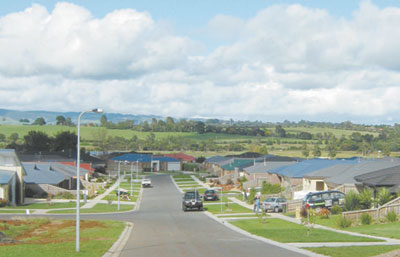
The largest growth occurred in Melbourne, which increased by 79,000 people to reach the population milestone of four million. Sydney increased by 75,600 people, Brisbane by 39,000 and Perth by 37,500. The outer suburbs of capital cities were again areas of rapid population growth. The four fastest growing Local Governments in Australia were on the outer suburban fringes of Melbourne with Wyndham up 8.8 percent, Melton up 7.1 per cent, Cardinia 6.7 per cent and Whittlesea up 6.1 per cent.
In Queensland, where the three most populous Local Governments in Australia are found, Brisbane increased by 14,800 people, Gold Coast by 12,900 and Moreton Bay by 11,100.
In South Australia, Playford in the northern suburbs of Adelaide, and Alexandrina on the Fleurieu Peninsula, were the fastest growing in the State, both increasing by 3.0 per cent.
In Western Australia, strong population growth continued in the outer suburban fringes of Perth.
In Tasmania, Latrobe with 4.2 per cent in the north and Brighton with 3.5 per cent in the south were the fastest growing Local Government areas.
Growth is not always seen as negative. Larger populations can create the economies of scale to introduce important services and facilities.
In Melbourne’s west, Melton Shire Council Mayor Justin Mammarella said the municipality would continue its fast growth for many years to come.Councillor Mammarella said that growth continued to be its biggest challenge as a community.
“This growth is something we welcome and we will continue to deliver on our promise to provide necessary services and infrastructure for our community,” he said.
At the other end of the country, Palmerston in the Northern Territory grew by 5.1 per cent between 2004 and 2009. The city also recorded the Territory’s second highest growth in property prices and a 23 per cent increase in baby bonus payments.
Palmerston Mayor Robert Macleod says the city’s growth was partly due to good planning.
“It’s a young, vibrant, green, beautiful growing city,” Councillor Macleod said. “We’ve got a lot of beautiful suburbs here and I think it’s just the open space and how well it is looked after that people like to come out here.”
Rising house prices are pushing some young people out of the city.