Integrated Planning and Fair Value for Long Term Financial Modelling: Can Strategic Asset Management (SAM) provide the answers?
It’s that time of the year again for Local Governments when long term financial plans, capital works programs and budgets must be in place. The fundamental strategies to be effective in long term financial planning revolve around:
- the allocation of monies from a global to project level
- transparently and objectively determining which services get priority
- determining how to rationally distribute available funds between asset classes
- establishing appropriate organisational targets for maintenance versus renewal
- accurately calculating what the year on year funding targets should be (not last year plus or minus five percent) and
- objectively optimising a capital works program that is needs based and not simply a wish list.
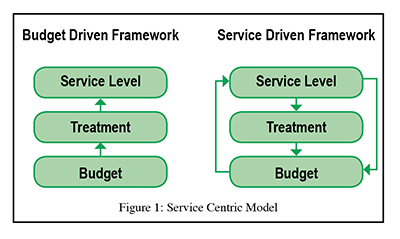
These are all difficult strategies to both justify and execute unless as an organisation SAM is embedded as a way of life, ensuring that decision-making is based on service needs. The National Asset Management Framework and the Department of Local Government’s Integrated Planning and Reporting Framework and Guidelines (IPR) is progressively pushing a service centric model as opposed to the purely budget driven model.
The Asset Management Team at the City of Stirling believes a Service Centric Model is the only method of demonstrating the long term impacts of short-term decisions. Without a SAM tool that is built on service–level modelling, we cannot show our stakeholders what the future will look like for each alternative long term funding scenario.
Implementing a service centric model using objectively defined criteria of intervention levels based on service criteria such as condition, capacity, functionality, safety, criticality and asset hierarchy provides the most powerful platform for ‘intelligent spending decisions’. SAM-based cost versus service centric models provide the fundamental tools to enable service level trade-offs for community consultations, ensuring that service delivery is optimised and actions are prioritised.
The City of Stirling has made the first step to tackling this challenge on the back of the Intergrated Planning and Report (IPR) and Fair Value mandate, using the embedded IPR and Fair Value framework within the City’s Corporate SAM tool, Assetic SAM Module. Scenario modelling and optimisation of available funding allows the City to select the most appropriate long term financial strategy.
For the City of Stirling, SAM is the fundamental methodology for determining:
- the current position in relation to asset health
- long term targets – five, ten, 20 years
- the funding required to meet the targets
- outcomes of underspends/overspends
- gaps, and the most appropriate course of action to address the situation and
- the current position in relation to the fair value of assets and their rate of consumption.
Many organisations, both state and local, are getting frustrated that future funding and CapEx is based on ‘cry loudest’ syndrome. Local Government needs SAM data models when it comes to long term financial planning, capital works programming and budgeting. In many instances, budgets are purely based on last year’s figures plus or minus five percent depending on immediate needs.
Objectives such as these pose some difficult questions. Can we change this type of decision-making framework? Can we ensure that decisions are based on community driven future targets and not short term goals? Can we make the whole asset management process more objective, more meaningful and more pragmatic, so that consistently sound decisions can be made on a ‘whole of life’ basis and a ‘whole of organisation’ basis?
In the experience of the City of Stirling Asset Management Team, the change can be inculcated over time by a deep-rooted strategic asset management framework based on service levels. The change has to be very deep i.e. the organisation’s values and attitudes on the whole have to encompass the SAM philosophy to put it into practice. If SAM becomes a way of life, good decisions automatically follow and the old 80/20 rule applies – let’s at least get the 80 percent objective decisions right and the other 20 percent will start to follow.
Developing SAM is a journey, not a destination! Stirling has now embarked on completing its advanced Asset Management Plans and looks forward to the next steps of its journey. These next steps are to continue working with the knowledge base i.e. our information services unit, finance services unit, engineering services unit, the field staff and the operational teams to improve the calibrations of our Fair Value and Planning Models in Assetic SAM module.
The support of the City’s leadership team has been critical in this journey. The Asset Management Business Unit or the SAM system on its own could not provide the end-to-end solution.