Home » Zapping weeds with technology

Zapping weeds with technology

New technologies, including a mobile app, in-house developed data capture and mapping processes, are helping the City of Onkaparinga in South Australia tackle a deep-rooted problem – weeds.

While the council has been working to fight weeds across the region for many years, the increasing use of in-field technology to map weeds is providing crucial missing information such as weed locations and levels of infestation.

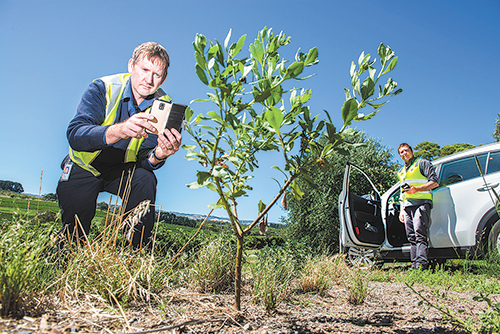
Weed mapping involves searching for priority weeds such as Box Thorn and African Love Grass and then recording that information using a mobile phone or tablet.

Senior Nature Conservation Officer, Ben Moulton, said having this information is essential for a successful weed control strategy.

“The information we’ve gathered helps us with our strategy to determine whether some weeds can be contained and prevented from establishing further or whether they can be eradicated completely.

“The information about what type of weed, its exact location, its development stage and even a photo is uploaded to our database via a phone app.

“With satellite technology the weed data is recorded whilst in the field and its exact location is added to an online map which then allows us to see in real time how wide spread a particular weed is to help us manage and eradicate it.”

After utilising the data to develop control priorities, contractors are sent to eradicate targeted weeds and by using the same weed mapping technology, where previously they would have had to use paper maps, locating the weeds on the roadside or reserve is easier.

Once an infestation is controlled, contractors can then also update the existing weed record by recording the date and method of control.

Council has a legal obligation to manage weeds under the Natural Resources Management Act 2004 and is working on updated strategies to respond to changes to the Act, after 24 species were added to the list of declared plants.

According to the Natural Resources Management Act 2004, plants are considered declared species if they threaten primary industries, the natural environment or public safety and are therefore required to be managed.

Damage that can be caused by weeds ranges from their ability to reduce pasture quality, as is the case with Texas Needle Grass, to changing the structure of natural vegetation that animals rely on.
Digital Editions


  • Baw Baw acting CEO tenure extended

    Baw Baw acting CEO tenure extended

    Baw Baw Shire Council has extended the contract of Acting Chief Executive Officer Sally Jones until 30 June 2026. The matter was considered as a…

More News

  • Jack Iori honored by the Hills.

    Jack Iori honored by the Hills.

    The Hills Shire Council has officially named the grandstand at Kellyville Memorial Park Community Centre the Jack Iori Grandstand, recognising the enormous impact Jack Iori OAM has had on rugby…

  • Farmers urged to register for rural aid

    Farmers urged to register for rural aid

    Farmers across Australia – particularly those in disaster-impacted regions – have been strongly encouraged to register with Rural Aid now, as ongoing natural disasters and worsening weather conditions continue to…

  • Coonabarabran VIC punches above it’s weight

    Coonabarabran VIC punches above it’s weight

    Warrumbungle Shire Council has welcomed new data confirming the Coonabarabran Visitor Information Centre as one of the top three performing Visitor Information Centres in New South Wales. Official figures released…

  • Storm-proofing Seymour River Bridge is long overdue

    Storm-proofing Seymour River Bridge is long overdue

    If I had a dollar for every time I saw the question, “Is the Seymour River Bridge open?” on social media, the upgrade to that stretch of road might already…

  • Newcastle Lord Mayor resigns

    Newcastle Lord Mayor resigns

    Newcastle Lord Mayor Cr Ross Kerridge resigned from his role as Lord Mayor of Newcastle in early February. The Lord Mayor wrote to City of Newcastle CEO Jeremy Bath to…

  • Unwavering support and thanks in Bondi aftermath

    Unwavering support and thanks in Bondi aftermath

    Councils across NSW are being encouraged to continue to provide direct support for the Waverley community in the wake of December’s devastating terrorist attack at Bondi while Waverley has paid…

  • Redlands Koala population stable

    Redlands Koala population stable

    Redland City Council has become the first local government in south-east Queensland – and within the koala’s federally-listed northern endangered range – to report stabilisation of its city-wide koala population.…

  • Looking for “Red Fleet” Solutions

    Looking for “Red Fleet” Solutions

    The Country Mayors Association of NSW (CMA) has met with NSW Emergency Services Minister the Hon Jihad Dib MP about the Red Fleet issue, which refers to local Councils currently…

  • Three small changes making big differences in grand programs

    Three small changes making big differences in grand programs

    Local government grant programs are designed to create community impact. Yet for many councils, the effectiveness of those programs is shaped less by intent and more by the processes that…

  • Alice skating program a success

    Alice skating program a success

    Free ice skating, packed programs and smiling faces have marked the end of a hugely successful school holiday program delivered through a partnership between Alice Springs Town Council, the Northern…