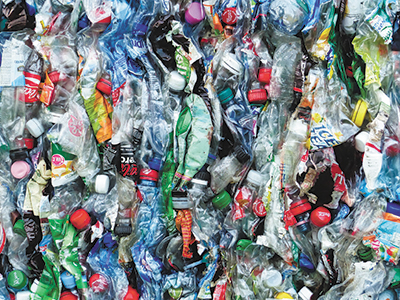
Councils around the country are struggling to keep their heads above the growing mountains of recyclable rubbish accumulating in the wake of China’s National Sword policy.
Since 1 January, China has enforced increasingly more stringent contamination standards on imported waste and recycled materials in an effort to address their own pollution problems.
China’s ban on ‘dirty rubbish’ also affecting European Union countries, Japan and the United States, has resulted in a worldwide glut of mixed recyclables and reduced the price paid for this material.
The trickle down effect is that councils now face significant new costs to continue providing kerbside recycling services to residents.
Victoria was first to feel the pain when, in early February, 14 rural and regional councils had to urgently renegotiate contracts with their kerbside recycling collection companies to continue providing the service for their residents.
The Victorian Government announced an interim support package to cushion the impacts on councils and residents while alternative arrangements are made with recycling processors, but councils will be required to meet any increase in recycling costs from 1 July onwards.
Other states are on notice with some New South Wales (NSW) councils already being asked to renegotiate kerbside collection contracts because of the added cost of processing recycling material locally.
In the past recycling companies offered a rebate to councils for processing their recyclable materials. As the export market for the product has dried up, recycling companies will recoup their costs by charging councils a fee for processing household rubbish.
City of Monash in Melbourne’s south estimates the cost to council over the next 10 years could be more than $18 million.
Monash says it is one of seven Melbourne councils that does not have a separate waste charge and will be seeking a variation to the current rate cap citing exceptional circumstances. Those councils that do have a waste charge will consider adjusting this fee to pay for increased costs to the service.
The Municipal Association of Victoria (MAV), the Local Government Association of New South Wales (LGANSW) and the Local Government Association of South Australia (LGASA) have called for their State’s landfill levies to be reinvested in the industry.
MAV Chief Executive Officer, Rob Spence, said that significant investment was needed to shore up the recycling industry and protect jobs and the environment.
“For more than a decade successive state governments have underinvested landfill levies from the Sustainability Fund back into Victoria’s waste and resource industry.
“Now there is an urgent need for landfill levy funds to support innovation in waste management and resource recovery, such as more advanced sorting systems, better processing technologies and new end markets for recycled materials.”
Queensland’s waste levy was abolished in 2012 resulting in hundreds of thousands of tonnes of waste being trucked in from across the NSW border triggering a Senate Environment and Communications References Committee inquiry into waste and recycling last August. The Inquiry has expanded to encompass the repercussions of China’s import ban.
Last month LGNSW President, Linda Scott, appeared before the Senate Inquiry saying that China’s ban could create local opportunities, and urging for financial support for the recycling industry.
“With State and Federal Government support we could develop new regional jobs in a home-grown environmental and recycling industry.
“But most important is the need to ensure that the hundreds of millions of dollars in waste levies collected from the community each year are fully reinvested to support recycling.”
She said the NSW Government had collected $659 million from Local Governments in waste levies in 2016-17 but only 18 per cent of that money was returned to Local Government.”
LGNSW is calling for the NSW Government to dedicate more of the waste levy ‘to the cause for which it was collected – the safe, environmental disposal of waste’.
Meanwhile, the Queensland Government has announced an intention to reintroduce the waste levy to deter cross border dumping.
The Local Government Association of Queensland (LGAQ) would like to see the funds used to develop zero waste technologies.
LGAQ President and Mayor of Sunshine Coast Council, Mark Jamieson, said the waste levy should be accompanied by a commitment from the State to transform waste management into a showcase for environmental sustainability.
Mayor Jamieson said the China ban was already impacting the existing business model for recyclable waste, with some councils starting to stockpile recyclable material and facing big losses of income.
He said the recycling industry in his state had not only taken a blow because of China’s change in policy, it was also facing other challenges such as the interstate transport of waste, an approaching ban on plastic shopping bags and the introduction of a container refund scheme.
“At the same time, we know the technology to progress to a true zero waste future now exists.
“Now is the time to invest in the infrastructure that can make this happen.”
Federal and State Government, and the Australian Local Government Association (ALGA) attended a workshop in Canberra on 13 March, on the current crisis along with representatives from the National Waste and Recycling Council, Waste Management Association of Australia, Australian Council of Recycling, Packaging Covenant and Sustainable Business Australia.
The ALGA reported that the workshop heard China’s tighter restrictions probably affects about 40 material recycling facilities and about eight companies but given the small number of operators, the impact if the industry collapses would be significant on the future of recycling in Australia.