Aussie Rules is a hugely popular spectator sport. Ground attendances, TV ratings and broadcasting rights are through the roof.
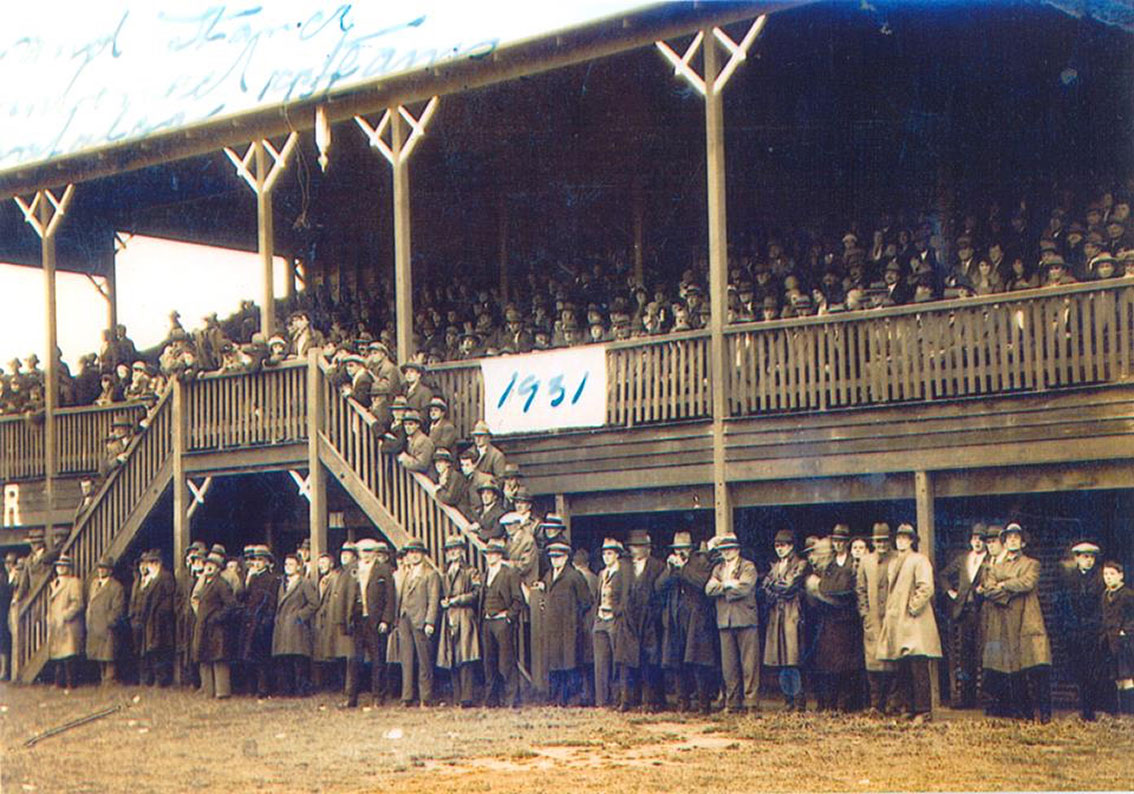
Meanwhile the sport in most regional areas is on life support. It wasn’t always like this. The accompanying 1931 photo of the bulging grandstand in Trafalgar, Victoria, is remarkable given that the town would’ve had a population of less than 1000.
Where have all the country spectators gone?
One of our ANU Aussie Rules Old Boys, Allan Hird (his son Jim played a bit for Essendon), has some thoughts. He explains that Aussie Rules was an inherently bottom up, localised sport. It developed in the second half of the nineteenth century in Victoria and quickly spread to South Australia, Western Australia, Tasmania and the Riverina in New South Wales. Players and older men established clubs and from them associations and leagues were formed to manage a competition between the clubs. From the beginning the clubs owned the associations and the league.
This was still the case in the 1980s when the Victorian Football League, then controlled by 12 clubs, was the major competition in Australia. But the local leagues in other states – like the WAFL, SANFL and TFL – were also strong and proud. Country towns too had thriving teams competing in country leagues. Collectively the clubs controlled the leagues and maintained their own grounds.
However, it all was about to change. The VFL went from being first among equals, to dominating the other state leagues. And the clubs no longer ran things.
Allan further explains, “The problem was compounded in the early 1990s when the Australian Football League came into being – a monopoly of elite teams emerged. It has led to the centralisation of decision making, and the undermining of the status of local clubs and leagues. Football at all levels is now structured to provide for the 1 percent of boys who make it onto an AFL team. And every player at each AFL club is now contracted to the AFL Commission. Further, some clubs are even owned by the AFL.”
The result is that the AFL is now strangling football at the grass roots – instead of football being played for the benefit of local players, families and their communities, it now exists to support the elite AFL competition. For example, to feed the AFL beast there are ‘pathways programs’ to develop talent – these are very damaging to local clubs because they lose talented juniors way too early, and they seldom return to their community clubs.
The problem is entrenched. The integrity of the code is compromised as the AFL is both the governing body and the promoter of the premier competition. Income from TV rights funds the AFL which is prepared to sacrifice the integrity of the code to satisfy the broadcaster. Meanwhile the eye-watering salaries paid to the players and administrators sit in contrast to the desperate circumstances of the footy clubs in the Bush.
Women’s footy
The development of football for women will be interesting to observe as it unfolds. Clearly young women have an appetite for playing the game. The disturbing thing though is the women’s competitions have not grown organically. They have been imposed from the top by the AFL as an exercise in marketing. Can women’s football takes root in local communities despite the financial constraints?
Solutions
The AFL Commission and its corporate structures have difficulty in recognising and valuing its traditional grass roots, and the critical role that Aussie Rules and other sports play in the social dynamics of small towns.
How might we address this? One radical option is to create two AFL divisions with more regional teams, and a relegation system e.g. to include Hobart, Launceston, Ballarat, Bendigo, Wagga, Bunbury, Darwin. This would have a trickle-down effect to the smaller local clubs. But it would be costly.
A second option would be to return to the former states-based system. The AFL Commission would fight this tooth and nail.
A third option is for the AFL to recognise the critically important social-health functions of country clubs, their feeder role to the elite levels, and their sponsorship constraints. The AFL must review their paltry payments to clubs for drafted players. And steps to address clubs’ spiralling operational costs are overdue. Could local councils partner with the AFL in this space?
Darling River debacle
The blame game is well underway on the Menindee fish kill – inept water officials, inefficient cotton growers, profiteering water licence holders, aggrieved South Australians. It’s hard to get a bead on the facts.
But one thing is certain. The issue is going to be a lightning rod for voters in the upcoming NSW and federal elections.
The Productivity Commission has just released its review of the Murray Darling Basin Plan – a hard read, and nothing about the cotton industry which is puzzling. The PC has put other industries to the sword.
Rod Brown is a Canberra-based consultant and lobbyist specialising in industry/regional development, investment attraction and clusters, and accessing federal grants. He also runs the Cockatoo Network.
Phone: (02) 6231 7261 or 0412 922 559
Email: apdcockatoo[@]iprimus.com.au