Australia’s emissions are at their lowest level in more than 25 years according to the latest Quarterly Update of Australia’s National Greenhouse Gas Inventory.
The update shows a 4.4 percent decline in emissions in the year to September 2020.
Waste accounted for 2.6 percent of the country’s inventory, and emissions from waste decreased by 2.7 percent over the year due to increased gas capture at solid waste disposal sites.
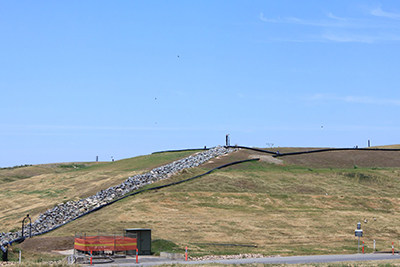
Sunshine Coast Council, Queensland, is just the latest local government area to come on board, converting waste to electricity at its Caloundra Renewable Energy Facility.
Australia’s first council to offset 100 percent of its electricity consumption through its own solar farm, is now the first in the region using gas from landfill to generate enough energy to power 1200 homes 24 hours a day, seven days a week.
The facility, officially opened on 24 November 2020, is linked to the power grid and generates 7000 megawatt hours of renewable electricity per annum and reduces greenhouse gas emissions by approximately 41,000 tonnes each year, the equivalent to removing approximately 9000 cars from the road.
Councillor, Christian Dickson said opening the facility was a step towards Council’s goal of transitioning to a circular economy for waste.
“Our general rubbish disposed of at the landfill releases biogas as it decomposes, which is made up of 50 percent methane – a potent greenhouse gas 28 times more harmful than carbon dioxide.
“We all need to transition to cost effective, renewable resources and low carbon energy and it’s great to see this waste become a resource.”
Council has been reviewing expressions of interest submitted by industry for Alternative Waste Treatment options, to harness the potential value of resources which have traditionally been discarded into landfill, Cr Dickson said.
“We partner with our community to reduce the amount of waste going to landfill through projects like ASPIRE market place, Living Smart, and ongoing recycling education.
“This is another project which ensures the Sunshine Coast contributes to achieving international, national and state greenhouse gas reduction targets, another step towards becoming Australia’s most sustainable region, healthy, smart, creative.”
Emerging industry
A 2019 study commissioned by Bioenergy Australia, funded in part by the Federal Government via the Clean Energy Finance Corporation and Australia Renewable Energy Agency (ARENA), Biogas opportunities for Australia, reported that, in 2017 there were 242 biogas plants in the country. Half of these were landfills collecting landfill gas, roughly half of which was not used as an energy source and was flared.
The total estimated biogas potential in Australia was put at 103 Terawatt hours or 371 Petajoules (PJ), which was comparable with biogas production in Germany at that time.
The report went on to say Australia’s biogas potential was equivalent to almost 9 percent of the country’s total energy consumption of 4247 PJ in 2016-2017, which could represent up to 90,000 biogas units.
Co-author of the report, Mendo Kundevski, believes biogas has the potential to contribute significantly to Australia’s greenhouse gas emissions abatement task.
He writes in Ecogeneration: Australia’s clean energy industry magazine, “It’s crazy to overlook the potential energy in what society discards as waste each day.”
Reducing the impact
Councillor, Winston Johnston said Sunshine Coast’s new energy facility had contributed to reducing the impact of waste on the environment.
“Previously, the landfill biogas was combusted via a biogas flare and released into the atmosphere – flaring of the biogas destroys the most harmful emissions.
“Now it’s converted to electricity at the new landfill-biogas-to-energy facility and fed directly into the power grid.
“When compared to a traditional coal-fired power station generating the same amount of electricity, the Caloundra Renewable Energy Facility will also save more than 15 million litres of water per annum.”
Plans are in place to expand the energy plants in the next five to 10 years.
The energy facility was designed and built at no cost to Council, by LMS Energy (LMS), a renewable energy and emissions reduction company, which will continue to operate and maintain the facility.
Best practice landfills
LMS Chief Commercial Officer, James McLeay explained how the facility works.
“The biogas is extracted from the landfill via a series of wells and network of pipes which connect to an 850KW Jenbacher engine, which generates approximately 7000 megawatt hours of renewable electricity each year – enough power to charge 40,000
electric vehicles.
“Capturing the biogas generated at the landfill and using it to generate renewable energy, reduces the environmental impact of the landfill significantly – in fact, due to the high biogas capture rates at the site, for every tonne of waste deposited at the Caloundra landfill, there are no net greenhouse gas emissions.
“Landfill biogas-to-energy facilities are key pieces of infrastructure for modern, best practice landfills around Australia. The opening of this facility sees the Sunshine Coast Council further enhance its position as a leading sustainable council, helping power the circular economy from waste.
“LMS is very proud to have a strong relationship with Sunshine Coast Council. Over the years, Council has demonstrated an ongoing commitment towards best practice waste management, and identified emissions reductions, renewable energy and the circular economy as a priority for both current and future generations.”