A new fire-retardant paint, formulated by engineers at UNSW Sydney, has become the first to pass a stringent Australian standard test that simulates a bushfire attack.
The paint, which is now on sale at selected Bunnings stores, achieved the Bushfire Attack Level (BAL) 40 standard which assesses the bushfire resistance of buildings and construction materials.
BAL-40 indicates that a building or material has been tested and approved to withstand higher levels of radiant heat (up to 40kW/m²) and ember attack during a bushfire, and therefore provides increased protection against bushfires in areas prone to extreme fire conditions.
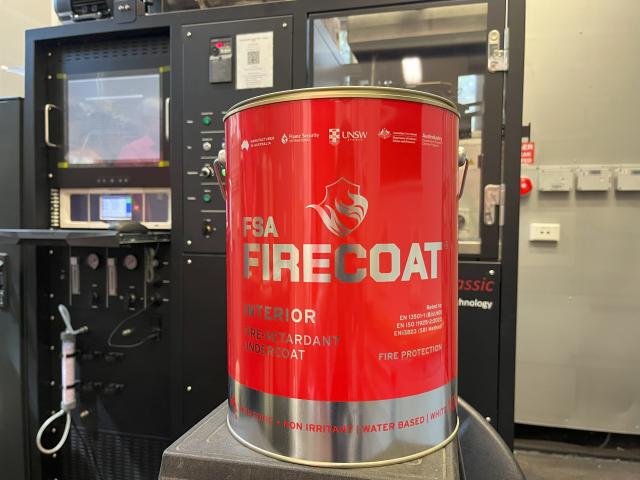
The new paint, commercially branded as FSA Firecoat, was developed at UNSW in partnership with Flame Security International. It was partially funded via a $3m Cooperative Research Centres Projects (CRC-P) grant from the Australian government.
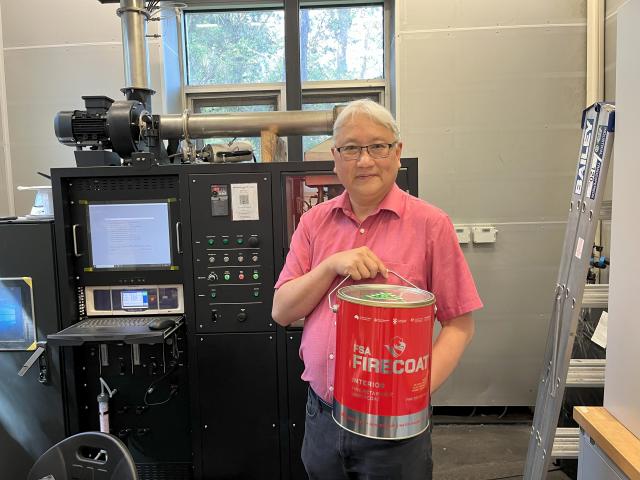
Professor Guan Yeoh, from UNSW’s School of Mechanical and Manufacturing Engineering, led the team that spent nearly five years perfecting the formula to ensure the paint incorporates the best fire-retardant properties.
The resulting product is a type of intumescent paint which means it is designed to expand as a result of heat exposure.
The specific chemicals in the paint also produce a thick layer of char which offers an insulating barrier and effectively deflects the heat from the fire away.
“The special additives we include in the paint mix formula promote the growth of the char, which is the important insulating element. The char is what helps the substrate, that is your house or your building, stay protected from the fire,” says Prof. Yeoh, director of the ARC Training Centre for Fire Retardant Materials and Safety Technologies at UNSW.
“In the rigorous tests you can see this char being created, but at the end you can just wipe it away and the wood underneath has virtually no damage.”
One major challenge for the research team was to ensure the all-important char, once produced, would not simply fall off vertical surfaces such as external walls.
The char needed to remain firmly in place to continue to work as a fire barrier.
“Forming a char on a horizontal surface is fine, but for this application we needed to include additives into the paint formula to ensure the char would also hold very well on vertical surfaces. Which is a challenge,” adds Prof. Yeoh.
“If it just falls off, that defeats the whole purpose. The char – which is basically pockets of air and carbon – can be more than 50mm thick, so retaining it in place can be tricky.
“But it’s so important because it’s providing the insulation and preventing the penetration of the heat.”
One of the big advantages of the new paint is that it does not need any special equipment to apply it, meaning it can be brushed or sprayed onto a variety of surfaces – including existing render, timber, aluminium, steel, concrete, plasterboard and brick – in the same way as normal paint.
The carbon ingredient means the FSA Firecoat product is only available in grey, but any standard coloured topcoat can be applied without affecting the fire-retardant properties.
Prof. Yeoh says the new fire-retardant paint could help prevent bushfires from spreading over a wider area, given the fact it protects buildings from burning down.
“If a building is not protected in any way and it starts to burn then it can become a source of heat for the fire to continue, like a chain reaction,” he says.
“So we can say this paint assists in limiting the spread of bushfires because it prevents a building from igniting and therefore compounding the original fire.
“Many people are saying that we are currently experiencing a dry season. But when it is a dry season, that often means that bushfires are just around the corner.
“We wanted to push the boundary with this paint so we did tests on probably 200 different formulas in the first couple of years of research before we arrived at the best one.
“That was using very high-grade materials, which would have made the paint too expensive to produce, so we then tested again with more commercially available ingredients to ensure we got the same performance in a final product that people can afford.”
Tony Overstead, CEO of Flame Security International, which has secured an initial order from Bunnings to supply 80,000 litres of FSA Firecoat paint, said: “The release of this fully accredited BAL-40 rated fire retardant paint, we believe, will better protect buildings and other assets from direct exposure to flames and extreme radiant heat.
“This will make a significant difference not only to the cost of building in affected areas, but also the potential risks to life and property.”
Flame Security International is pleased with the strong collaborative research partnership established and the successful outcomes of fire safety products achieved particularly through the support of the Cooperative Research Centre project (CRC-P) Round five grant with UNSW.
To pass the BAL-40 test, an external windowed building facade was treated with the paint and exposed to the flame attack of a BAL-40 furnace for 10 minutes.
The facade consisted of timber weatherboard, specifically radiata pine which is the most combustible and commonly used timber in Australia. FSA Firecoat paint was applied as a primer and undercoat paint, before a standard commercial Dulux topcoat was added.
During the flame attack the facade was monitored using thermocouples to test the internal and rear temperatures and to determine the ability of the UNSW-developed paint to protect the structural integrity of the building facade, as well as prevent the flames from spreading to the inside and rear of the facade over 60 minutes.
The paint succeeded in passing all six of the stringent criteria, the first time any paint has achieved the BAL-40 rating.