Tourism is so important to many regional communities. In this context, nostalgia tourism has long been an economic driver in Europe, and now it’s taking off in Australia. This month we examine some under-appreciated possibilities.
Echuca
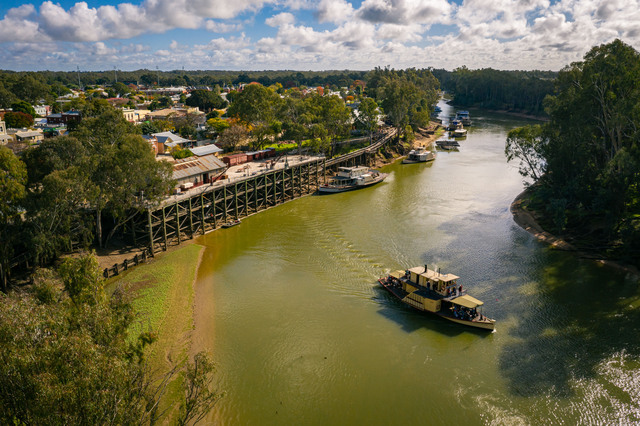
Thirty years ago the Echuca Wharf comprised a motley collection of disconnected activities paying homage to the past. But thanks to local leadership and perseverance, it’s now a standout tourism cluster – the original wharf, a museum, historic buildings, hotels, restaurants, equipment displays, paddlesteamer cruises, horse-drawn carriages and blacksmiths, etc.
Various tranches of federal, state and local council money have underpinned the development. Indeed the Discovery Centre and a wharf upgrade was made possible via grants of some $12.6 million. As usual, there are the knockers who question its value, but I’m advised that changes to governance and operating systems are in train to manage the precinct’s recurrent expenses. These sorts of concerns are of course everyday issues to councils responsible for similar projects across the nation, especially when events like Covid pandemics, airlines strikes, floods, fires, petrol price surges, etc., can blow a massive hole in tourism patronage.
But let’s consider the wider economic and social benefits of such projects. The international economic development literature is replete with advice about why regional communities must think about their unique value proposition (USP), to understand their competitive advantages as a place to generate wealth and jobs, and to develop initiatives to deliver the wider benefits.
To explain, the Murray River’s past and present role in delivering agricultural wealth is the USP of many communities in the region. And the Echuca Wharf precinct is a direct and practical initiative consistent with that. The problem is that the wider benefits of this precinct are not fully appreciated. One of its benefits lies in building the Echuca brand and in generating community confidence. Another benefit lies in enticing tourists – out of Melbourne in particular – to visit and inject expenditure into the community as well as other communities along the Murray Valley.
I believe that such precincts are under-appreciated because they’re work-in-progress. Why? In the case of the Echuca Wharf precinct, there are undoubted opportunities for more businesses and government agencies to locate there to capture the commercial synergies. But it’s a slow process. Moreover the evolution of the ‘commercial mindset’ takes time. An example of this is the food offering. I spent some time, to no avail, searching for Murray Cod on the menus of Echuca restaurants. My logic was that tourists driving from Melbourne or indeed Canberra do not want to eat awful NZ Hoki – they expect to eat local produce i.e. the same Murray Cod as served up in the capital cities. A further example is the absence of a local food emporium, where tourists can stock up on some of the great meat, fruit and vegetables from the surrounding farms. The Barossa and Noosa economies are precedents in this regard.
Nyah West
This town deserves a place in Australian sporting and social history. How so?
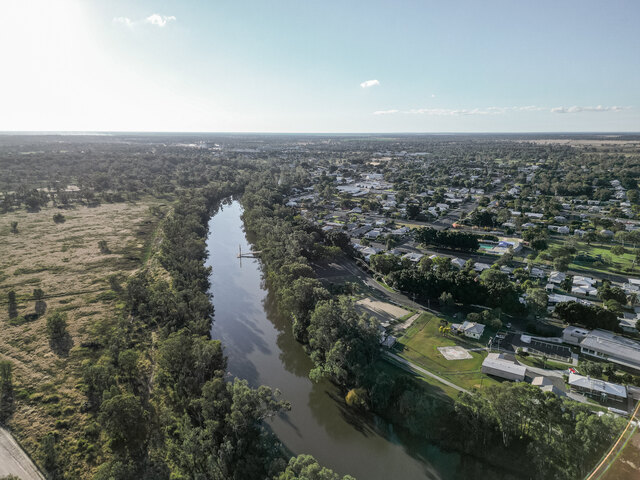
Well, Nyah West (pop. 700) is about two hours drive down the Murray Valley highway from Echuca. Like much of the Mallee and Wimmera, it has de-populated since the soldier settlement programs following the world wars.
In this case, it’s the hometown of Bob Rose (1928-2003), a true legend of the Collingwood Football Club, and Aussie Rules football in general. His upbringing was in a small fibro cement house with six siblings, parents, grandmother and uncle. He grew and sold vegetables and had a job clearing irrigation channels. He starred for the local footy team and had boxing matches at the Grand Hotel in Nyah West. It was probably quite grand in those days, and hopefully still is.
He was recruited by Collingwood at the age of 17, and the rest is history. He was a tough and skilful player, and later coach. His unfortunate legacy is that he coached Collingwood to three Grand Final losses (1964, 1966, 1970) by an aggregate of 15 points. Collingwood supporters still have nightmares about this. But it was his quiet dignity in accepting these losses, plus his devotion to Collingwood and his quadriplegic son Robert (Collingwood player, Victorian cricketer) in following years that seared his name into the memories of the Collingwood faithful.
Collingwood FC has a huge supporter base. Indeed, it prides itself on the working class origins, and its connection to hard-working folk across the nation. And Bob Rose was the epitome of that.
Fast forward to 2024 and there are literally hundreds of thousands of Collingwood fans sitting in suburban loungerooms who’d relish a weekend visit to Nyah West – to honour the Collingwood legend, to watch the sun set across the thirsty paddocks, to walk the Nyah West oval and then retire to the Grand Hotel to imagine Bob Rose boxing in a makeshift boxing ring. Then roast lamb with trimmings, watching a highlights reel of Collingwood’s greatest and lowest moments. Yes, those Grand Final losses probably have a mollifying effect on Collingwood tragics.
The obvious place for honouring the Bob Rose nostalgia is indeed the Grand Hotel – it’s where the local folk meet. No need to finance a new building. I’m currently discussing possibilities with the publican.
Other possibilities
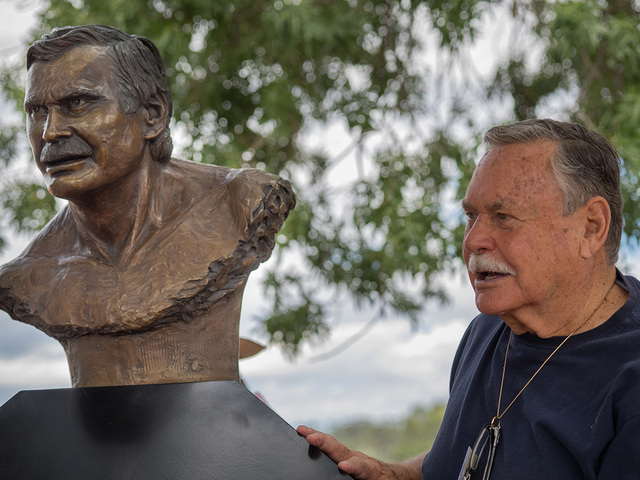
Castlemaine and Guilford (between Ballarat and Bendigo) are where the late Ron Barassi, another AFL legend, spent his formative years. Barassi was a force of nature and left an indelible mark on Melbourne FC supporters. He initiated the links to Gaelic football and got involved in so many community agendas.
Roma (350km west of Toowoomba) is another town with fascinating nostalgia tourism potential. It’s where Artie Beetson (1945-2011), the hugely popular and skilful NRL prop forward grew up in modest circumstances – his mum was a member of the Stolen Generation. Artie’s physique was sculpted by a large intake of meatpies. He was also reputed to have eaten eleven hotdogs in a single sitting. Imagine a Roma pub with an Artie Beetson Hotdog as an entrée followed by a Roma steak, while watching Artie’s career highlights. I can’t wait.
Meanwhile, Whyalla is the hometown of South Australia’s best ever AFL player, Barrie Robran. And Latrobe (northern Tasmania) is where Darrel Baldock developed his amazing ball skills. These towns have pubs that might usefully rub the nostalgia genie.
Nostalgia tourism extends of course to other pursuits like the arts. For example, June Bronhill (Broken Hill) and Nick Cave (Warracknabeal-Wangaratta) are honoured locally, but there’s still considerable potential to drive your tourism numbers if you can align the product.
Each of the above possibilities could arguably be advanced with a modest grant to access the relevant video footage, develop a compelling story to draw footy supporters to the town, and to devise a marketing strategy. Please email us if you’d like to explore the opportunities.
Rod Brown is a Canberra-based lobbyist specialising in industry/regional development. Email apdcockatoo@iprimus.com.au