It is the energy solution that could help underpin the Federal Government’s plan for a “Future Made in Australia”.
As thousands of manufacturers and heavy industry players take on the challenge of reducing both emissions and operating costs, renewable gas is emerging as a critical piece in the nation’s future energy puzzle. Renewable gas solutions like biomethane are primed to help hard-to-abate sectors in reducing emissions efficiently and affordably.
So why aren’t more renewable gas solutions being offered to industry, given its success in Europe, the UK and USA? This innovation is already here, with biomethane and hydrogen projects moving from pipedream to pipelines across Australia and overseas, demonstrating and providing a low-emissions alternative to natural gas, that can help industry to decarbonise operations efficiently. And, with biomethane able to flow through current gas network pipelines, infrastructure and appliances, the pathway to lower emissions can be even more time- and cost-efficient.
Given the importance and the enormity of the challenges ahead, Australia needs all energy and fuel options on the table to decarbonise efficiently, while continuing to provide affordable and reliable energy for all customers. The Federal Government’s Future Gas Strategy, announced in May, reflects this sentiment.
It is clear Australia’s manufacturing and industry sectors will long be reliant on gas to provide the extreme heat required for their smelting, firming or operational processes. It is a reality that requires an innovative and open-minded approach. Transitioning to all-electric technology is simply not a viable option for many businesses. The technology either does not exist for their operational needs or is too expensive or cumbersome for many businesses to implement.
Renewable gas can be the key that helps to unlock this conundrum, giving industry and manufacturing sectors the ability to remain competitive, and reduce emissions simultaneously, without significant disruption to their operations or bottom line.
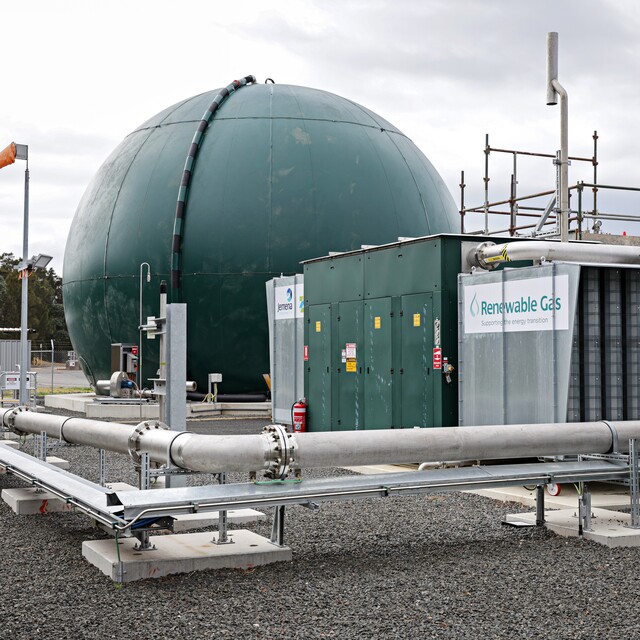
While renewable gas has experienced phenomenal growth across Europe and North America over the last two decades, Australia’s journey towards a renewable gas future has begun in earnest. But while there is a lot of ground to make up, a solid foundation has been laid courtesy of a partnership between Jemena and Sydney Water. On Sydney’s eastern fringe, Australia’s first biomethane injection plant has begun injecting renewable gas, which has been converted from waste water, directly into the NSW gas network. Not just an alternative to natural gas, but certified by GreenPower as a low-emission renewable gas.
The Malabar Biomethane Injection Plant exemplifies the emissions and cost-saving potential of renewable gas; giving industrial gas users a new low-emission energy source, delivered through existing pipeline infrastructure with no impact to their existing equipment and processes.
Approximately 70 per cent of industrial gas usage in NSW is from businesses that cannot easily or affordably electrify their process either because of the high heat required in their operations, or because they use gas as a feedstock. It is crucial that these industrial users not only have access to renewable gas, but have the ability to count its usage towards their emissions reduction targets, to ensure they are meeting their obligations under the Safeguard Mechanism.
A national certification scheme would greatly assist, like the GreenPower Scheme, where producers can create and sell certified renewable gas using existing gas network infrastructure, and where renewable gas users can then claim their emissions reductions under the National Greenhouse and Energy Reporting (NGER) legislation. It is not a significant ask, given the policy framework already exists, but this step is paramount.
To fully reap the benefits of using renewable gas, certificates must be fully recognised under the NGER scheme, enabling businesses to offset scope one emissions against their gas consumption, while pursuing electrification where feasible. Ensuring that businesses can count renewable gas use towards emissions targets is crucial for driving adoption across industries.
There is also a “back to the future” policy that governments could employ to generate investment in this space, following on from the success of solar rooftop deployment in Australia. And the economic imperative is clear.
According to a study by ACIL Allen released in April, adopting a Renewable Gas Target (RGT) to increase the availability and utilisation of renewable gas could add $30 billion to Australia’s economy as it moves towards its clean energy future. The study confirmed that implementing a RGT would be a more cost-effective way to reach net zero emissions than an “electrify-everything” approach, because it would allow the producers to use current infrastructure to deliver an additional type of renewable energy.
Using the old to deliver the new, to advance Australia’s economy to its renewable energy future. It just takes some big picture thinking.